Summary

  1. A key question: What does Andy Burnham think of the defence investment plan?published at 10:07 BST

    Henry Zeffman
    Chief political correspondent

    The simple answer is we don’t know. But the political reality is that he will have to tell us soon enough.

    There will be intense criticism from the government’s political opponents - as well as some Labour MPs - over the course of the day about the amount of money the government is committing.

    The question of whether extra money should be spent, and if so how that extra money could be generated, will be a question for Burnham to address in less than three weeks.

    If no other Labour MP makes a leadership bid, Burnham is expected to become prime minister on 20 July.

  2. BBC Verify

    How does defence compare with other government spending?published at 10:03 BST

    By Anthony Reuben

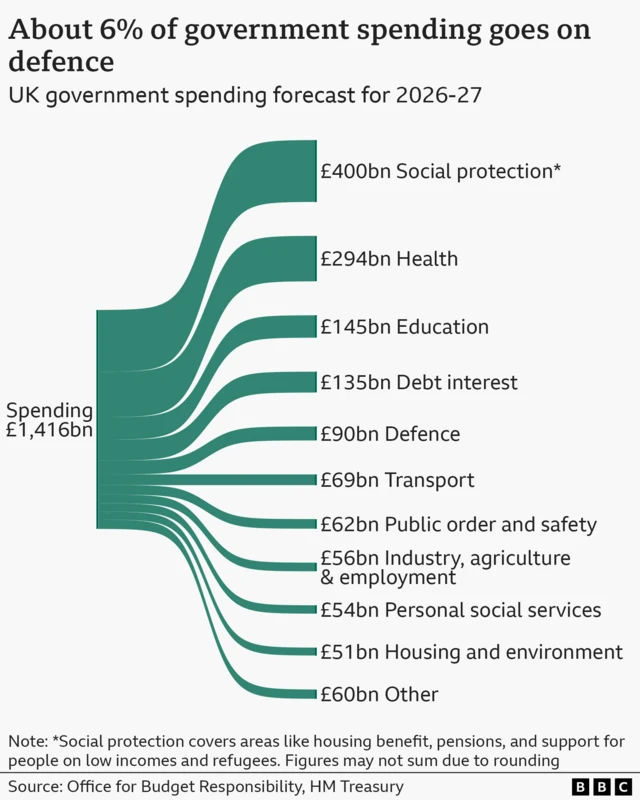
    This chart breaks down what the Treasury was planning to spend in the 12 months from April this year.

    A diagram showing total UK government spending broken down by category, with each category represented by a red flow out of the total. Total spending is forecast to be £1,416 billion in 2026-27. The breakdown is as follows (figures may not sum due to rounding): Social protection £400 billion Health £294 billion Education £145 billion Debt interest £135 billion Defence £90 billion Transport £69 billion Public order and safety £62 billion Industry, agriculture and employment £56 billion Personal social services £54 billion Housing and environment £51 billion Other £60 billion

    The largest category is what the Treasury calls “social protection” which covers things like the state pension and working-age benefits. More than £150bn of that £400bn is expected to be spent on the state pension, external.

    If you add health spending on to social protection you have already covered about half of what the government is expected to spend.

    Next comes education at £145bn, and then debt interest payments of £135bn on the money the government borrows.

    Defence spending comes next at £90bn - which is about 6% of the government’s spending plans.

  3. UK not producing drones at sufficient scale, says British supplierpublished at 09:56 BST

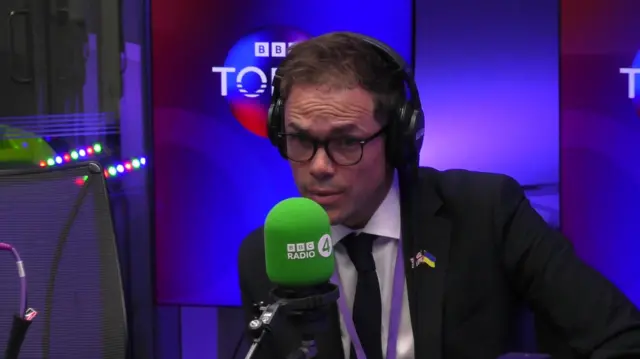
    A man wearing a black suit with a white shirt and black tie, and glasses, speaking into a green microphone which says "BBC Radio 4". Behind him is a blue screen which reads "BBC Today".

    Tom Redman, CEO of British-based drone supplier Evolve Dynamics, says £5bn being invested in the use of drones is "really welcome".

    Redman, whose company supplies drones to the British and Ukrainian Army, tells BBC Radio 4's Today programme: "Any modern Nato nation is now modernising their militaries with uncrewed systems, with autonomy at the heart of it."

    Asked if the UK is self-sufficient, Redman says "buying drones is not the same thing as building a sovereign, resilient drone industry".

    He adds it's "very different" purchasing from overseas manufacturers than "having the ability to produce that capability at scale" in the UK.

    Using Ukraine as an example, he says millions of drones are being made and used by the country every year - and the UK is providing about 150,000, external.

    "In terms of what we can produce, we are nowhere near that scale. And in a wartime scenario, it's going to be the industry that underpins these uncrewed systems that really wins," he says.

  4. Drones have been our 'saviour' against Russia, says Ukrainian commanderpublished at 09:40 BST

    A commander in the Ukrainian army says drones have "dramatically" changed the battlefield since the start of the war against Russia in 2022.

    The drone unit commander, who uses the call sign Neo to hide his identity, told Radio 4's Today programme that drones have made it easier for Ukraine "to match Russia" and were its "saviour".

    "Technological advantage was the only chance for us. Russia is now in a very bad position and things are getting worse for Russia and a majority of it comes from the drones."

    He says drones are a "much cheaper weapon" and more accurate than other missiles.

    As we reported earlier, today's defence investment plan will include more than £5bn to be spent on drones over the next four years.

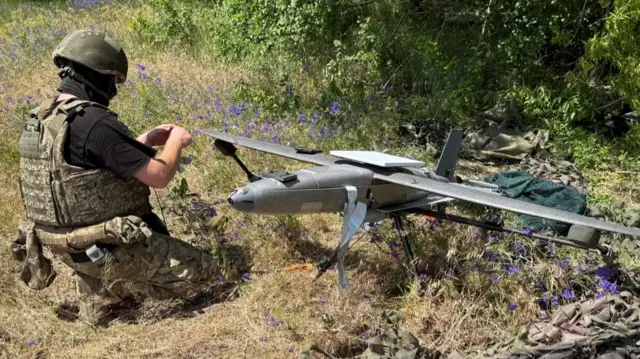
    A solder wearing a camouflaged flak jacket, trousers and green helmet with a balaclava crouches in a field. He is preparing to launch a silver drone, which has long wings and rudder on the back.Image source, Reuters
    Image caption,

    A Ukrainian serviceman prepares to launch a drone towards Russian troops in the Donetsk region

  5. BBC Verify

    What has happened to the size of the armed forces?published at 09:31 BST

    By Ben Chu

    In 1990 - at the end of the Cold War - the army had 153,000 regular soldiers, external in its ranks. This is now down to 73,790, external.

    The 2025 Strategic Defence Review recommended, external that the British army's regular force should not drop below 73,000. In its latest update, the Ministry of Defence (MoD) confirmed the number of people applying to enlist in the regular army had fallen by around 40% in 2025 compared to 2024. Since 1990, the number of reservists has fallen from 76,000 to 25,770.

    This Flourish post cannot be displayed in your browser. Please enable Javascript or try a different browser.

    In 1990, the Royal Navy had 48 major combat ships, external (13 destroyers, 35 frigates). That has dropped to seven frigates, external and six destroyers, external. There has been criticism of the Navy's readiness after it took weeks to deploy a single ship - HMS Dragon - to the Gulf to help protect a Royal Air Force base in Cyprus during the Iran war.

    In 1990, the RAF had more than 300 combat jets, external - now it has 107 Eurofighter Typhoons, external and at least 37 F-35 Lightning II, externals - which while fewer in number are technically superior.

    Uncrewed aircraft systems, also known as drones, now form an element of the UK's military air capabilities which did not exist in 1990.

    The threat from drones has been highlighted in the Ukraine conflict where they now kill more people than traditional artillery, external. Analysts say the UK needs to invest considerably more in this military technology.

  6. More money needed than currently on the table - retired generalpublished at 09:09 BST

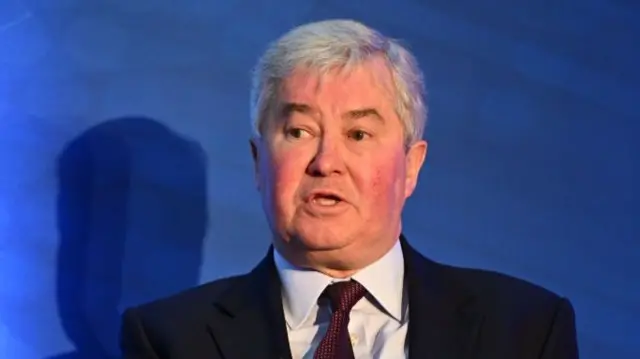
    Gen Sir Richard Barrons speaks at a military event in LondonImage source, Getty Images
    Image caption,

    Gen Sir Richard Barrons co-authored last year's strategic defence review, which laid the foundations for the defence investment plan

    The plans that will be released later today contain a "decent transformative element" but "more money is needed" to keep the UK safe, Gen Sir Richard Barrons says.

    Speaking to the BBC's Today programme, Barrons - one of the authors of last year's strategic defence review - says: "It is still not going to crack the issue of, in order to defend the UK sufficiently well, sufficiently quickly, more has to be done sooner and that requires more money than is currently on the table."

    Barrons, former director of operations for the Army, says the prime minister has warned Russia could attack Nato by 2030. "The plan we're seeing today gets us ready for a fight that might occur in 2030 by not before 2035," he says.

    He also says the UK is falling behind its European allies in Nato, who are "spending more money much faster on revitalising and beginning to transform their armed forces".

    In terms of capabilities, Barrons says the UK is "pretty much on the bottom - we're not keeping up with our allies, we're certainly not keeping up with our enemies".

    "Until we come to terms with the fact that we have to find more money for defence sooner - and yes it will be at the cost of other things we like more - we are simply not going to be ready to defend this country properly," he adds.

  7. Analysis

    There's still bad blood in government over defence funding rowpublished at 08:25 BST

    Henry Zeffman
    Chief political correspondent

    John Healey resigned as defence secretary almost three weeks ago, meaning that Dan Jarvis will be beside Keir Starmer at the launch of the defence investment plan instead today.

    Healey’s resignation was a bitter blow to the prime minister, but Healey’s criticism of the government’s approach was more directly targeted at Rachel Reeves, the chancellor.

    There is still a lot of bad blood swilling around government about that.

    A source close to the chancellor made the case to me yesterday that Jarvis had managed to get more money for the plan since becoming defence secretary because he had behaved "in a much more collegiate way". The source claimed that "John wasn’t really willing to work with us direct".

    An ally of Healey said in response that he had been in regular contact with Treasury ministers until the shortfall in defence spending was identified, at which point No 10 took charge of resolving the issue.

  8. A closer look at UK defence spending planspublished at 08:20 BST

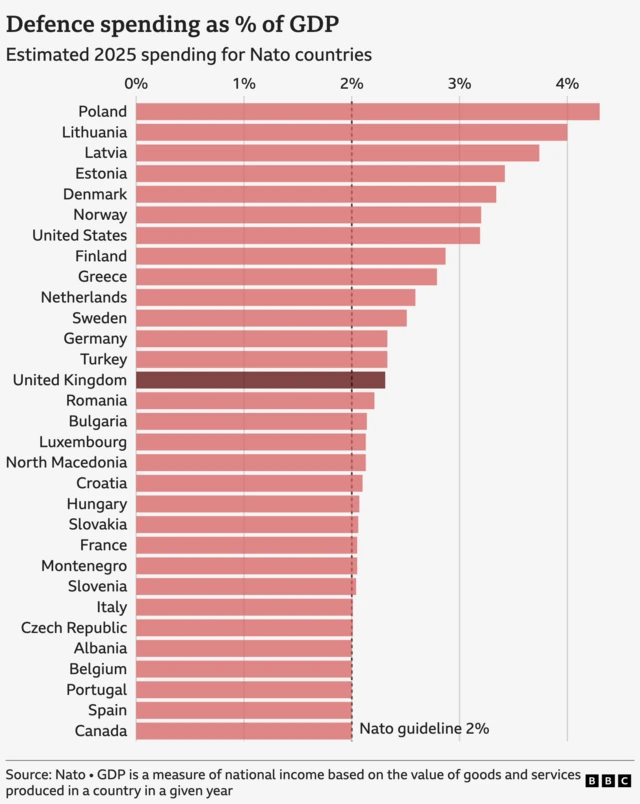
    Bar chart titled “Defence spending as % of GDP” showing estimated 2025 defence spending for Nato countries. Countries are listed vertically, with horizontal bars indicating spending as a percentage of GDP from 0% to just over 4%. Poland is the highest at just above 4%, followed by Lithuania, Latvia, and Estonia at around 3–4%. Several countries, including Denmark, Norway, the United States and Finland, spend around or above 2%. A dashed vertical line marks the Nato guideline of 2%, with many countries clustered near this level, including the United Kingdom, Germany, and France. Source information and a BBC logo appear at the bottom.

    The UK's spending of 2.3% of GDP in 2025 put it just above the mid-point of spending by Nato members, according to figures from the military alliance.

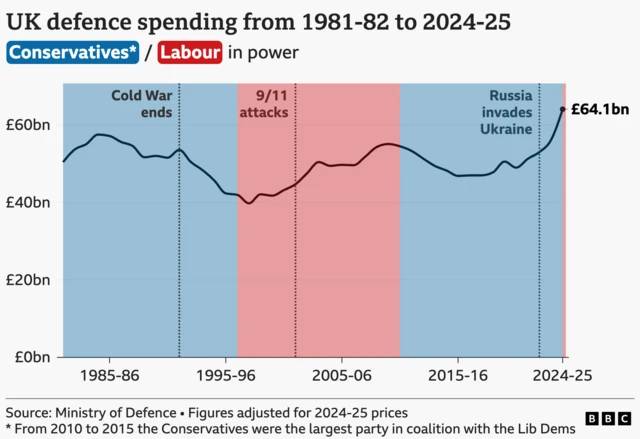
    The government has said it will increase it to 2.5% in 2027 with an "ambition" to raise that to 3% in the next Parliament, which is expected to start in 2029 and end in 2034.

    It has also committed to increase defence spending to 3.5% of GDP by 2035, in line with Nato commitments.

    Former Defence Secretary John Healey - who resigned over the defence investment plan - says the UK needs to be spending 3% on defence by 2030.

    He criticised the government for having "no date for reaching 3%, no path to 3.5%".

    It is understood that Healey was presented with a plan to take spending from 2.6% of GDP to 2.68% by 2030.

    The UK has also committed to a Nato target to spend 5% of GDP on "national security" by 2035.

    The government has said this would be made up of 3.5% of GDP on "core defence" and another 1.5% of GDP going on things like protecting critical infrastructure and ensuring civil preparedness.

    Line chart titled “UK defence spending from 1981–82 to 2024–25” showing inflation‑adjusted annual defence spending in billions of pounds. A single line tracks spending over time, fluctuating between about £40bn and £60bn. Shaded backgrounds indicate which party was in power: blue for Conservative governments and red for Labour governments. Key moments are marked, including the end of the Cold War in the early 1990s, the 9/11 attacks in the early 2000s, and Russia’s invasion of Ukraine in the early 2020s. Spending dips in the mid‑1990s, rises after 2001, falls again in the 2010s, and then increases sharply to around £64.1bn in 2024–25. Source is the Ministry of Defence, with figures adjusted to 2024–25 prices, and a BBC logo at the bottom.
  9. Investment in drones will help armed forces 'stay ahead of our adversaries' - defence secretarypublished at 08:12 BST

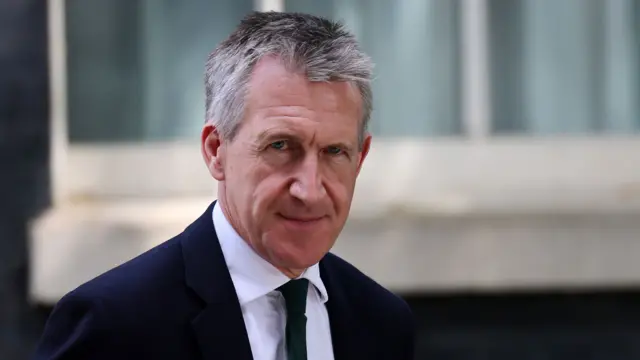
    Dan Jarvis, wearing a black suit and tie, departs No 10 following a Cabinet meeting in LondonImage source, EPA/Shutterstock
    Image caption,

    Dan Jarvis replaced John Healey as defence secretary earlier this month

    Dan Jarvis, the new defence secretary, has spent the last two weeks "refocusing" the defence investment plan to ensure it learns the lessons from the wars in Ukraine and Iran, the MoD has said.

    This includes how drones have been used to destroy high-value targets, with Jarvis saying the "character of warfare is rapidly changing".

    In a brief statement that accompanies the information released by the government ahead of plan's publication, Jarvis says: "In Ukraine and the Middle East, uncrewed systems are defining conflicts.

    "This largest ever UK investment into these evolving technologies will help our armed forces stay ahead of our adversaries, backed by the best of our defence industry."

    For context: Jarvis took on the role earlier this month after John Healey resigned saying the funding for the defence investment plan fell well short of what is needed. Jarvis has reportedly secured some extra funding - the full plan will be released later.

  10. Analysis

    Today is likely the most significant policy announcement of Starmer's final weekspublished at 07:56 BST

    Henry Zeffman
    Chief political correspondent

    The defence investment plan is almost certain to be the most significant thing Starmer will announce in his remaining three or so weeks in office.

    It was originally meant to be published last autumn in a very different political context, but was delayed repeatedly because of tensions at the top of government about the amount of money available to spend on defence.

    It was delayed again a few weeks ago when, just days before the plan was finally about to be published, those same tensions spilled into public view, with John Healey quitting as defence secretary.

    He was followed out the door by Al Carns, a junior defence minister. Both argued that the government in general, and Rachel Reeves in particular, were unwilling to fund defence by the amount it needs.

    Healey’s resignation is seen by many of Starmer’s closest allies as a pivotal moment on the path to his departure as prime minister, because it undermined Starmer’s ability to make the case that despite difficulties on the domestic front he had done what was necessary to protect the UK from global turmoil.

  11. Lib Dems criticise plan as 'late and underfunded'published at 07:48 BST

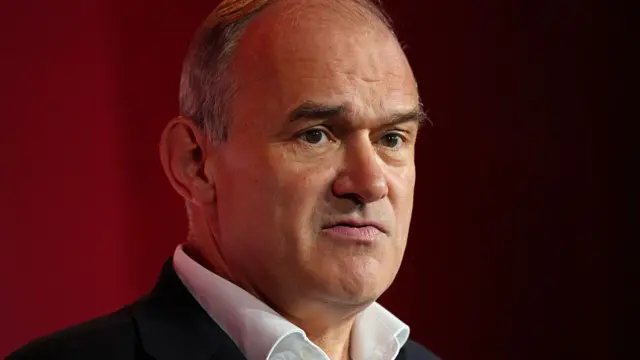
    Ed Davey, leader of the Liberal Democrats, gives a keynote speech at the British Chambers of Commerce Global Annual ConferenceImage source, Getty Images

    Liberal Democrat leader Ed Davey has criticised the defence investment plan as "late and underfunded", which he describes as "unforgivable".

    Reacting to information released ahead of its publication, Davey says it represents a "political choice that makes us all less safe, puts jobs at risk and threatens businesses across the country in supply chains".

    He says the government has "dangerously short-changed our armed forces" after years of "Conservative negligence".

    "Defence chiefs have been forced to make hard choices when they should be given what they need," he adds.

  12. Push to publish defence spending plan ahead of upcoming Nato summitpublished at 07:34 BST

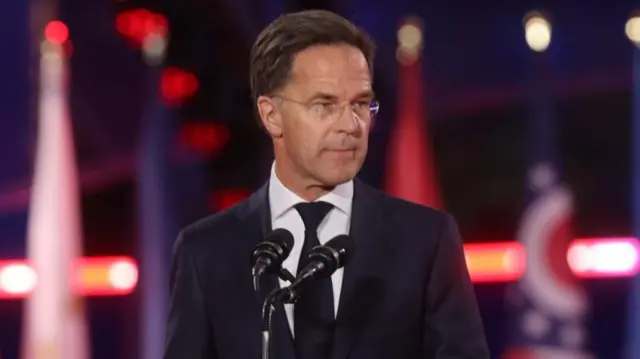
    Nato Secretary-General Mark Rutte looks to his side while standing behind two microphones. He is wearing a dark coloured suit.Image source, EPA/Shutterstock
    Image caption,

    Nato Secretary-General Mark Rutte has said he expects members of Nato to arrive to next month's summit with "credible" defence spending plans

    After months of delays, Keir Starmer set out a plan earlier this month to publish the long-awaited defence investment plan before the Nato summit in Turkey on 7 July.

    That new deadline has proved challenging to meet - amid the final wrangling over funds, the defence secretary and another defence minister have resigned, which played a significant role in the prime minister announcing his own intention to stand down.

    Nato Secretary-General Mark Rutte, who met with Starmer yesterday, has said he expects all members of the alliance to arrive at the summit next week with "clear, concrete and credible plans" on how they will increase defence spending.

    European countries have come under pressure to boost their defence budgets following Russia's full-scale invasion of Ukraine in 2022, and with Donald Trump at times suggesting he would not protect Nato allies failing to spend more on defence, and even pushing to acquire Greenland for the US.

  13. Defence investment plan 'too little, too late' - shadow defence secretarypublished at 07:09 BST

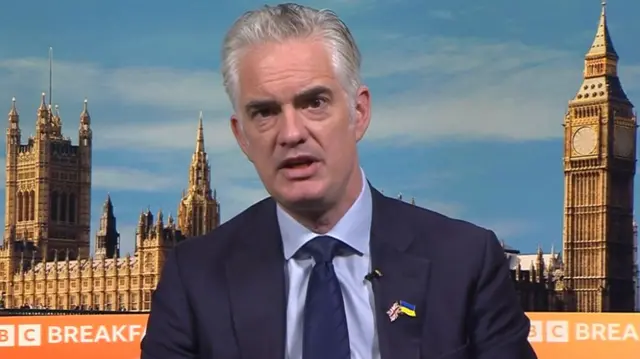
    James Cartlidge, shadow defence secretary, speaks to BBC Breakfast

    The defence investment plan is "too little, too late" and does not provide enough funding or military hardware to keep Britain safe, the shadow defence secretary says.

    Speaking to BBC Breakfast, James Cartlidge says that while some of the capabilities announced as part of the plan "sound impressive", they will come into operation too late as "the threat we face is today".

    He accuses Keir Starmer of being "too weak" to deliver more funding for the plan, whilst also criticising the delay in its publication.

    "We waited so long for this defence investment plan but because it hasn't got the money, it isn't delivering and it isn't delivering soon enough," he says.

    Cartlidge is then quizzed over the Conservatives' defence record during their 14 years in power, a period which saw Army numbers fall to their smallest since the Napoleonic era.

    He says it is a "fair question" and he accepts that since 1989 "all governments in power thought that we had this thing called the peace dividend and spending fell".

    He says once Russia launched its full-scale invasion of Ukraine in 2022 the situation changed, and he is proud of his party's record in funding and arming Ukraine before that happened.

  14. Analysis

    Royal Navy to transform how it operates over the next few yearspublished at 07:01 BST

    Frank Gardner
    Security correspondent

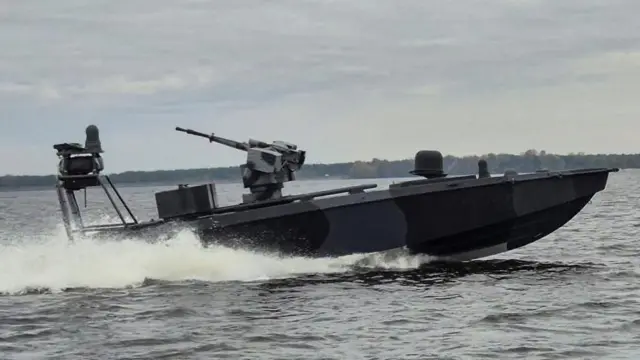
    A Ukrainian naval drone boat at seaImage source, Reuters
    Image caption,

    Ukraine is already deploying naval drones in its war with Russia

    The Royal Navy is to transform the way it operates over the next few years.

    Britain's six Type 45 destroyers, designed for air defence, will no longer be replaced by the planned Type 83 versions.

    Instead, the Navy is to get several cheaper ships called common combat vessels that will act as hubs controlling a fleet of uncrewed vessels or drones.

    The change is part of the long-delayed but now updated defence investment plan (DIP) being announced by the government today.

    It's called hybridisation – combining traditional crew-operated weapons platforms like frigates, with fleets of uncrewed and autonomous systems.

    In the Royal Navy's case, it gets to keep the frigates, which will be updated with new versions in the pipeline. But the big, powerful and expensive Type 83 destroyers, yet to be built, are now being scrapped in favour of the drones.

  15. £5bn allocated for drones in defence investment plan - MoDpublished at 06:56 BST

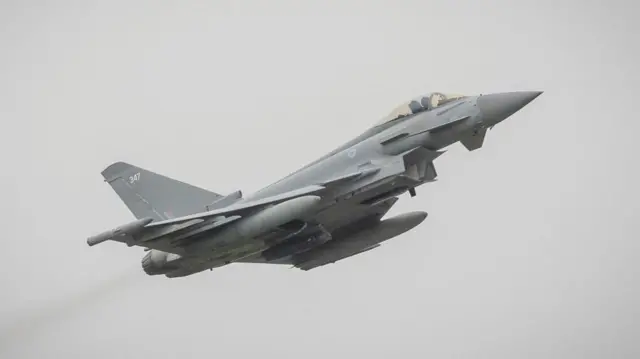
    An RAF Typhoon aircraft against a cloudy sky.Image source, UK MOD Crown
    Image caption,

    The drones are envisioned to help RAF jets become 'invisible' to enemy detection

    Today's defence investment plan will include more than £5bn to be spent on drones over the next four years, the Ministry of Defence says.

    The government department says the figure represents the largest ever drone investment in the UK armed forces and will create "thousands of British jobs".

    It will also help fund Europe’s biggest drone testing centre, the uncrewed systems centre, which was opened earlier this month in Swindon, as well as a new uncrewed systems taskforce to rapidly develop and field "new autonomous capabilities" with industry.

    The investment will see a "flexible, integrated force" of attack drones flying alongside Army helicopters, as well as RAF jets being made "invisible" to enemy detection, the MoD says.

    A hybrid Royal Navy consisting of crewed and uncrewed vessels is also envisioned, alongside at least six new warships being built.

  16. Previous defence secretary resigned saying funding plans fell 'well short'published at 06:48 BST

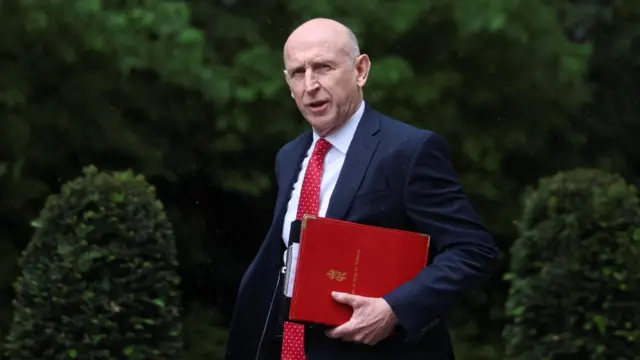
    John Healey walks in a navy suit with a red tie in. He is holding a red folder.Image source, Reuters

    Former Defence Secretary John Healey resigned earlier this month in a scathing letter warning that the level of military spending proposed "falls well short" of what's needed to protect the UK.

    Internal wrangling over defence spending has been rumbling on for months following multiple delays to the defence investment plan, which was originally due last autumn.

    Healey had expressed concern that the financial settlement for the armed forces was "backloaded" when the "pressure of operations and imperative to speed up readiness to fight is in the first two years".

    He said the prime minister had been "unable" and the Treasury "unwilling" to "commit the resources that the nation needs to defend the country at this time of rising threats".

    Dan Jarvis, the security minister and a former British Army officer, was then appointed to replace Healey in the cabinet role, and has pushed for additional funding and changes to the defence investment plan since then.

  17. 'Game-changing investment' - Starmerpublished at 06:40 BST

    Kier Starmer wears a black suit jacket and a dark coloured tie. He is being pictured mid-talking.Image source, PA Media

    The new defence investment plan will give the UK's armed forces the "cutting-edge capabilities" they need to deter evolving threats and keep the British people safe, Keir Starmer has said.

    The prime minister says the "game-changing investment" would "strengthen our armed forces on land, at sea and in the air, ensuring our servicemen and women" have the equipment they need to keep Britain safe.

    Starmer also says the plan will help drive growth across the UK by "backing British innovation, British industry and British jobs and delivering opportunity to every corner of the country".

    He adds that the plan will give the UK's industrial base the "certainty and support it needs to develop and scale the technologies that will keep our country safe and secure long into the future".

  18. Defence investment plan follows last year's strategic defence reviewpublished at 06:35 BST

    The defence investment plan expected later today follows the wide-ranging strategic defence review published in June last year.

    That review, carried out by former Labour Defence Sectary Lord Robertson, outlined a shift towards "warfighting readiness" to deter threats and pledged billions in extra spending for extra ammunition, next-generation fast jets, drones, and new attack submarines.

    But it warned that the UK's armed forces were "not currently equipped" to fight opponents like Russia or China, saying the Ministry of Defence must embrace new technologies such as artificial intelligence, robots and lasers,

    The report warned the UK is already experiencing daily attacks on its critical national infrastructure, testing the economy's vulnerabilities "and challenging its social cohesion".

    This Flourish post cannot be displayed in your browser. Please enable Javascript or try a different browser.

  19. Analysis

    Still unclear how £28bn gap in defence spending will be filledpublished at 06:31 BST

    Frank Gardner
    Security correspondent

    This, says the Ministry of Defence, will be the largest ever drone investment in UK armed forces – more than £5bn invested over the next four years.

    Not before time, say military commentators who note how drones have recently transformed the way war has been fought in Ukraine and the Strait of Hormuz. The transformation will apply to all three services.

    The Royal Navy will receive a raft of surveillance, reconnaissance and attack drones, in place of the new Type 83 destroyers it was expecting to get.

    The Army is to get uncrewed ground vehicles, similar to the ones deployed with such effect on the frontline in Ukraine.

    And the RAF will get autonomous fighter jets that will fly alongside planes with a pilot still in the cockpit. This is the face of modern, 21st Century warfare.

    But what’s missing from the plans published so far is how the government plans to plug the yawning £28bn gap in defence spending, something that prompted the previous Defence Secretary John Healey to resign.

  20. Long-delayed defence spending plan to be publishedpublished at 06:29 BST

    Soldiers from 16 Air Assault Brigade set up a mortar firing position after parachuting from a British Royal Air Force A400M transport aircraft onto Salisbury Plain at Copehill Down training facilityImage source, Getty Images

    A long-delayed military spending plan will be published today, with Prime Minister Keir Starmer saying it will keep Britain "safe and secure long into the future".

    The Ministry of Defence says the defence investment plan (DIP) includes £5bn worth of investment to increase the armed forces' use of drones and autonomous weapons.

    Earlier this month, the Treasury and No 10 agreed a £13.5bn funding increase, well short of the £28bn the MoD wanted - though new Defence Secretary Dan Jarvis has pushed for more in recent weeks.

    The row has seen two defence ministers - John Healey and Al Carns - resign over what they said was an inadequate funding increase in the original version of the plan.

    The disagreements over funding are also thought to be behind repeated delays to the document's publication, which was originally due last autumn.

    The Conservatives say it is "too little, too late", while the Liberal Democrats say the defence investment plan has "dangerously short-changed our armed forces".

    While the government has provided some details, we still don't have the full plan yet - it's due to be published later today.

    We'll have updates and analysis throughout.