

EXPLORE EPISODE SEVEN - 16 to 13
Local Navigation

Bringing to life spectacles of natural wonder on our doorstep
No.15
Pods of Dolphins
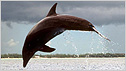
Dolphins are all members of a group of marine animals called cetaceans (pronounced:see-tay-shuns and derived from the Latin and Ancient Greek words meaning a sea monster). All cetaceans are mammals with blow holes linking their lungs to the air. There are two kinds of cetacean… odontocetes which have teeth and mysticetes which don’t. Dolphins are odontocetes.
The Scottish Bottlenose Dolphins (Tursiops truncates) are some of the world’s largest and can be a metre longer than those living off Florida. They also tend to be fatter, which may have something to do with the amount of blubber they need to survive in the very cold water of the Scottish winter.
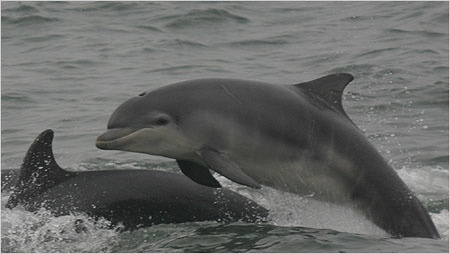
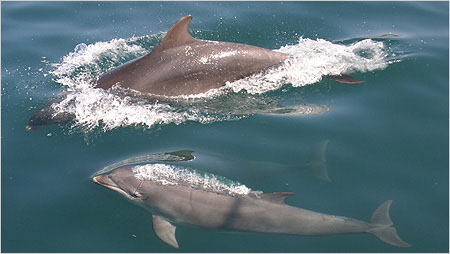
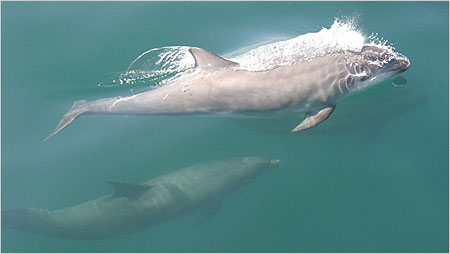
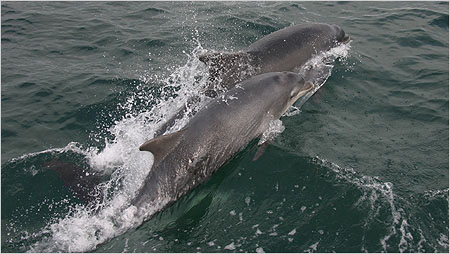
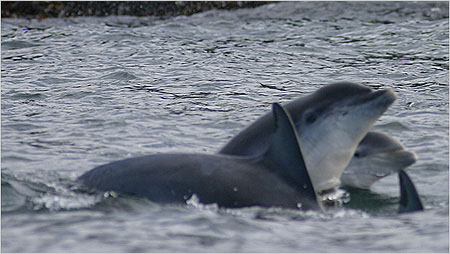
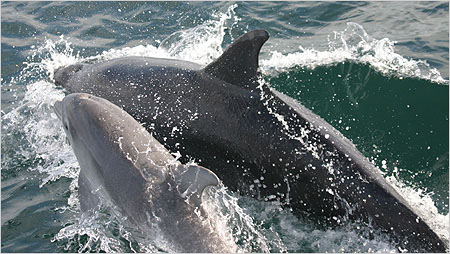
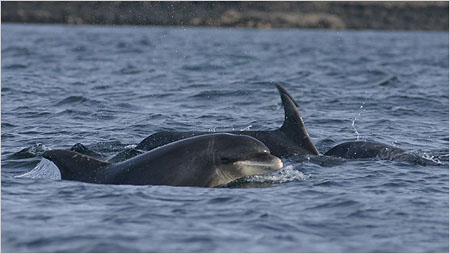
Bottlenose Dolphins appear a uniform grey although their colouring can be very variable. They have a short well developed snout which resembles an old-style gin bottle (hence the name). The easiest way to recognise a Bottlenose Dolphin is to look for the obvious dark and curved-back dorsal fin.
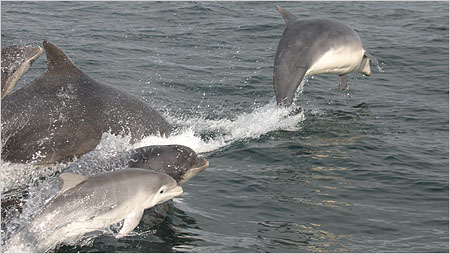
Bottlenose Dolphins are very athletic and can leap several metres out of the water. They can also been seen ‘playing’ with seaweed or other animals and ‘breaching’ which is when they leap completely out of the water often falling back sideways with a big splash.
Find out more about Dolphins...
Weblinks
Whale and Dolphin Conservation Society
Cardigan Bay Marine Wildlife Centre
Hebridean Whale and Dolphin Trust
The BBC is not responsible for the content of external internet sites.
Photo gallery
Watch and Listen
Chris Packham watches a group of dolphins putting on a show in the Moray Firth:
Hear the sounds of Bottle Nose Dolphins, courtesy of the Hebridean Whale and Dolphin Trust:
Help playing audio/video
Tips
Tips for viewing this species:
- The Moray Firth and particularly Chanonry Point on the Black Isle is the best place in the UK to see Bottlenose Dolphins.
- There are also regular sightings of dolphins around the Hebrides in the Isles of Mull (in particular the Sound of Mull), Iona, Coll, Tiree, and Barra.
- In Wales there are dolphins which can be seen from land at Cardigan Bay.
- And you have a good chance of seeing dolphins from land in various other parts of Britain…in England at Durlston Head in Dorset, Prawle Point in Devon, Porthgwarra in Cornwall and in Scotland at Loch Gairloch at Wester Ross.
- Choose your site carefully… getting some height above sea level means you can see further… if you’re watching dolphins from a cliff top you may be more comfortable if you can watch from your car. You may be there a while and the weather in the far north of Scotland for example can be a little cold!
- For similar reasons taking spare clothing and waterproof clothing is a good idea.
- Take a good pair of binoculars and be patient.
Habitat
Bottlenose Dolphins can appear anywhere on the coastline of the UK. There are ‘resident’ populations at the Moray Firth and Cardigan Bay. The Moray Firth is on the north east coast of Scotland. It’s Scotland’s largest firth with more than 800kms of coastline and thousands of birds and other wildlife thrive on its cliffs and mudflats. Cardigan Bay is also a rich environment for wildlife with an unspoilt coastline of sandy coves, beaches and cliffs. You can actually see three kinds of dolphin in the bay the Common Dolphin, the Rissos Dolphin and the Bottlenose.
Scientists have spent years studying the fascinating and complex series of noises that dolphins make. Despite not having any vocal cords they still ‘speak’ by making a variety of clicks, whistles, squeaks and grunts. The whistles are unique to each dolphin and it seems they use them as identification, like we use names. The clicks are part of a dolphin ‘radar’ system called echolocation which is used for finding food. The dolphin makes the click, which goes out through the water and bounces off objects in its path, for example a fish. From hearing the echo, the dolphin can then work out the precise size, shape and position of the object.
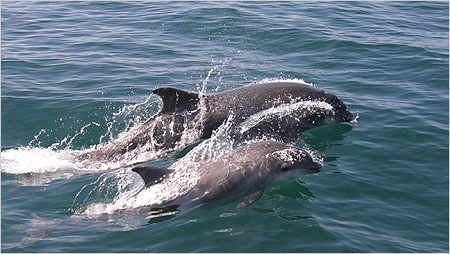
They feed on squid, shrimp, eels and a wide variety of fish. They’re very social animals and will live in groups of one to 10 in inshore waters and groups of one to 25 further offshore although some schools can be much bigger.
No. 16 - Courting Great Crested Grebes
Increased road and rail building managed to turn round the fortunes of the Great Crested Grebe.
Best places to see - Lowland Britain and Ireland.
No. 14 - Boxing Hares
Why do 'Mad March Hares' chase each other across the fields and appear to have 'boxing' matches?
Best places to see - Combinations of arable and grassland in England, Wales and Scotland.
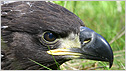
No. 13 - Hunting Sea Eagles
The Sea Eagle is the UK's largest bird of prey, and the fourth largest eagle in the world.
Best places to see - Scotland's Highlands and Islands.


Also on Nature's Top 40
BBC Nature & Wildlife
More from bbc.co.uk nature

BBC iD
BBC iDBBC navigation
BBC links

BBC © 2014The BBC is not responsible for the content of external sites. Read more.
This page is best viewed in an up-to-date web browser with style sheets (CSS) enabled. While you will be able to view the content of this page in your current browser, you will not be able to get the full visual experience. Please consider upgrading your browser software or enabling style sheets (CSS) if you are able to do so.
