

EXPLORE EPISODE THREE - 32 to 29
Local Navigation

Bringing to life spectacles of natural wonder on our doorstep
No.29
Rook roosts
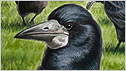
It’s estimated that there are more than a million pairs of Rooks (Corvus frugilegus) in Britain. They’re members of the Corvidae family which also includes the Raven (Corvus corax), the Jackdaw (Corvus monedula) and the Carrion Crow (Corvus corone).
They’re usually seen in flocks or in smaller groups, often with Jackdaws, and will gather together in open fields to feed before roosting for the night. Jackdaws are a rather grey crow about the size of a pigeon. They have black caps and grey necks.
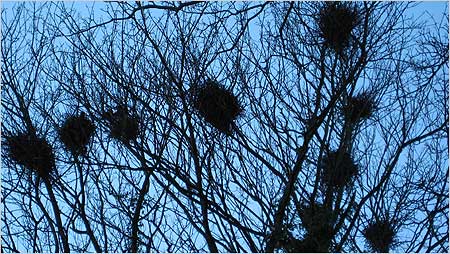
The Rook is the only species of crow to nest colonially in rookeries. These structures are home to an extended family of Rooks for about six months of the year. The nests in a rookery are usually between 50cm and 2m apart, although they can be even closer together with some of them actually touching.
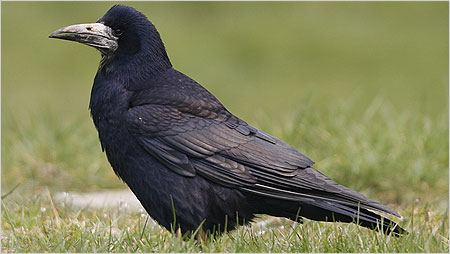
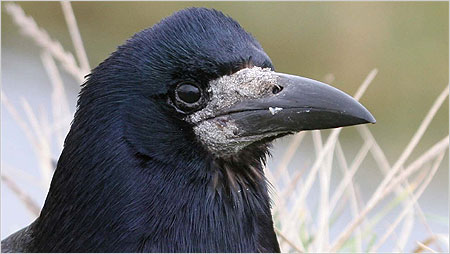
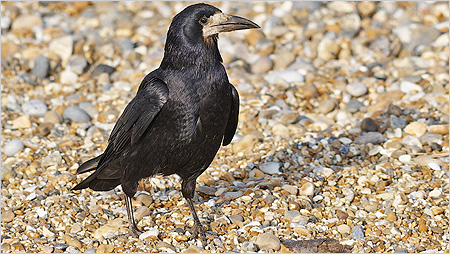
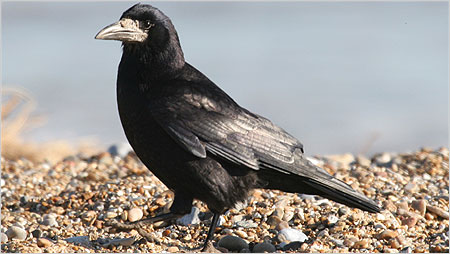
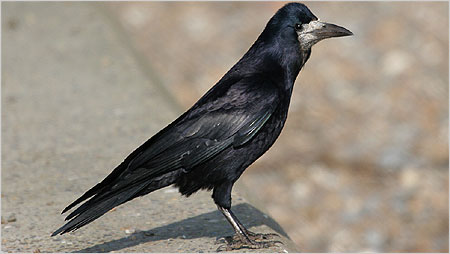
The Rook is very similar looking to the Carrion Crow but is often described as more ‘untidy’.They can be distinguished from the Carrion Crow by their bare greyish/white faces, slimmer beaks and the shaggier feathers around the legs. They’re about 44 – 46cm in length with a wingspan of 81 – 99cm.
Corvids have been, some would say unfairly, given a bad name in films and literature from Edgar Alan Poe’s narrative poem,‘The Raven’ to the evil foreboding of the gathering flock of birds in Alfred Hitchcock’s classic 1963 film ‘The Birds’.
Find out more about rooks...
Weblinks
The BBC is not responsible for the content of external internet sites.
Photo gallery
Watch and Listen
Mike Dilger joins Rook lover Mark Cocker to see the Rooks gathering to roost at one of the largest rookeries in Britain:
Listen to the sound of Rooks on the RSPB website:
Help playing audio/video
Tips
Tips for viewing this species:
- One of the biggest rookeries in Britain, with several thousand pairs, is at Hatton Castle in Aberdeenshire.
- Check out woods on farmland for roosting Rooks as dusk falls…you’ll see the birds approaching in a swirling cloud. And remember that the birds leaving the roost at dawn can be just as spectacular… if you don’t mind getting up early!
- Binoculars will help you get a closer look at the birds.
- The expression ‘as the crow flies’ is probably a reference to Rooks rather than crows, and the way they fly in straight lines of birds to and from their colonies.
- Rooks build their nests higher up in trees than almost any other British bird. On average the nests are 19.4m above ground.
- Rooks are relatively easy to distinguish from crows and jackdaws. Their most striking feature is the area of pale grey skin at the base of the beak. Crows are entirely black, and jackdaws although mainly black, have a grey hood.
Habitat
Rooks are often seen in flocks feeding on farmland or in small groups by the roadside. The may be seen in parks and villages but tend to stay clear of large built up areas. They eat worms, grain and insects.
Their practice of feeding on corn brought a decree from James 1 of Scotland in 1424 that they should be destroyed but the damage that rooks do to crops may be offset against the benefit they bring by eating insect pests.
One of nature’s great spectacles takes place in Norfolk when up to 80,000 rooks gather at woodland at Buckenham and form a rookery.
Every morning and evening the birds flock into and out of the rookery.
The nests are built close together high up in trees. The young hatch out over a period of days and the first one to hatch will take most of the food. The last one to hatch is the least likely to survive. Both parents feed the young.
One theory about rookeries is that they act as a place of safety with all those eyes watching, plus all the swirling around would confuse a predator like a peregrine falcon. Some people also think that they act as information exchanges where the birds swap information about good feeding places for example.
Rooks are also considered to be one of the most intelligent birds in the UK.
It is said that if you see a flock of crows then they’ll be Rooks. This is not strictly true as Carrion Crows, although usually found alone or in pairs, do form flocks. Rooks, however, are the only member of the crow family to nest together in colonies.
No. 32 - Goats
See the rutting Goats of Snowdonia. These feral animals live wild on the hillsides.
Best places to see - Nant Gwynant Valley in Snowdonia.
No. 31 - Swarms of Swallows
One of the UK's most familiar wild birds which flies 10,000 miles each year to breed.
Best places to see - UK-wide, reedbeds are a favourite for roosting.
No. 30 - Hunting Otters
Find out about the animal now making a come back after once being considered as vermin.
Best places to see - Northumberland, Morven Peninsula on the West Coast of Scotland and the Isle of Skye.


Also on Nature's Top 40
BBC Nature & Wildlife
More from bbc.co.uk nature

BBC iD
BBC iDBBC navigation
BBC links

BBC © 2014The BBC is not responsible for the content of external sites. Read more.
This page is best viewed in an up-to-date web browser with style sheets (CSS) enabled. While you will be able to view the content of this page in your current browser, you will not be able to get the full visual experience. Please consider upgrading your browser software or enabling style sheets (CSS) if you are able to do so.
