Hands that hold hammers instead of books
Countless children are working at mines rather than in school in Sierra Leone. Benedict is trying to change that.
Nothing can hide from the sun in Makeni, Sierra Leone’s third largest city.
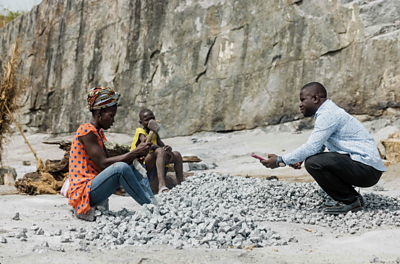
Its harsh glare throws everything into sharp relief, including the dust that collects between the toes of a five-year-old boy as he climbs up the rockface of a vast quarry. It's 9am and he should be at a school desk, ready to start a new day of learning. Instead, his family has no choice but to send him to work at one of the many artisanal mines in the region. These sites were long ago abandoned by large corporations and are now used by the local community to excavate minerals such as iron, diamond and gold, largely by hand. Families like these desperately need the money, and without the efforts of the everyone, including the children, they wouldn’t be able to feed themselves.
Daniel is one of nearly one hundred children out of school on this Wednesday morning, small hands holding hammers instead of schoolbooks. Their mothers have babies strapped to their backs as they strike vast slabs of granite. The eldest children, boys of no more than 16, light fires to soften the rock before breaking it into smaller pieces so that the younger children can use their hammers to crush it further – they sell it on to construction contractors for between $1 and $3 a day. Children scamper up the steep and unstable surfaces of the pit, their silhouettes barely visible against the high West African sun.
I lost my husband. I have four kids. This quarry is my only source of income. This is my only means of survival."
Saio and her family have no other option other than to work at the mine. She even came to the pit to work while heavily pregnant. “I worked until I had to take bedrest,” she says, “And even after I gave birth, I came back after three weeks.” Today she works side-by-side with her children, backs bent, knuckles scarred, sweat mixing with dust.
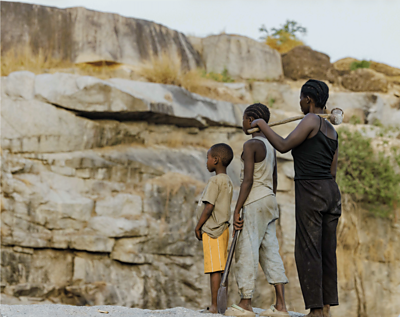
Child labour at mines around eastern Sierra Leone is common. Unicef estimates that almost one in five children in Sierra Leone have experienced child labour at some point. Even in Makeni, where infrastructure is more advanced than rural provinces, many children come to work instead of going to school. Parents struggle to afford school fees, let alone books and uniforms; although education is free in theory, poorly-paid teachers request payments from families.
Benedict AbuBakarr Conteh climbs the quarry face behind Saio, recorder in hand. He is an investigative journalist and founder of Beline Media Empire, a news outlet in Sierra Leone focusing on impartial, trustworthy journalism. His investigation and training has been funded by BBC Media Action. His mission is clear: “I want to see an environment where [these children] can focus on their education rather than going to the mining sites to help their parents.”
Benedict is one of many young journalists changing the face of journalism in Sierra Leone. Trained by BBC Media Action in impartiality, factchecking and research, his brave work is uncovering hidden stories and pushing for policy change by telling the uncomfortable truth.
“Without the necessary funding for us to work on these investigations, I believe the world would be in a state without flow of information,’ say Benedict, whose story went viral when he published it.
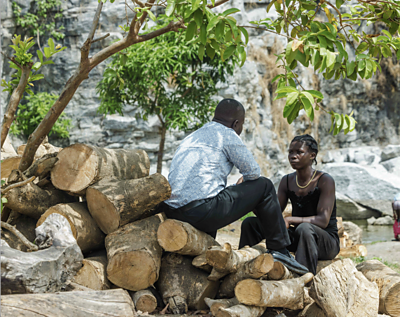
He wants his work to make the case for stricter child labour laws and more benefits for families living in poverty, so that children don’t have to resort to working at quarries like this one. Upon publication, the paramount chief of this community in Makeni approached Benedict to thank him – he said he was unaware children were being taken out of education to help their mothers and fathers.
The chief has now made education compulsory for the children in his community, allowing them to work at the mine for a few hours a day as long as they also attend school. Since the publication of Benedict’s article, residents have also formed WhatsApp groups to draft bylaws against child mining, an unprecedented grassroots action for this community. As part of BBC Media Action's work, townhall discussions have also been held in communities like this one, giving miners the opportunity to voice challenges to local authorities and discuss potential solutions.
Benedict’s journalism highlights how deep this issue goes, affecting not only children’s education and future opportunities, but ricocheting through generations of Sierra Leoneans who struggle to escape the cycle of poverty. “We don’t want our kids to have the same life as us. I want people to help my kids get an education, so they don’t end up like me,” says Saio.
I am happy that BBC Media Action is here to listen and share our stories. We are hopeful help will come our way.”
By shining a light on the truth here in Makeni and amplifying these voices, Benedict hopes the future might begin to look different. “One of my hopes from publishing this story is that policy makers and decision makers take action and say no to child labour,” says Benedict.
As the sun sets on the quarry, mothers and children pack up their shovels and picks and set them aside for another day, each holding onto the hope that one day, mining may not have to be the only answer.
More about BBC Media Action

Read more about our support for investigative journalism
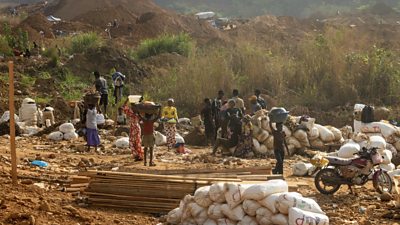
Digging for the truth
Holding those in power to account, Davida Spaine-Solomon reports on hidden truths in Sierra Leone's mines.
The buried voices that still sing
Mabinty Kamara amplifies the voices of survivors of gender-based violence in mines across Sierra Leone, to try and stop it happening again.
Search by Tag:
- Tagged with Sierra LeoneSierra Leone
- Tagged with Media developmentMedia development
- Tagged with AfricaAfrica
