Sexual harassment in the media
A new study of 2,800+ media professionals across 21 countries contains revealing findings about the prevalence of sexual harassment in newsrooms
Download the global report
A safe, respectful and inclusive media workplace is a moral and strategic imperative – yet the 2025 report on sexual harassment in the media reveals many have made little progress in the last five years.
A new multi-country survey to understand the current realities of sexual harassment in media workplaces has found that on average, 69% of respondents who reported experiencing sexual harassment do not report it. Under our global PIMHIE project BBC Media Action, in collaboration with WAN-IFRA Women in News and City St George's, University of London, conducted this study, across 21 countries and with over 2,800 respondents, builds on an earlier 2020 study by WAN-IFRA Women in News, examining the current situation and how it has evolved.
The survey explores new areas of inquiry, such as online harassment, and examines individual experiences, leadership attitudes, policy effectiveness, training impact, and newsroom culture.
- Sexual Harassment in the Media - DashboardOur interactive dashboard shows the global distribution of sexual harassment in newsrooms.
Progress remains slow and uneven
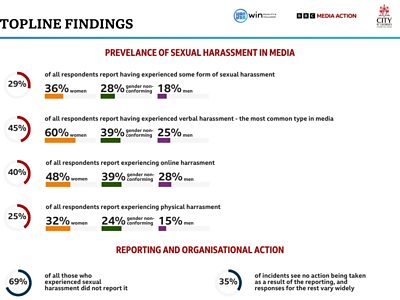
Across genders and regions, reported prevalence of sexual harassment is 29%. But the picture is not uniform. Globally, there is a clear gender divide. Women are 2.4 times more likely to experience verbal harassment and 1.8 times more likely to experience online harassment.
Sexual harassment goes beyond the newsroom. Women journalists also face harassment from sources, public officials, and individuals they are assigned to cover. I have been sexually harassed during an assigned beat.
Experiences of physical harassment and rape are relatively lower but remain consistent threats. A quarter of all respondents report instances of physical harassment, with 5% of women and 4% of men citing they are rape survivors.
Among men, reported experience of harassment has increased from 12% to 16% since 2020. Research consistently shows that men are less likely to identify or report experiences of harassment. The increase may point to a growing willingness among men to name what has happened to them.
Most harassment goes unreported
A decline in prevalence is only part of what determines whether a workplace is safe. The other part is whether the people who experience harassment feel able to report it – and whether actions are taken when they do.
On both counts, the findings are sobering. The new report shows that only 31% of those who experienced harassment reported it. Seven in 10 incidents still go undocumented and unaddressed.
There were times I would feel journalism is not for me ... editors wanting to sleep with me just to be at a higher position or just to get a job or remain in one. I have been too ashamed and embarrassed to even seek help. One time I confided in my then editor and he responded saying some matters should not be discussed in public.
Fear of losing their job, of retaliation or of not being believed; a lack of reporting mechanisms; and not considering harassment a “big deal” remain key barriers to reporting.
I reported the matter to the managing director, but nothing was done, nothing was taken seriously. I have raised concerns before to the board of the office, but nothing has been done – no action has been taken, and this is a challenge that has really negatively affected my work.
Where incidents are reported, organisations were found to have taken action in only 65% of cases. A consistent and effective organisational response is not yet guaranteed. And women are consistently more likely than men to report that no action was taken, particularly in cases of physical harassment.
Taking action against these abuses is extremely difficult because those in positions of authority are often the same individuals responsible for handling complaints. As a result, many women find it hard to report such cases, leading some to resign, step down from leadership roles, or move from one media organisation to another in search of a safer working environment.
Dr Lindsey Blumell, City St George's, University of London notes: "Sexual harassment has a deeply negative impact on those who experience it and the general working atmosphere in newsrooms. Our research shows that no matter the type of harassment, experiencing it decreases job satisfaction, increases risk of leaving the industry, and many other negative mental and even physical consequences to victims/survivors. Underreporting sexual harassment reflects a lack of trust in reporting systems and signals an overall acceptance of violence in newsrooms."
Persistent underreporting can also shape what management perceives to be the scale of the problem. Without clear and effective reporting mechanisms, complaints do not surface and management remains unaware of the problem organisations.
The safeguarding policy hasn't worked on my side. I have been sexually harassed on several occasions ... [and] the institute I was working for never had any form of aid to help people.
Journalism becomes narrower, less representative, and less trusted
Unsafe and unequal workplace cultures (particularly sexual harassment, online abuse and misuse of power) create structural barriers that lock women and marginalised groups out from editorial decision-making. When reporting systems are inaccessible, unsafe, or ineffective, harm remains unaddressed and inequality is reinforced.
My immediate supervisor repeatedly made sexual advances toward me. When I firmly refused his demands, the workplace became a battlefield. To punish my refusal, he began sabotaging my professional standing. He withheld necessary work assistance and frequently lied to his superiors, claiming I was incompetent and ‘unfit’ for my role. He would scold and humiliate me constantly, to the point where I began to hate the job I once loved.
Those who experience harassment and find no recourse may resign, withdraw from leadership roles, or step back from the parts of their work that bring them into contact with perpetrators.
Rejecting him cost me my job. After I stood up to him and told him off, he started giving me a cold attitude, stopped considering me as one of the managers, and always threatened to dismiss me. Later, I was dismissed by the director's wife over the same issue – she bluntly accused me of entertaining her husband.
This attrition results in journalism becoming narrower, less representative, and less trusted: who decides which stories are told, how they are framed, whose perspectives are prioritised, and what is considered “newsworthy”.
Sometimes a woman is given a leadership position in a media organisation merely as a symbolic gesture to demonstrate gender equality. However, key decision-making roles remain dominated by men, and women are often excluded from real authority and decision-making processes.
From evidence to action
Longitudinal data across five years creates a comprehensive picture of where conditions are improving, where they are not, and what distinguishes one from the other. That picture can inform change in individual newsrooms, across media sectors, and at the level of policy and advocacy.
The findings point toward four areas where action is both urgent and possible.
- Policies that function in practice
Effective institutional accountability requires more than a written policy: it requires trusted, trained responders within newsrooms, transparent processes, and a clear understanding among all staff that reporting leads somewhere.
Strong policies, ethics and laws set by the management of my workplace ... protect employees of both genders, male and female, and if it is determined that an employee is subjected to sexual violence in any environment, then strict legal action is taken against him or her, including termination of employment.
- Training that builds capacity
Awareness alone is not enough: the survey finds that access to training remains limited across all global respondents, with 72% having never received any training. Targeted training for all genders, from new reporters to those in leadership, that covers legal frameworks, evidence preservation, trauma-informed response, and digital safety can equip people with the practical capacity to act.
Read how we're working with partners to respond in Bangladesh here.
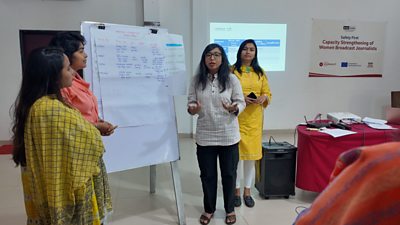
After attending a BBC Media Action workshop, I understood my position and rights better as a woman in the media industry. Since then, I have not faced any challenges in this field.
- Support that reaches survivors
Harassment affects mental health, professional confidence, and career trajectories in ways that data alone does not capture. Accessible, confidential, survivor-centred support structures that combine psychosocial assistance with legal and professional pathways can complement policy and training. Peer mentorship networks can provide targeted support to strengthen professional grounding and resilience, particularly where institutional structures are still developing.
Leadership and mentorship programmes have equipped me with the confidence, professional boundaries, and ethical grounding needed to resist such advances and protect my integrity.
- Collective engagement
Harassment is still widely perceived and institutionally treated as primarily a women's issue, which has direct consequences for how it is resourced and addressed. Sustained change requires the active engagement of colleagues across genders as well as bystanders, with a shared stake in the newsroom cultures that harassment corrodes.
Ensuring a safe and fair working environment is more effective through collective action than individual initiatives. Sustained pressure, active participation of male colleagues, and increasing the numerical strength of women journalists are key to driving real change at the ownership and management levels.
Search by Tag:
- Tagged with Women and girlsWomen and girls
- Tagged with Media developmentMedia development
