

Chaos on wheels greets Kouchner
- 10 Oct 08, 05:19 PM
Convoy Kouchner was quite literally chaos on wheels. A high-speed chase through what was the Russian buffer zone between Georgia and South Ossetia.
The French foreign minister, who helped negotiate the ceasefire during the war, was out in front in a blue French armoured car, followed by another such vehicle, and then a train of police cars and in their wake a ragtag and bobtail of local and international journalists, gunning their engines trying to keep up.
The armoured car would stop, sometimes for hardly more than a minute, Georgian police would jump out, lining the route, pointing their sub-machine guns into the middle distance, cameramen and reporters screeched to a halt and ran up to the head of the convoy, just in time to take a couple of pictures as rather bewildered locals coming the other way tried to drive through the mass of abandoned vehicles.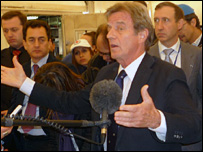
After grabbing a couple of pictures of the minister saying something wise, everyone ran back to their cars and the convoy then moved off again, amid much honking and hooting, losing stragglers at each stop.
At one village, where Mr Kouchner stopped for about quarter of an hour, he spoke to a woman whose house had been blown up at the beginning of the war. He stood and chatted with her in front of the shell of her home, its roof blown off, twisted metal and glass crunching under our feet. Mr Kouchner later said it was "very sad, but not hell".
Perhaps a woman we spoke to in the village might not agree. She told us that she had just come back to visit her house and it was all in ruins, so she would be returning to the refugee camp in Gori. She said she only just managed to escape the bombs, and many of her neighbours were killed then and afterwards. She'd got ill living in the camp and was worried that as she was all alone she had no one to help her out. As she put it, "there is no one to bring me a glass of water if I call out from my bed".
Mr Kouchner was not trying to be insensitive, but is proud of the peace deal negotiated on behalf of the European Union. He described it as "not perfect, but a document negotiated under fire". He said it had stopped the Russians rolling on to take the capital Tbilisi.
But what bothers the Georgian government is that they say the Russians have kept land taken in the war, particularly the area of Akhalgori, an area of 26 villages next to, or in, South Ossetia, depending on your point of view. Mr Kouchner's convoy must have passed the turn-off on their way back to the capital, but did not go to investigate.
Whatever you call the area, the Russians weren't there before the war, and are now. No one seems to dispute that. So it is logical to see it as a breach of the ceasefire which states they must move troops back to where they were before the conflict began.
Mr Kouchner didn't suggest this logic was wrong, but didn't seem too bothered about this breach. He said the ceasefire was "not complete, not perfect". When I pressed him he said: "Did you listen for the noise of shots? Is the withdrawal complete? Yes, yes" - and pulled a face. He said that this and other problems would be a question for a conference that starts in Geneva next week.
Another journalist had a go, asking how he could say that the ceasefire had not been breached. "Do you have another solution?" he asked. "Step by step we'll do it."
Mr Kouchner has a habit of asking questioners what they would do and many European diplomats agree with him that there's no point in being purist about this.
One very senior European diplomat told me they were in for the long haul and the peace process is likely to last as long as that to solve the status of Kosovo. Many in the EU think the status quo is the best they will get and better than they could have hoped for in August.
As the senior diplomat put it, "time to take the money and run".
Get Ganley!
- 10 Oct 08, 08:10 AM
Get Ganley! That's the word going out from Dublin and Brussels...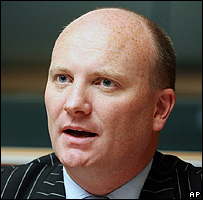
I sit in the office of a senior politician, a serious man who is taking a conspiracy theory seriously, a man who has taken time to get the measure of the man in his cross-hairs... a man who feels his enemy is acting on behalf of an alien, foreign ideology.
No sniper from the Irish secret service, if there is one, is carefully packing away infra-red sights, no hit man from the European Parliament's non-existent military wing is spending time with mercury tilt switches.
But Declan Ganley, the millionaire businessman who bankrolled and masterminded the successful "No" campaign in the Irish referendum, is a target all the same. Many in the European establishment would like to see Mr Ganley come a cropper, see his campaigning days terminated and his nascent political career liquidated before he can do any more damage.
The mysterious Mr Ganley is now talking about turning his think-tank Libertas into an EU-wide political party. He's been touring Europe looking for support for his campaign to turn next year's elections to the European Parliament into another referendum: on what he calls the anti-democratic Europe of the Lisbon Treaty. You remember - that's the one that so many say is just like the constitution the Dutch and French threw out.
But the European Parliament has instructed the Irish authorities to investigate his funding and motives: many believe that the mysterious Mr Ganley is a stooge of the American military industrial complex, doing the bidding of the right-wing neo-cons in the CIA and Pentagon, hell-bent on smashing the rise of a political Europe.
I write "mysterious" because I think it must be obligatory under international journalistic law. Every article does it. Several times. In fact, he's not mysterious, but open and accessible. What they mean is he's exotic, like a character from a mystery movie. An Irishman who speaks with not a lilt but a London accent, who lives in singer Donovan's old mansion, who travels around by helicopter or Mercedes or Rolls Royce, who went to the former Soviet Union and made millions out of timber and telecoms, as capitalism emerged blinking and unfolding from the wreckage of the old system. He holds the Louisiana Distinguished Service Medal. That medal says a lot to his foes. He received it for getting emergency communications up and running after Hurricane Katrina - he's chairman and chief exec of a company that specialises in secure emergency communications networks and has a $200m contract with the American military. That is what raises both hackles and suspicions.
The senior politician sitting in front of me has clearly been giving it a lot of thought: he traces a lot of Mr Ganley's ideas to a particular individual at a particular right-wing Washington think-tank.
I express some scepticism. But he enthusiastically tells me: "You can do a lot with textual analysis - he says 'European elites' a lot. It's not an expression that springs to the lips of a boy from an Irish village - it's neo-con language".
I am impressed, but when I put the term into Google the top hits are articles from The New Statesman and The Guardian - not usually thought of as CIA tools.
Mr Ganley shrugs off the accusations when I ring him. I'm trying to arrange an interview, but he's in an airport about to get on a plane to the States. "Off to see my controllers," he says cheerfully. Later, as I try to pin him down, he fires off a characteristically colourful rebuttal. "Madder than a box of monkeys... patronising to the Irish people to suggest that someone put something in their cornflakes that morning to get mind control and influence their vote." But is he close to the neo-cons?
"Ridiculous and untrue... it is utterly baseless," he says. "These people in Brussels would rather talk about anything than the subject. I want the EU to be prosperous, respected and stand tall in the world, and that's only going to happen if we bring democracy to the heart of it."
Mr Ganley's views are a little curious. He always paints himself as in favour of the European Union, but says he wants a different sort of EU, one with an elected president. That would horrify many British Eurosceptics as well as his supposed mentor in that Washington think-tank. Then the unelected European commissioners would be reporting directly to an elected politician, rather as the unelected Condoleezza Rice or Hank Paulson report to George W. So perhaps there is something of an American model in his thinking.
I am not quite sure if the American defence establishment, rather than some intellectuals, are particularly bothered about the Lisbon Treaty. Most Washington right-wingers are happy enough to sneer at Europe in general, and do worry that the EU could undermine Nato. But a significant number would love the EU to do more foreign policy and spend more on bombs and bullets and take care of its own borders, particularly as those currently in power in Paris and Berlin are pretty keen on the transatlantic alliance.
As I leave the politician's office he hands me photocopies of a book called Blood Money, about American business deals in Iraq. There are underscorings, annotations, scribbled questions in the margins: "nb who his partners?" All because it mentions a "mysterious Irish entrepreneur Declan Ganley". Will they succeed and get Ganley? It's a mystery to me.
The BBC is not responsible for the content of external internet sites
Description
Archive
« October 2008 »
| Sun | Mon | Tue | Wed | Thu | Fri | Sat |
|---|---|---|---|---|---|---|
| 1 | 2 | 3 | 4 | |||
| 5 | 6 | 7 | 8 | 9 | 10 | 11 |
| 12 | 13 | 14 | 15 | 16 | 17 | 18 |
| 19 | 20 | 21 | 22 | 23 | 24 | 25 |
| 26 | 27 | 28 | 29 | 30 | 31 |
Being Discussed Now

Latest from BBC News blogs
Nick Robinson: |  |
Douglas Fraser: |  |
Brian Taylor: |  |
 |
Richard Black: |  |
Jonathan Amos: |  |
- News Editors
- Sport Editors
- Journalism Labs
- BBC Internet Blog
- Radio 4 Blog
- Peston's Picks
- Nick Robinson's Newslog
- Stephanomics
- Mark Easton's UK
- Mark Mardell's America
- Nick Bryant's Australia
- Andrew Harding on Africa
- Gavin Hewitt's Europe
- Soutik Biswas' India
- dot.Rory
- Science: Jonathan Amos
- Richard Black on environment
- Today: Tom Feilden
- Fergus Walsh's medical files
- Newsnight: Paul Mason
- Newsnight: Mark Urban
- Torin Douglas
- Will Gompertz's arts
- Phil Coomes on photojournalism
- Magazine Monitor
- Mark D'Arcy in Westminster
- NI: Mark Devenport
- Scotland: Brian Taylor
- Scotland: Douglas Fraser
- Wales: Betsan Powys
- Martin Rosenbaum on FOI
- 5 Live Breakfast
- Newsnight
- PM programme (iPM)
- World Tonight: Robin Lustig
