Form
The Some poems adopt specific 'forms'. For example, they could be sonnets or narrative poems. Many don’t have an identifiable form. of a text is the type of text you are reading or watching. The form of Journey’s End is a dramatic play, which means the text we study is the script used by actors and directors to perform the play in front of an audience.
Journey’s End is a realist or Representing something in a realistic way. drama.
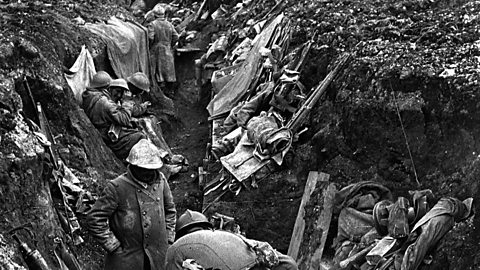
This is shown immediately in Sherriff’s detailed opening stage directions in which the setting is made to mimic real life. For example, in the first act the stage directions note the gloominess of the A shelter for soldiers in the trenches, made by digging a hole in the ground and covering it with a roof. but add that there are “a few tattered magazine pictures pinned to the wall of girls in flimsy costumes.” The setting lets us know immediately where we are. It reflects the horrors of war while showing how the men tried to make their surroundings homely or personal. This gives the play Something that seems real and believable, has the appearance of truth..
This kind of naturalistic drama began to be popular around the beginning of the 20th Century. It attracted audiences who would previously have felt that theatre was too Intellectual or involving serious artistic ideas., intellectual or pompous.
Journey’s End appealed to people from every walk of life. Winston Churchill – who went on to be the British Prime Minister during World War Two – was reportedly a fan of the play.
In order to analyse form you must:
- consider what aspect of form you are looking at
- think how Sheriff has used this for effect
- think how this could impact the audience
Structure
The The way the poet has organised the poem on the page eg number of stanzas, lines per stanza, breaks in between lines and stanzas. of a text refers to the way in which events are organised inside the play as a whole.
The events of this play are organised into three In drama, an act is a section of the performance, usually made up of a number of scenes., but take place over four days. Act One contains one scene, Act Two contains two scenes and Act Three contains three scenes. The scenes therefore get shorter as the play moves on.
This quickens the pace as we move towards the end, and tension rises in the dugout while the men wait for the oncoming attack.
Act One is an The part of a narrative that sets the scene for the audience, for example giving the backstory of the characters or information about the setting. scene, allowing us to understand the situation and to become familiar with the characters and their relationships with each other. There is a lot of boredom and sitting around chatting. This portrays how much waiting there was in war, and creates tension as the audience are waiting for something to happen.
An imminent attack – expected in two days’ time – is mentioned in Act Two, Scene One. This introduces tension, but again the audience are left waiting.
There is no more war action until Act Two, Scene Two, when the Colonel comes to inform Stanhope which officers will be involved in the planned raid on the German forces. Again this is drawn out, and there is no sign of any actual fighting in Act Two. The act ends poignantly with the young Raleigh excited and flattered about being picked to take part in the raid.
The pace of the action steps up in Act Three, Scene One. It begins slowly, with the men eating – but by the end of the scene the raid is over and Osborne is dead.
The remaining short scenes see Stanhope left cynical by the lack of care from his superiors about the loss of men. The play finally ends with the death of Raleigh, and the remaining characters going forth to the attack they have been waiting for since Act Two.
This conclusion reinforces the futility of war as all the characters we have gotten to know during the play are now dead or – we assume – about to die.
Language and dramatic methods
Language refers to the choices of style and vocabulary made by the author.
As Journey’s End is a play, the language can be split into The words said by a character in a story or play. and stage directions. The dialogue is realistic and it can:
- add personality to the characters
- help the audience understand their motivations and relationships
- move the action forward.
The stage directions tell the actors what to do on stage or how to say their lines. In Journey’s End the stage directions give information about the physical appearances of the characters and setting, highlighting aspects of how the actors should look, speak and move.
When analysing the language Sheriff uses, it’s useful to examine:
- what are the ideas Sheriff is trying to get across?
- how has he chosen particular words to reflect this?
- what effect does this have on the audience?
Many of the effects mentioned throughout when discussing character, themes, form and structure are created through Sherriff’s innovative use of language and other dramatic methods. You will be expected to discuss these throughout your essay and analyse how they are used in every point that you make.
In order to analyse language you should:
- Choose a section from the text to analyse and then select a quote from it. Make sure that it is relevant to the question and the point you want to make.
- Consider how the quote reflects character/theme/context. If the quote contains a language device or dramatic method (such as repetition, A metaphor is a word or a phrase used for dramatic effect, to describe something as if it were something else., Everyday language. or a note about staging such as lighting) then name the method.
- Explore in detail the impact specific words or phrases have upon the audience.
- Evaluate how effective the author's choice of language is.
Stage set
The language used to describe the set in the stage directions creates atmosphere immediately. There is little in the way of home comforts and the sense of darkness is reinforced: “The flames of the candles that burn day and night are steady in the still, damp air.”
There is no natural light as the stage is set in a dugout under the ground. This is also shown in the description: “Gloomy tunnels lead out of the dugout to left and right.” The lighting on stage would be used as a dramatic method that helps to create this atmosphere.
This claustrophobic setting conveys the horrors of life for soldiers at war. The description of “earth walls” which “deaden the sounds of war” shows how men had little comfort in the trenches and were surrounded by violence and death at all times.
Use of dialogue
As this is a realist play, the men’s dialogue varies according to their position and Social groupings, sometimes used to measure people's place in society.. This shows the hierarchy in the military, but also how people from every social class were heroes in the face of adversity.
Stanhope, Osborne and Raleigh all mention that they were public schoolboys and this is reflected in their use of A form of speech that lays claim to a grammatical 'correctness' and clear pronunciation, avoiding slang and valuing precision. and words like “rugger” and “chaps”.
At the beginning of World War One, only men educated at public school could become officers. But it was around this time that the class system became less regimented and strict – possibly because so many privately educated officers died. It wasn’t long after the war began that men who did not go to public school could get promoted.
In Journey’s End we see that Trotter is an officer. Yet his use of the The language or dialect spoken by the ordinary people of a country or region. – “I know a decent bit o’ pudden when I see it” – shows him to be less well educated. This is Sherriff using dialogue to illustrate character and reflect the changing times.
Look closely at the dialogue of the Colonel and Mason – both from very different classes – to see examples of these variations.
References to life outside the trenches
While the play is set over four days leading up to the final attack, the past is still important. This is shown by the discussions the men have about their lives outside the war.
Trotter’s description of his garden “with flower-borders – geraniums, lobelia, and calceolaria”, and Osborne’s revelation that he played rugby for England humanise these characters. We are reminded that every soldier was a real man with a life, just like the rest of us.
References to Stanhope’s fiancé and Osborne’s wife also remind us of how many people back home suffered from the war – women and children lost fathers and loved ones.
It is particularly Bringing about a sense of sadness or regret. when Osborne removes his wedding ring because he doesn’t “want the risk of losing it.” We suspect the truth is that he does not expect to survive and wants the ring to be given to his wife when he dies.
Stage directions
The stage directions are the part of the script – often in brackets or italics – that tell the actors how they are to move or speak their lines.
While they do not form the dialogue of the play and are not read by the play’s audience, they are obviously important as they tell us what the writer intended us to observe on stage.
However, there are times where the stage directions use language which is significant for a reader as well as an audience – note how the word “boy” is repeated in the stage directions as Raleigh is dying to emphasise his youth and innocence, and how the A simile is a word or phrase used to make a comparison for dramatic effect, using 'like' or 'as'.“like a child” is used to describe how the Sergeant Major carries him.
These linguistic devices emphasise how young Raleigh is, reinforcing the futility of a war that kills so many young men with so much potential.
Sound effects
The stage directions refer frequently to the noises heard from outside the dugout. This means that, even in the seemingly calm moments on stage, we are always aware there is a war going on because of the sound effects used.
Sherriff uses A word that sounds like what it is describing, eg 'crunch', 'meow', 'plop' and 'scrape'. at times, describing the sounds vividly. For example, the “sharp crack” of grenades and the shells that “whistle and hiss and moan”.
The opening stage directions describe the “sounds of war” as “faint and far away”. This is in contrast to the final shelling, which “has risen to a great fury” – a metaphor which suggests the violent aggression of the fighting. This final attack is described using words and phrases such as “shriek” and “fevered spatter”, which give associations of fear, distress and chaos.
The threatening but distant sounds of war shown at the beginning become a close reality at the end.
Use of silence
Alongside the dialogue and sound effects, Sherriff also uses a careful absence of these in places for added impact.
The stage directions in Act Two, Scene Three – during the tense dialogue between Stanhope and Hibbert – refer repeatedly to “silence”. This emphasises the awkwardness of the situation and – at times – Stanhope’s calm leadership skills.
At other times – during Raleigh’s death scene for example – silence is used to allow the audience to take in and reflect on the A type of drama in which characters undergo suffering or calamity and which usually ends with a death. A sad or catastrophic event causing suffering or death. of the situation.
Foreshadowing
Sherriff gives many hints throughout the play as to what is to come. Before the play even begins, the title itself Hint at something that will happen later and have greater significance. that these men may be coming to the end of something.
Stanhope and Osborne’s discussion about the shame of men who go home when they are not really sick, foreshadows the tense situation between Hibbert and Stanhope later on in the play.
In Act Two, Scene One their conversation about “the worms wandering about round the stones and roots of trees” may be an Suggestive of danger to come.foreshadowing of the death and decay that will come to many of the characters. Also, when Osborne takes off his wedding ring before he goes on the raid this hints that he may not be going to return.
All of these things increase tension and introduce the theme of danger and death early in the play.
Juxtaposition
Two things placed side by side to highlight their differences. is a dramatic method where two things are placed side by side in order to highlight the differences between them.
Sherriff juxtaposes scenes of eating and chatting with scenes of discussions about battle and violence. This has the effect of reminding us that these are human beings.
We often talk of war and the vast numbers of men who died without really considering that each of those lives belonged to people just like us or our loved ones.
Seeing the men concerned about what is for breakfast, discussing gardening and sports, and being nervous and scared before going into battle removes the glamour and heroism sometimes associated with fighting for one’s country in the propaganda of the time. It also contradicts the Showing extreme patriotism in an aggressive or warlike way, often combined with hostility toward other countries. works of poets of the time, like Jessie Pope.
A conversation between Raleigh and Osborne in Act Three, Scene One shows this method of juxtaposition well:
Osborne: D’you like coffee better than tea?
Raleigh: I do for breakfast. [Pause.] Do these smoke bombs make much row when they burst?
Osborne: Not much. [Pause.] Personally, I like cocoa for breakfast.
Mundane topics like beverage preferences are discussed alongside dangerous weapons. This shows how the men have become so accustomed to danger and violence that it is just an everyday feature of their lives.
Dramatic irony
When the audience knows something that the characters don’t. is created when the audience knows something about the situation that another character doesn’t know.
In this play there are many examples, but the most striking is when Hibbert complains to Stanhope of his "neuralgia". The audience is already half aware of what Stanhope’s response will be because he has talked of his disapproval of such a tactic before.
Contrast
Sherriff uses contrasts to guide the audience’s response to characters and actions. There are contrasts in language and stage directions at the beginning of the play and at the end.
The characters themselves are contrasted to emphasise certain physical or personality traits. For example, when the tall and slim Stanhope first appears on set he is with chubby red-faced Trotter. This emphasises the heroic physical A quality or characteristic. of Stanhope and helps us to understand the boyish love Raleigh has for him.
Hibbert’s desire to leave – and his pretence at illness to escape – is contrasted with the character of Stanhope who has “never had a rest” according to Osborne. This helps heighten the sense of Stanhope being a noble and worthy leader.
The contrast in Trotter’s addiction to food with Stanhope’s addiction to alcohol is used to show how everyone uses crutches to deal with the horrors of war.
They may choose different things to help them cope, but in the end everyone finds their own way of “breaking the strain”.
Test yourself
Further study
World War One: The global conflict that defined a century. collection
The First World War was the first truly global conflict – the battle raged not just in the trenches of the Western Front but in Africa, the Middle East and Asia.
World War One. collection
A collection of programmes relating to World War One

Bitesize: World War One
A collection of articles covering World War One as part of Key Stage 3 History (Environment and Society).
More on Journey's End
Find out more by working through a topic
- count5 of 5

- count1 of 5

- count2 of 5

- count3 of 5

