What is an adjective?

An adjective is a word that describes a noun.
They went to an exciting football match.
The adjective 'exciting' tells you more about the noun 'football match'.
Adjectives can go before or after the noun.
The football match was exciting.
Using more than one adjective can add detail and make your writing more interesting and specific for the reader.
Fans filled the enormous, buzzing stadium.
What are adjectives?
Follow along with this story about a football match to see how adjectives are used to describe what happens.
When are adjectives used?
Adjectives are a type of word you can add to your sentences to make your writing more descriptive and detailed.

Adjectives give more information about nouns.
The pitch was muddy after the match.
A noun is a person, place or thing. The adjective 'muddy' describes the noun 'pitch'.
Adjectives help make sentences more specific.
The huge, echoing stadium shook as the crowd cheered.
Without the adjectives, it sounds more plain.
The stadium shook as the crowd cheered.
Adding 'huge' and 'echoing' tells the reader what kind of stadium it is, making the image clearer and more vivid.
Example 1
When using more than one adjective in a sentence, it is most effective when the adjectives describe different things.
The team scored after a long, accurate cross from the wing.
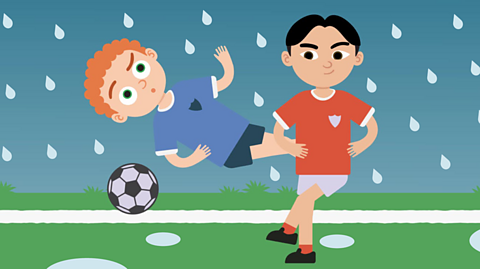
Look at this picture from the team’s football match. Can you think of five different adjectives to describe the action?
✓ Here are five adjectives you could choose to describe the scene from the football match.
- dramatic
- soaking
- tense
- exhilarating
- heart-racing
Your list may look very different. That’s because there are so many adjectives you can use to enhance your writing and help set the scene.
Example 2
Writers sometimes join two words with a hyphen to make one powerful adjective.
Look at these sentences below about the football match. Which adjectives are hyphenated and what do they tell us?
James made a goal-saving tackle to stop Fred scoring.
Chloe scored after a last-minute pass from Lucas.
✓ These adjectives have been made with a hyphen.
James made a goal-saving tackle to stop Fred scoring.
Chloe scored after a last-minute pass from Lucas.
Both 'goal-saving' and 'last-minute' are hyphenated adjectives.
They join two words together to describe a noun in more detail (a tackle that saved a goal, a pass that came at the last minute).
Other ideas could be 'record-breaking run', 'quick-thinking keeper' or 'crowd-pleasing finish'.

Task

Spice up your shopping list
Next time you help with the food shop at the supermarket, why not make the shopping list more interesting?
Add different adjectives to the items on the list.
outrageous oranges
large, sumptuous lasagne
emerald-green broccoli
500 Words
The UK's biggest children's story-writing competition for 5-11 year-olds is open for entries!

More on Grammar
Find out more by working through a topic
- count6 of 17

- count7 of 17

- count8 of 17

- count9 of 17