Form
Animal Farm could fit into the genre of a fairy story, A type of story with animals as characters. It teaches the reader a lesson., A story or poem which has a hidden (usually political) meaning. or Writing that ridicules political figures or society..
- Fairy story – the idea of talking animals and the simple written style are elements that fit this form.
- Allegory – the farm and the animals are an extended metaphor. The farm represents Russia and its experience of revolution in the 1900s. Mr Jones and the animals represent the Russian leaders and people of the time.
- Fable – a fable is a story that teaches a lesson or moral. Orwell uses the actions of the animals to teach the reader lessons about equality, power, corruption and freedom.
- Satire – Orwell satirises the political leaders of Russia in the 1900s.
On the surface the novel is very simple, a Narrative is another word for story. with a lesson that is suitable for children. When seeing the narrative as a A metaphor is a word or a phrase used for dramatic effect, to describe something as if it were something else. or allegory it becomes more complex – the reader needs prior knowledge to appreciate the novel on this level.
The novel has a A third person narrator is not a character in the story. They see the events from the outside and tell the story using third person pronouns, like 'him', 'her' and 'they'.Able to observe everything; a narrator who knows the thoughts and actions of all the characters., meaning we see and know everything that happens and hear the characters' thoughts. This gives the reader an overview which allows us to come to our own conclusions about events on the farm.
Structure
Animal Farm follows a simple The way the poet has organised the poem on the page eg number of stanzas, lines per stanza, breaks in between lines and stanzas.. It is written in 10 chapters that can be divided into three sections:
- the Dream
- the Rebellion
- Napoleon’s regime
Each chapter tells a story in its own right and has an 'ending', which makes the story easy to follow. It also allows the reader a chance to reflect about the lessons taught in each chapter.
We can see this my looking at the ends of some of the chapters:
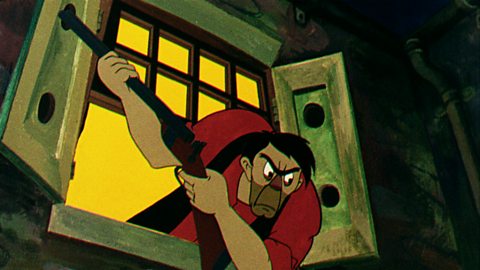
“He seized the gun which always stood in a corner of his bedroom, and let fly a charge of Number 6 shot into the darkness. The pellets buried themselves in the wall of the barn and the meeting broke up hurriedly. Everyone fled to his own sleeping-place. The birds jumped onto their perches, the animals settled down in the straw, and the whole farm was asleep in a moment.”
— End of chapter one
After the excitement of Old Major's speech, the ending of chapter one reminds the reader that Mr Jones is a tyrant. The reader wants to know if the rebellion Old Major spoke of will ever happen.
“The importance of keeping the pigs in good health was all too obvious. So it was agreed without further argument that the milk and the windfall apples (and also the main crop of apples when they ripened) should be reserved for the pigs alone.”
— End of chapter three
At the end of chapter three, the reader begins to see the cracks in the newly founded 'Animal Farm'. There's a chance to think about the lesson on equality that Orwell is trying to teach. The reader wants to read on to see if the pigs make any more unfair changes to the farm.
Have a look at the end of each chapter. How does Orwell end each one? What do you think he's trying to say at the end of each chapter? How does the reader respond?
The narrative could be described as A cyclical process is one in which a series of events occurs in a repeating pattern, for example the change of seasons each year. or circular - this means that it circles round to end as it began, with the animals being oppressed by a cruel leader.
Why did Orwell choose to write Animal Farm as a circular narrative?
- The ending highlights that oppression is impossible to escape – the pigs were always going to become tyrants
- It shows that there will always be groups in society that abuse their power – Orwell tries to show this to the reader so that they will challenge this sort of behaviour.
- It also shows that equality is difficult to achieve – Orwell shows that equality must be fought for.
Literary devices and narrative techniques
The language Orwell uses in Animal Farm is simple, clear and accessible. Description and The words said by a character in a story or play. are kept to a minimum and Orwell avoids sentimentality – even the most heart-breaking sections of the text are very direct in style. He focuses on telling the story, allowing the reader to concentrate on the lessons he wants us to learn. Through the pigs, Orwell shows how Artful persuasive speaking. can be a powerful tool of manipulation.
When analysing the language Orwell uses, you should consider:
- What has Orwell done?
- How and why has he done it?
- What effect does it have on the reader?
- How could the words you have chosen to look at be interpreted differently?
Always try to:
- Use a quote to back up your point.
- Avoid explaining what literary devices (or language devices) mean. For example, when saying that Orwell has used simile, there is no need to say: "a simile is a way of comparing one thing to another".
| Literary device | How is it used? | Why is it used? | What is its effect? |
|---|---|---|---|
| Persuading questions | “Now, comrades, what is the nature of this life of ours?” | To make the other animals question their positions on the farm. | This A question asked in order to create a dramatic effect or to make a point, rather than to get an answer. is used to encourage the animals to rebel. Old Major asks the question and then he provides the animals with the answer he wants, persuading them that he is right. |
| Controlling questions | “Are you certain that this is not something that you have dreamed, comrades? Have you any record of such a resolution?” | Squealer controls the others by questioning their memories. | This rhetorical device is used to make the animals doubt themselves. Orwell shows how Artful persuasive speaking. can be used negatively. |
| Repetition | “Long live the windmill! Long live Animal Farm!” | Here Napoleon uses repetition to reinforce his message. | Repeating ‘Long live’ helps emphasise Napoleon’s point that he wants ‘Animal Farm’ to continue forever. Whilst this appears to be positive, here Napoleon uses the sentiment to make a scapegoat (an individual irrationally blamed) of Snowball. |
| Emotive language | “A cry of horror burst from all the animals.” | The scene when Boxer is taken away is very emotive. | The fact that the ‘horror’, in itself an emotive word, ‘burst’ from the animals gives a clear indication that their fear was so great it almost exploded from within them. |
| Direct style | “Boxer was never seen again.” | Orwell uses very plain language to describe Boxer’s disappearance. | In contrast to the emotive language seen above, Orwell uses direct and understated language. This helps to make Boxer’s treatment more tragic. |
Test yourself
Further study
Listen in full to Animal Farm by George Orwell. audio
The landmark allegory about hypocrisy and corruption of power.
The Real George Orwell. collection
A journey exploring the man Eric Blair and the writer George Orwell.

Animal Farm by George Orwell. collection
A selection of programmes about George Orwell's classic Animal Farm.
In Context: Animal Farm (part one) video
Andy Kershaw explores how the allegorical novel Animal Farm reflects the events leading up to Stalin seizing power in Russia.
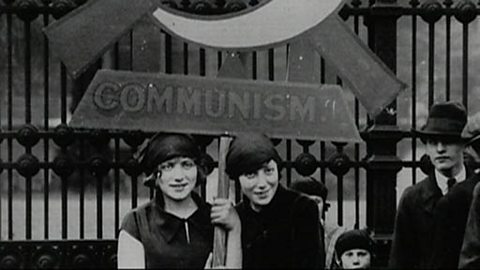
In Context: Animal Farm (part two) video
An analysis of how and why the workers' paradise represented in George Orwell's Animal Farm became a brutal dictatorship.
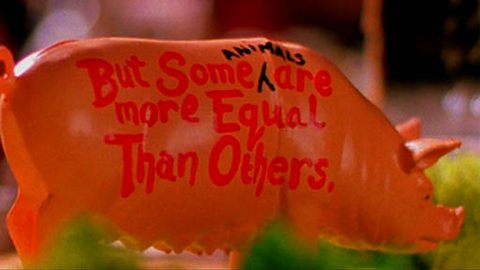
In Context: Animal Farm (part three) video
An analysis of George Orwell's Animal Farm as a representation of the corruption of the revolution by its leaders and of the rise and fall of Stalinism.
More on Animal Farm
Find out more by working through a topic
- count5 of 5
- count1 of 5
- count2 of 5
- count3 of 5