Religion and life
In this article, learn about how Hindus view the origins of the universe as well as some of life's big questions.
Key points
- Hinduism teaches that all life contains In Hinduism, the immortal soul and inner self., making every being sacred and interconnected.
- Hindu scriptures including the A collection of Sanskrit hymns dedicated to the ancient gods. describe creation through the sacrifice of Meaning the cosmic person or spirit that brought the universe into being; a divine consciousness., showing humanity’s place within the wider cosmos.
- Hinduism teaches that the purpose of human life is to fulfil Duty in life., gain good The intentions behind actions and what the consequences of actions are. The idea that all actions (no matter how big or small) have consequences that can cause happiness or suffering., and ultimately achieve Release from the cycle of birth, life, death and rebirth..
- Many Hindus believe that humans, unlike animals, can reflect morally and spiritually, giving them responsibility in shaping their destiny.
Video
Watch the video below to compare Hindu, Muslim, and Christian attitudes towards whether religious creation stories contradict the Big Bang Theory.
Christian presenter: Do religious creation stories…
Hindu presenter: contradict…
Muslim presenter: the Big Bang theory?
Christian presenter: Hello, I'm Christian
Hindu presenter: I'm Hindu
Muslim presenter: and I'm Muslim
Christian presenter: We all believe that God created the world.
Hindu presenter: And there are ancient stories in our holy books that describe how it happened.
Muslim presenter: But science can now explain how the universe began.
Christian presenter: In the 1920s, a Russian mathematician called Alexander Friedmann and a Belgian physicist called George Henri Lemaitre, who was also a Roman Catholic priest, explained the origins of the universe with what became known as the Big Bang Theory.
Hindu presenter: It says that about 13.8 billion years ago, all of time and space was concentrated into one tiny spot smaller than an atom. And then it exploded outwards and the universe began. And it's still expanding.
Muslim presenter: The earth was formed about 4.6 billion years ago, and life developed because the conditions just happened to be right.
Christian presenter: People who believe that God made the world in exactly the way it's described in their holy books are called creationists.
Hindu presenter: And they are troubled by the Big Bang Theory
Muslim presenter: because it suggests that the universe might have appeared by chance, but
Hindu presenter: do religious creation stories contradict the Big Bang Theory?
Christian presenter: The first book of the Bible is called Genesis, and it describes how God made the world in six days, starting with light and finishing with the first man, Adam, who was created from dust.
Hindu presenter: Our scriptures tell us that before there was anything, there was Brahman, the one unseen spirit, and the sound of Brahman's energy, Aum. “In one version of the creation story, the god Vishnu appeared, and from his belly button a lotus flower grew, which floated away on a dark, empty ocean. Sitting in the flower was the god Brahma, who used the petals to create the heavens, the sky, and the earth.” Then Brahma created the beautiful goddess Saraswati, and together they had a son called Manu, the first man.
Muslim presenter: Creation is mentioned in several surahs, or chapters, of the Qur’an. They teach us that Allah made the heavens and earth in six days. He made the animals and plants and then the angels to serve him. Finally, Allah created the first man, Adam, from Clay.
Christian presenter: The religious creation stories are very different to the scientific explanation.
Hindu presenter: So despite the evidence, some religious people reject the Big Bang theory
Muslim presenter: because they believe it contradicts their holy books.
Christian presenter: Some say the world is just too complex, too perfect to have appeared by chance.
Hindu presenter: Some say it doesn't make sense for everything to be the result of a big explosion.
Muslim presenter: But it's difficult to ignore the science.
Christian presenter: From a literal reading of the Bible, strict creationists have decided that the world is only about 7000 years old, which goes against strong scientific evidence.
Hindu presenter: So maybe our religious stories were never meant to be read as factual accounts. What if they are more like poetry, which we reinterpret in a different way?
Muslim presenter: The Qur’an is a book of guidance, not a science textbook. It teaches us that Allah created the earth, not exactly how he did it.
Christian presenter: Professor John Polkinghorne was an Anglican priest and a scientist. He said “Genesis is not there to give short technical answers about how the universe began. It gives us the big answer that things exist because of God's will. One can perfectly well believe in the Big Bang but believe in it as the will of God the creator.” In other words, he thought that the Big Bang could be what happened when God created the universe. Remember George Henri Lemaitre, one of the scientists who developed the Big Bang Theory, was also a priest.
Hindu presenter: Some Hindus believe that life goes in repeated cycles, that people are born, live, die, and then are reborn, over and over again. And the same goes for the universe. This isn't the first and it won't be the last. Who knows? The Big Bang could be how the latest universe began.
Muslim presenter: Some Muslims believe that the Big Bang theory is in line with what it says in the Qur’an. There's a verse that says “the heavens and the earth were joined together as one unit, before we clove them asunder,” which could be a poetic description of the first massive explosion.
Christian presenter: I used to think that science threatened my beliefs, but now I think of it as humans discovering God's actions. I believe it's absolutely possible that the Big Bang is the way in which God created the universe. I interpret the story of Genesis as a poem that describes God's creation of a beautiful world.
Hindu presenter: So you don't have to choose between our holy books and The Big Bang Theory
Muslim presenter: although it depends on how you interpret the religious stories.
Christian presenter: Are they poetry or a literal description of what happened?
Hindu presenter: Is there really a contradiction?
Muslim presenter: That's for you to decide.
Click here for a helpful tip!
Hinduism teaches, all beings share the divine spark of Brahman, but humans have the unique ability to pursue moksha through moral living and spiritual discipline.
Religion and life scripture
The origins of the universe
Hinduism teaches that the universe is cyclical, meaning it goes through repeated cycles. It is created, destroyed, and recreated endlessly across vast ages of time. This links with The cycle of birth, death and rebirth., showing that just as the universe moves in cycles, so too do human lives until Release from the cycle of birth, life, death and rebirth. is achieved.
One of Trimurti; a Hindu god who creates all things by the power of Brahman, the Great Power., one of the The three main deities of Hinduism. Refers to Brahma, Vishnu and Shiva., is often described as the creator of the universe. He is the shaper of the world and of living beings, while Vishnu preserves and Shiva destroys so the cycle can continue.
In Hinduism there is no single creation story, instead Hindu texts offer different ways of understanding the origins of the universe.
The A collection of Sanskrit hymns dedicated to the ancient gods. creation hymn teaches that creation is a mystery. It says that in the beginning there was neither existence nor non-existence, and even the gods may not know how the universe began. This reminds Hindus that they should respect the gods and remember that the limited human mind cannot fully appreciate the nature of the divine.
The The scientific theory that describes the early development of the Universe. in science states that the universe emerged in one moment from an event known as the Big Bang.
Many Hindus believe that modern science, like the Big Bang theory, fits well with their beliefs. Science is understood to explain how the universe formed, while Hinduism explains why it exists - to sustain life, order, and Duty in life..
Hindu texts such as the The Mundaka Upanishad is a sacred Hindu text, inside the Atharva Veda, used to teach spiritual knowledge regarding Brahman and the Atman. describe creation as emerging from a golden egg, Hiranyagarbha. This symbol shows the universe as divinely originated, filled with meaning and sacred order.
Exam-style question
Explain two Hindu views on the origin of the universe. Refer to scripture or sacred texts in your answer.
One Hindu view is that Brahma created the universe from the golden egg, as found in the Upanishads. This shows creation as a divine act.
Another Hindu view is the Rig Veda’s “Hymn of Creation,” which says the origin of the universe is unknown even to God. This shows Hindus can accept uncertainty and mystery about creation.
Hindu beliefs on the value of the universe
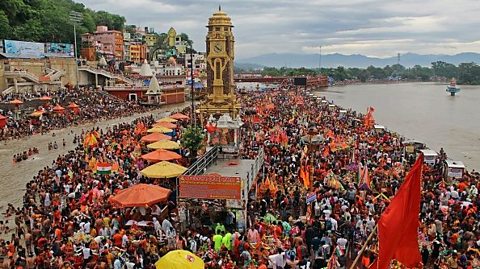
Hinduism teaches that the natural world is sacred because it reveals Brahman is the ultimate reality, the divine consciousness, one supreme spirit. Brahman is male, female and even animal., the supreme spiritual reality present within all things. The world is not separate from God but is infused with divine presence.
Many Hindus believe that different deities live within parts of the natural world. Rivers, mountains, and forests are often linked to particular gods and goddesses. The river Ganges in India, for example, is sacred to the goddess Ganga and is seen as purifying and life-giving.
In Hinduism the Earth is is also viewed as Prithvi Mata (Mother Earth). She provides everything needed for life and sustains all beings. Because she gives freely, Hindus believe she must be treated with gratitude and respect.
Hinduism teaches that all living beings contain In Hinduism, the immortal soul and inner self. a spark of Brahman. This means that harming the world also harms the divine presence within it. The value of the world lies not just in its usefulness to humans, but in its spiritual connection to God.
Many Hindus believe that caring for the Earth is a religious duty. By protecting nature and living sustainably, they believe they show respect for God’s creation and build good The intentions behind actions and what the consequences of actions are. The idea that all actions (no matter how big or small) have consequences that can cause happiness or suffering., helping them move closer to Release from the cycle of birth, life, death and rebirth..
Exam-style question
Explain two Hindu teachings about the value of the world.
Sample answer
One Hindu teaching is that the world should be cared for because it is seen as Prithvi Mata, Mother Earth, who provides for her children. This idea shows that humans have a duty to protect and respect the environment.
Another teaching is that all living things have a spark of Brahman. This means harming the environment damages the divine presence in creation.
Issues in the natural world
The environment
Hinduism teaches that caring for the environment is a sacred duty. Actions that damage nature, such as pollution, overconsumption, or waste, go against the principle of The Buddhist, Hindu and Sikh principle of total non-violence, in thoughts, words and actions. and harm the divine presence within all living things.
Because all life is connected through Brahman, harming the environment affects not only nature but also a person’s spiritual wellbeing. Many Hindus believe that by protecting the environment, people create good The intentions behind actions and what the consequences of actions are. The idea that all actions (no matter how big or small) have consequences that can cause happiness or suffering. and help maintain balance in the world. The deity Vishnu, known as the preserver, symbolises the need to sustain harmony and goodness in creation.
Modern Hindu leaders and organisations often take part in environmental campaigns. The Hindu declarations at Assisi (1986) and Ohito (1995) teach that all beings share the same divine spirit and that harming nature means harming the divine.
Global warming
Global warming is the dramatic increase in the Earth’s average surface temperature and is caused by greenhouse gases like carbon dioxide and methane being released into the atmosphere, known as emissions. Because all life is connected through Brahman, global warming is seen as harming both the environment, the animal kingdom, and humanity. Many Hindus therefore support actions that reduce emissions, limit waste and protect the Earth for future generations.
Animal rights
The principle of The Buddhist, Hindu and Sikh principle of total non-violence, in thoughts, words and actions. is a central belief in Hinduism, therefore individually many Hindus choose to follow a vegetarian diet.
The cycle of birth, death and rebirth. teaches Hindus that all living things are connected and share the same In Hinduism, the immortal soul and inner self.. Because of this, animals should be treated with the same care and respect as humans, which means avoiding things like animal testing.
“By not killing any living being, one becomes fit for salvation.”
The Manusmriti
Importance of animals in Hindu tradition
Many animals are revered in Hindu tradition:
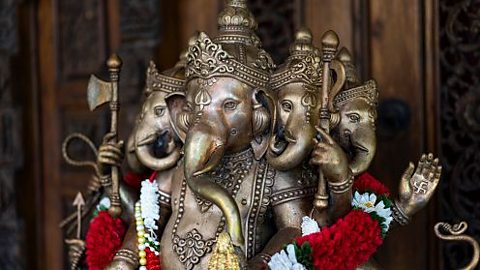
- Ganesha – elephant-headed deity, associated with wisdom and known as the remover of obstacles.
- Hanuman - monkey god symbolises devotion and courage.
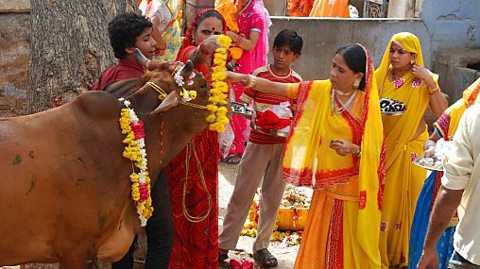
- Cows in particular are considered sacred and are seen to symbolise life, nourishment, and motherhood. Therefore most Hindus do not eat beef, and protecting cows may be seen as a religious duty.
These examples support the belief that animals hold spiritual importance in Hinduism.
The origins of human life
Hinduism teaches that all life contains In Hinduism, the immortal soul and inner self., a spark of Brahman is the ultimate reality, the divine consciousness, one supreme spirit. Brahman is male, female and even animal., so humans are not superior but part of the wider divine order.
The Meaning the cosmic person or spirit that brought the universe into being; a divine consciousness. Sukta, a hymn from the A collection of Sanskrit hymns dedicated to the ancient gods. describes the universe and human life as coming from the sacrifice of the cosmic being, Purusha. Different parts of his body became the social groups, showing that humanity is interconnected with the universe and rooted in the divine.
Many Hindus see Vishnu’s avatars, his ten different forms taken to protect the world, as reflecting stages of development in life. The sequence begins with a fish, then an amphibian, then animals, and finally humans.
In the 19th century, Charles Darwin proposed the Theory of Evolution, supported by evidence that is now widely accepted, including by many Hindus, as an explanation of how human life developed. Some interpret this as symbolic of evolution, making Hindu beliefs compatible with evolutionary theory about life developing in stages.
Some Hindus may accept scientific ideas like evolution, but believe that all life is connected through Brahman, the divine spirit.
Abortion
An abortion is a way of ending a pregnancy. Abortion is legal in the UK in specific circumstances which are set out in law.
Hinduism teaches that life begins at conception, and that all human life is sacred, therefore many Hindus disagree with abortion. From a Hindu perspective, abortion ends a life that contains the divine spirit and also stops a reincarnated soul from working through the bad The intentions behind actions and what the consequences of actions are. The idea that all actions (no matter how big or small) have consequences that can cause happiness or suffering. it carries from past lives.
In addition many Hindus argue that abortion breaks the sacred trust between mother and child. They believe it contradicts the Hindu principle of shelter, which teaches protection of the vulnerable.
Many Hindus strongly support the sanctity of life, believing that all human life is sacred because it contains atman, a spark of Brahman. This means abortion is often seen as morally wrong because it destroys a life that has spiritual value and interrupts the soul’s journey through samsara.
However, some Hindus also consider quality of life, especially in situations where the mother’s life is at serious risk or where extreme suffering is involved. In these cases, protecting the woman’s life through The Buddhist, Hindu and Sikh principle of total non-violence, in thoughts, words and actions. (non-violence) and acting according to Duty in life. (duty) may lead some Hindus to accept abortion as the most compassionate option.
Ethical approaches such as situation ethics stress that decisions should be made out of love and to minimise harm. For Hindus, this connects to dharma and acting according to one's duty.
Euthanasia
Euthanasia is the act of deliberately ending a person's life to relieve suffering. Euthanasia or assisted dying is currently illegal in the UK (March 2026).
Hindus see life as part of Brahman is the ultimate reality, the divine consciousness, one supreme spirit. Brahman is male, female and even animal. and the natural cycle of The cycle of birth, death and rebirth.. Euthanasia may be viewed as interfering with this cycle, preventing reincarnation, and going against the principle that all life is sacred.
Suffering is understood as part of The intentions behind actions and what the consequences of actions are. The idea that all actions (no matter how big or small) have consequences that can cause happiness or suffering., allowing the soul to learn and progress. Therefore, for many Hindus, ending suffering early through euthanasia may prevent spiritual growth and the completion of one’s karmic journey.
Some Hindus believe euthanasia contradicts The Buddhist, Hindu and Sikh principle of total non-violence, in thoughts, words and actions. because it involves actively ending a life. Hindu scriptures teach that the soul continues after death and how life ends affects future rebirths. Ending life unnaturally may disrupt this spiritual process.
Because all human life contains atman, a spark of Brahman, many Hindus believe life has sanctity and absolute value. This means euthanasia is often seen as morally wrong because it destroys a life that is spiritually sacred and interferes with the soul’s karma and journey towards moksha.
However, some Hindus believe ahimsa can also mean preventing suffering. In cases of extreme pain, euthanasia may be seen by some as a compassionate response, and viewed as peaceful spiritual renunciation rather than suicide.
Modern Hindu perspectives may draw on the idea of situation ethics, focusing on love, compassion, and minimising harm. This allows more flexible responses to complex situations such as euthanasia.
Life after death
Hinduism teaches that the In Hinduism, the immortal soul and inner self. is eternal and never dies. Death is seen as the shedding of the body, like discarding old clothes, before taking on a new form. The cycle of The cycle of birth, death and rebirth. is a central Hindu teaching, and escaping samsara through Release from the cycle of birth, life, death and rebirth. is the ultimate aim of existence for Hindus.
Most Hindus believe that reincarnation is guided by The intentions behind actions and what the consequences of actions are. The idea that all actions (no matter how big or small) have consequences that can cause happiness or suffering., which means a person's actions in this life affect how they are reborn in the future. Beliefs about death and rebirth shape many Hindus' behaviour in daily life. Many seek to act morally, perform duties, and pursue spiritual growth to improve their rebirth.
Sacred texts like the A 700 verse Scripture which is part of the Mahabharata, one of the Sanskrit epic poems from Ancient India. describe the soul’s eternal journey. Many Hindus therefore view life after death as a spiritual certainty, not just a comforting story.
Exam-style question
Explain two Hindu teachings about life after death. Refer to scripture or sacred texts in your answer.
One Hindu belief is that the soul is eternal and is reborn in a new body after death. This is taught in the Bhagavad Gita.
Another belief is that the goal of life is to break free from samsara and reach moksha. This is the soul’s final union with Brahman.
Test your knowledge on Hinduism
More on Hinduism
Find out more by working through a topic
- count2 of 3