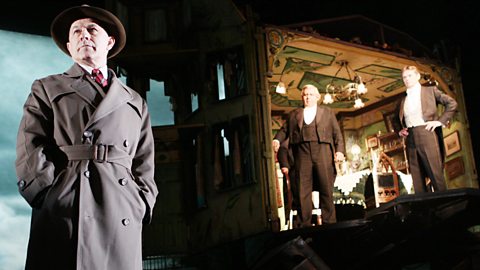
An Inspector Calls – Characters overview
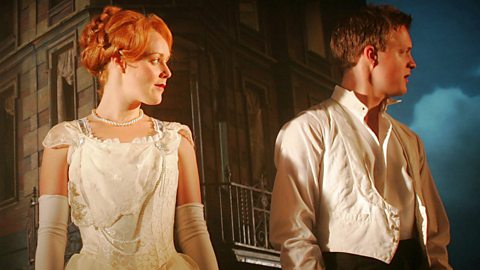
An Inspector Calls has six main characters. The Birling family are Arthur, Sybil, Eric and Sheila. Gerald Croft, Sheila's fiancé, joins the Birlings for dinner. Inspector Goole arrives to conduct his investigation.
This investigation focuses on the death of Eva Smith, who changes her name to Daisy Renton. She is significant, but we never actually meet her.
The Birlings' maid, Edna, may seem insignificant, but she serves as a reminder of the Birlings’ wealth and the presence of the lower classes. She also introduces the Inspector and provides insight into the life of Eva Smith since they come from a similar background.
A quick guide to the characters in An Inspector Calls, by JB Priestley
With An Inspector Calls, JB Priestley, the playwright, was very kind to GCSE students. He kept it simple and only used six main characters.
An Inspector Calls is set around a dinner to celebrate the engagement of Sheila, the daughter of the wealthy Birling family, to the even wealthier Gerald Croft.
Arthur Birling, the head of the family, is a wealthy man in his fifties. But he wasn't born into money. He had to earn it. As such, he's keen to blend in with his social superiors, such as Gerald Croft's family.
Arthur's proud that his daughter Sheila is marrying Gerald, not only because it'll make her happy, but also because it might help his social standing and his business interests.
Arthur is highly motivated by success and money. He explains to Eric and Gerald that a man should look out for number one and make his own way.
While the others feel guilty about Eva's suicide, Arthur thinks only of himself. He's not concerned with Eva's welfare. Instead, he worries about damaging his chances of a knighthood.
He's a proud, ambitious, but ultimately selfish man.
Sybil Birling is Arthur's wife. She's a cold, snobbish woman who looks down on other people.
Sybil is patronising to her grown-up children, Sheila and Eric, disrespectful to the Inspector, and couldn't care less about the death of a working-class girl called Eva.
Sybil turns a blind eye to a lot of the Birling family's problems, including Eric's drinking, Gerald's affair, and Eric's relationship with Eva.
Even though she refused to give Eva any charity money, she still feels no remorse.
Sheila Birling is a much nicer person than her parents.
While they take no responsibility for the fate of Eva, Sheila feels guilty. Instead of seeing Eva as just a working-class girl, she sees her as a fellow human being.
Sheila is also very perceptive. It's Sheila who spots Gerald's guilt when he's questioned. She also guesses that Eric is involved and becomes suspicious of the Inspector's identity quite early on.
She's compassionate, perceptive and conscientious.
Eric Birling, the son of the family, is a mixed-up young man. On the one hand, he's shy and awkward, but on the other, he can be quite aggressive.
He behaves that way because he's a heavy drinker. As the play goes on, his parents gradually realise he has a serious drink problem.
Yet Eric isn't a bad person. Like his sister, he has a social conscience, and even though he treated Eva badly, he ultimately tries to help her, albeit by stealing money from his father.
Eric is confused, guilty and frustrated, but also has a strong sense of responsibility.
Gerald Croft is a good-looking aristocrat. His marriage to Sheila will help her parents' social standing.
Gerald is a difficult character to make out. He's not as callous as Mr and Mrs Birling are about Eva's suicide, but neither is he as ashamed as Sheila and Eric.
Rather than wrestling with the ethics of his actions, he tries to undermine and challenge the Inspector because he thinks this will get him off the hook.
However, it doesn't get him off the hook with Sheila. She's not impressed by his lack of social responsibility.
Inspector Goole is an enigma.
Who is he? How does he know so much about the family? Is he really an inspector? Is he a fake? We may never know.
He works very methodically, opening up the characters with his disconcerting stare. He also seems to know an extraordinarily large amount of information.
To add to the mystery, it seems he knew about Eva's suicide before it actually happened.
Is he a ghost? Is he the voice of our consciences? Is he the voice of God?
The play never gives a definitive answer, leaving the audience to decide for themselves.
Listen to a podcast about the characters of Inspector Goole, Mr Birling and Mrs Birling in JB Priestley's play, An Inspector Calls
Carl: Hello, and welcome to the BBC Bitesize English literature podcast.
Jean: We're here today to help you dive a little deeper into some of the texts in GCSE English literature. Don't forget that whilst you're in the BBC Sounds app, there's loads of other things you can use to help your with revision. It's important to let you know that in this podcast, there will be discussions of suicide and sexual abuse.
Carl: In this series, we're going all the way back to 1912 and into a fictional town in the Midlands called Brumley. To explore JB Priestley's play An Inspector Calls.
Jean: I’m Jean Menzies, author and ancient historian.
Carl: and I'm Carl Anka, an author and journalist, and in this episode, we are going to take a look at the first set of characters in An Inspector Calls. Today we're going to talk about Inspector Goole. Mr Birling, and Mrs Birling.
Jean: We're introduced to the inspector just a few pages into the play. When he walks into the living room in the middle of the Birling's family dinner.
Carl: We get a really clear description of him through the stage directions:
Extract:
The inspector need not be a big man but he creates at once an impression of massiveness, solidity and purposefulness. He speaks carefully, weightily, and has a disconcerting habit of looking hard at the person he addresses before actually speaking.
Jean: The inspector investigates the family's role in the death of Eva Smith by questioning them one at a time. And by doing that he reveals the domino effect that sent Eva's life into a downward spiral.
Extract:
Inspector: This girl died a horrible death, but each of you helped to kill her. And don't ever forget that, but then I don't think you ever will.
Carl: We also learn a lot about the inspector through Priestley’s stage directions, specifically the way the inspector speaks and interacts with the other characters. The inspector is cutting through massively.
There's also a bit where the inspector is talking coolly, looking hard at him. He is also described as talking gravely and also talking dryly. There's also a lot of things happening impressively, harshly, sharply and very sternly.
Jean: The inspector interrupts a character when they're speaking and doesn't show any deference or submission to Mr and Mrs Birling, and unlike their parents who treat them like children, the inspector treats Sheila and Eric like adults.
Carl: the inspector drives the drama forward getting the characters to reveal a shocking truth with each question. He acts as the moral voice of the play, getting the audience to empathise with each other.
Jean: We'll talk about this more in episode four and seven, but the inspector is a mouthpiece for JB Priestley's own views on this too.
Extract:
Inspector: A girl died tonight. A pretty, lively sort of girl, who never did anybody any harm. But she died in misery and agony – hating life.
Jean: By the end of the play, it's revealed the inspector isn't actually a local inspector, but it's not revealed who he really is. Priestley leaves it up to the audience to imagine who he could be
Carl: His name, Goole (ghoul) suggests something supernatural. It's suspicious that he seems to know what the characters are going to say before they say it.
Jean: So the inspector could be a ghost, the conscience of the audience or something else. But it doesn't really matter. What matters is what the characters did to Eva. That's actually a really big point going into exams. It's so easy to get hung up on who the inspector really was. But actually, we want to look at how Priestley uses these characters to present ideas.
Carl: The inspector also delivers a pretty ominous message before he leaves just before the end of the play, too.
Extract:
Inspector: We don't live alone. We are members of one body. We are responsible for each other. And I tell you that the time will soon come when, if men will not learn that lesson, then they well be taught it in fire and bloody and anguish. Good night.
Carl: The inspector delivers an ominous message to all before he leaves where he references the hell that awaits men who do not learn a lesson.
Jean: Let's move on to the next two characters Mr and Mrs Birling.
Carl: One thing you notice reading the play is the clear differences in attitudes and values between the Birling parents and the Birling children.
Jean: Mr and Mrs Birling represent the older generation’s old fashioned values. Let's start with Mr Birling. We get our first introduction to him in the stage directions
Extract:
Arthur Birling is a heavy-looking, rather portentous man in this middle fifties with fairly easy manners but rather provincial in this speech
Carl: So, he's a serious man. But Priestley describes him as provincial in his speech, which is his way of seeing that Mr Birling comes from a lower class background, and we also learn a lot about him through the way he speaks and acts.
Carl: He speaks explosively or angrily, lines are delivered sharply or even very sharply. He's very often furious. Mr Birling is the arrogant head of the Birling household who made himself and his family wealthy by owning a factory, and he tells the younger generation that it is a man's job to look out for number one, and not to waste time trying to help other people.
Extract:
Birling: Take my word for it. And I've learned in the good Harvard School of experience. A man has to mind his own business and look after himself and his own.
Jean: He didn't grow up wealthy, like his wife or Gerald. And during quite a few moments in the play, he comes across as insecure and self-conscious about this.
Extract:
Birling: I have an idea your mother feels you might have done better for yourself socially.
Jean: So Mr Birling has decided to become an active member of the Brumley community, which is all in order to boost his own social status, rather than from a genuine desire to help his community.
Extract:
Birling: I thought you must be. I was an alderman for years – and lord mayor two years ago – and I’m still on the bench – so I know the Brumley police offices pretty well – and I thought I’d never seen you before.
Jean: He thinks that he might be in the running to receive a knighthood.
Extract:
Birling: there's a fair chance that I might find my way into the next honours list. Just a knighthood, of course.
Carl: When the inspector arrives, he reveals that Mr Birling knew Eva Smith because she once worked at his factory, but then she went on strike.
Extract:
Birling: They wanted the rates raised so that they could average about twenty-five shillings a week. I refused, of course.
Inspector: Why?
Birling:(surprised) Did you say 'why?'?
Inspector: Yes. Why did you refuse?
Birling: Well, inspector I don't see that it's any concern of yours how I choose to run my business.
Jean: From Mr Birling's point of view, he didn't need to pay Eva and the other workers a better wage, so he sacked them for talking too much. What he actually means there is that she had opinions about worker’s wages and wouldn't just be quiet like he wanted her to be.
Carl: And he doesn't take any responsibility for ruining her life. In fact, when the questioning is done, Mr Birling is more worried about the damage that the investigation could do to his reputation than he is about the girl who just died.
Extract:
Birling: Nothing much has happened! Haven't I already said there'll be a public scandal – unless we're lucky – and who here will suffer from that more than I will?
Carl: And then when the play ends, Mr Birling is shaken up and shocked by son's behaviour when the inspector leaves. It's clear he didn't really learn anything.
Jean: When he finds out that the inspector might have been an imposter, he's overjoyed and mocks everyone else for having been tricked by the investigation.
Carl: He's happier that he's reputation isn't going to be ruined than he is that Eva Smith might still be alive, which tells us a lot about his character. He's selfish, he's arrogant, he's unremorseful.
Carl: Let's move on to the next character. Mrs Sybil Birling. Mrs Birling is about 50, rather a cold woman and her husband's social superior. We find out more about her through the way she speaks and acts. She speaks grandly, bitterly, with sudden anger and she also is alarmed and speaks severely. Mrs Birling is Mr Birling’s wife and Sheila and Eric’s mum. She has pretty traditional ideas when it comes to gender and how to be a good wife. Ideas that she tries to pass on to her newly engaged daughter Sheila.
Extract:
Mrs Birling: When you're married, you will realise that men with important work sometimes need to spend all their time and energy on their business. You will have to get used to that just as I had.
Jean: Mrs Birling treats Sheila and Eric like children, even though they're adults. She doesn't see Eric's poor behaviour and unlike the rest of the family refuses to admit or see that he has a dependency on alcohol.
Extract:
Inspector:(cutting in) isn't he used to drinking?
Mrs Birling: No, of course not. He's only a boy.
Inspector: No, he's a young man. And some young men drink far too much.
Carl: Like her husband, Mrs Birling cares more about how things look to other people than how things actually are. Throughout dinner, she tells Sheila and Eric off for things that she considers impolite while turning a blind eye to Eric's drinking.
Jean: And despite being a key member of the local women's charity, Mrs Birling is quite prejudiced and cold-hearted.
Carl: The inspector reveals that Mrs Birling used her influence to stop Eva from getting the help that she needed. This is all because Eva didn't act in a way that Mrs Birling expected from a lower class woman who needed help.
Jean: But despite being the person who refused to help Eva Smith when she needed the charity’s help more than ever, like her husband, Mrs Birling doesn't accept any responsibility for her part in Eva Smith's death.
Carl: She doesn't appear to have learned anything or changed her mind when the play ends.
Extract:
Mrs Birling: You're quite wrong to suppose I shall regret what I did to her.
Jean: Her cold, uncaring actions are what leads to Mrs Birling's downfall. She unknowingly condemned her own son in one of the most dramatic scenes of the play. When she says that the baby's father should be the one to take responsibility for Eva.
Extract:
Inspector:(grimly) Don't worry Mrs Birling. I shall do my duty. (He looks at his watch.)
Mrs Birling:(triumphantly) I'm glad to hear it.
Inspector: No hushing up, eh? Make an example of the young man, eh? Public confession of responsibility – um?
Mrs Birling: Certainly. I consider it your duty. And now no doubt you'd like to say good night.
Inspector: Not yet. I'm waiting.
Mrs Birling: Waiting for what?
Inspector: To do my duty.
Sheila:(distressed) Now, mother – don't you see?
Mrs Birling:(understanding now) But surely …. I mean … it's ridiculous . . .
Birling:(terrified now) Look Inspector, you're not trying to tell us that – that my boy – is mixed up in this - ?
Inspector:(sternly) If he is, then we know what to do, don't we? Mrs Birling has just told us.
Birling:(thunderstruck) my God! But – look here –
Mrs Birling:(agitated) I don't believe it. I won't believe it . . .
Sheila: Mother – I begged you and begged you to stop-
Jean: We'll find out more about him, his sister Sheila and his soon-to-be-brother in law, Gerald in the next episode.
Carl: We’ve still got a lot to discuss. So have a listen to the other episodes to find out more.
Thanks for listening to this episode of the Bitesize English literature podcast.
Listen to a podcast about the characters of Sheila, Eric and Gerald in JB Priestley's play, An Inspector Calls
Carl: Hello, and welcome to the BBC Bitesize English literature podcast.
Jean: We're here today to help you dive a little deeper into some of the texts in GCSE English literature. Don't forget that whilst you're in the BBC Sounds app, there's loads of other things you can use to help you with revision. It's important to let you know that in this podcast, there will be discussions of suicide and sexual abuse.
Carl: In this series, we're going all the way back to 1912 and into a fictional town in the Midlands called Brumley to explore JB Priestley's play An Inspector Calls.
Jean: I’m Jean Menzies, author and ancient historian.
Carl: and I'm Carl Anka, an author and journalist, and in this episode, we're going to take a look at the second set of characters in An Inspector Calls and get to know Sheila, Eric, and Gerald.
In the last episode we talked about Inspector Goole who acts as the play’s moral conscience, we talked about Mr And Mrs Birling, parents of the family who live by more old fashioned 19th century values. But in this episode, we're going to be looking at the younger generation of characters. So let's get back to the dinner party.
Jean: When the play begins, the family is celebrating Sheila and Gerald's engagement. Let's start with Gerald since he's the only one who isn't a Birling. We get our first introduction to Gerald through the stage directions:
Carl: Gerald Croft is an attractive chap about 30 years of age, but very much of the easy well-bred young man about town.
Jean: The Birlings are pretty pleased about Sheila and Gerald's engagement. Gerald comes from a family of upper class business owners and Mr Birling hopes their families can join forces in business
Carl: and that by marrying Sheila, Gerald will improve the Birling’s social status.
Extract:
Birling: Your father and I have been friendly rivals in business for some time now – though crofts limited are both older and bigger than Birling and company – and now you've brought us together, and perhaps we may look forward to the time when Crofts and Birlings are no longer competing but are working together – for lower costs and higher prices.
Gerald: Hear, hear! And I think my father would agree to that.
Mrs Birling: Now, Arthur, I don't think you ought to talk business on an occasion like this.
Jean: At the beginning of the play, Gerald is confident and charming, but this quickly changes when the inspector reveals that he had an affair with Eva Smith when she was going by the name Daisy Renton.
Carl: First, Gerald is evasive and tries not to talk too much about it. But then he realises that Sheila already suspected they had an affair. So Gerald opens up and reveals that he knew Eva/ Daisy.
Jean: But she was not happy with him.
Extract:
Sheila: Well, Gerald. Were you in love with her?
Gerald: It's hard to say. I didn't feel about her how she felt about me.
Sheila: Of course not. You were the wonderful fairy-tale prince. You must have adored it.
Gerald: All right, I did for a time.
Jean: You don't really get to be a knight in shining armour if you end up having an affair and cheating on your girlfriend.
Carl: Not at all, but unlike the Birlings, Gerald did make Eva/ Daisy happy. She adored him. And he gave her a safe place to stay when they were having their affair. But then he ended it. Eva was left heartbroken.
Jean: There's such a problematic power dynamic in this relationship. Eva/ Daisy is totally dependent on Gerald for money and shelter. So the play does hint at the ways that society is unfair to women. This kind of relationship is not healthy.
Gerald: She told me she'd been happier than ever before, but that she knew it couldn't last - hadn't expected it to last. She didn't blame me at all. I wish to God she had now. Perhaps I’d feel better about it.
Jean: Now Sheila gives him back her engagement ring after she hears the truth. And at the end of the play, when the family finds out that Inspector Goole isn't who he said he was, Gerald tries to give Sheila her ring back, which really shows he hasn't changed.
Extract:
Gerald: Everything's all right now. So what about this ring?
Sheila: No, Gerald, not yet. It's too soon. I must think.
Jean: now, it takes a lot for a party to start with someone trying on their engagement ring and then for it to end with them calling off the engagement.
Carl: Yep. And that's because Sheila goes through a real transformation. Let's rewind to the start of the play.
Extract:
Sheila:(excited) Oh – Gerald – you’ve got it – is it the one you wanted me to have?\
Gerald:(giving the case to her) Yes – the very one.\
Sheila:(taking out the ring) Oh – it's wonderful! Look – mummy – isn't it a beauty? Oh – darling - (she kisses Gerald hastily.)
Jean: Sheila is a privileged and naive young lady whose parents treat her like a child. She's introduced to us through the stage directions:
Extract:
Sheila is a pretty girl in her early 20s, Very pleased with life and rather excited
Jean: In the first half of the play, she speaks gaily, half serious, half playful. But by the end of the play, she speaks severely and passionately.
Jean: So when the inspector first arrives, she's shocked by the news of Eva Smith's death and feels really bad. She has an emotional response, which really highlights the difference between her and her mother.
Extract:
Sheila: Sorry, it's just I can't help thinking about this girl destroying herself so horribly. And I've been so happy tonight.
Carl: But when the inspector starts to question Sheila, she almost immediately knows what part she played in Eva's death. She looked at a dress in a shop and she didn't think it looked good enough. But then she caught a glimpse of Eva Smith holding the dress up to her body, it looked so good with Eva that it instantly brought Sheila's insecurities out.
Extract:
Sheila: It just didn't suit me at all. I looked silly. I went to the manager of Milwards. And I told him that if he didn't get rid of that girl, I would persuade mother to close our account with them.
Carl: using your influence to punish someone just because you can. I wonder when she picked her up from…
Jean: The apple does not fall very far from the tree in this case. But unlike her mother, Sheila immediately feels guilty for her actions and takes responsibility for the negative effect they had on Eva's life.
Extract:
Sheila: I felt rotten about it at the time. And now I feel a lot worse.
Carl: As the play goes on, Sheila matures and shows her assertive side by standing up to her mother and her father. She also refutes their belief about working class people. This really speaks to a growing sense of social responsibility.
Extract:
Sheila: These girls aren't cheap labour. They're people.
Jean: She shows us that she's insightful and intelligent. She can see where the inspector's investigation is going and tries to warn her family not to deny the role they played in Eva Smith's death.
Carl: Indeed, by the end of the play, Sheila has matured and has realised that her actions can and did have grave consequences. She knows that the story of Eva Smith has changed the way that she sees the world.
Jean: And unlike her parents, Sheila isn't the same person at the end of the play. She matures from a girl to a woman. She ends her engagement with Gerald and shows genuine remorse.
Extract
Sheila: Everything we said had happened really had happened. If it didn't end tragically then that's lucky for us. But it might have done.
Jean: Unlike her parents, she will actually learn something from the inspector and so does her brother Eric.
Carl: When the play starts we’re introduced to Eric, the Birling's son. He's a man but his parents still treat him as a boy.
Jean: Eric is in his early 20s. Not quite at ease, half shy, half assertive.
Carl: And you can see that boyishness in the way that the stage directions describe the way he speaks and acts
Jean: Rather noisily, uneasily, defiantly, miserably and sulkily
Carl: When the dinner party starts you can tell that Eric isn't very confident. And at one point, he tries to stand up to his father, but his father talks down to him.
Jean: It becomes pretty clear that Eric is drunk at the dinner table and later it’s revealed that he's been drinking too much for quite some time. But his mother thinks that Eric is just her perfect baby boy.
Carl: Mrs Birling is completely oblivious to who her son really is. Until she finds out that Eric aggressively pushed Eva Smith into sleeping with him when he was drunk. And then Eva Smith became pregnant. We have to pause here and call out what that behaviour really is, because it really isn't acceptable.
Jean: Although the words aren't used in the play themselves, we know as an audience that what Eric has done is sexual assault.
Extract:
Eric: Yes, I insisted – it seems. I'm not very clear about it, but afterwards she told me she didn't want me to go in but that – well, I was in that state when a chap easily turns nasty – and I threatened to make a row.
Jean: After getting her pregnant, Eric tried to take some responsibility for Eva and the unborn child. But instead of earning his own money, he stole it from his father's business so Eva refused to take it.
Carl: At the end of the play, Eric takes responsibility and stands up to his parents and gets angry at his mum for not helping Eva when she went to the women's charity.
Extract:
Eric:(almost threatening her) You don't understand anything. You never did. You never even tried – you.
Jean: Although he's still not my favourite character, Eric shows that he can be assertive when he's expected to actually act like an adult. The inspector’s questioning forces Eric to take responsibility for his actions. And by the end of the play, we as an audience no longer see him as the childish boy, his parents treat him as but as the grown man who has done something terrible that the inspector highlights him as.
Extract:
Eric: I stole some money. But the money is not the important thing. It's what happened to the girl. And what we all did to her that matters.
Whoever that chap was, the fact remains that I did what I did. And mother did what she did. And the rest of you did what you did to her. It's still the same rotten story.
Carl: The inspector has had a real effect on both Sheila Birling and Eric Birling. Their parents treat them like children, but the inspector treats them like adults and gets them to take responsibility for their actions.
Jean: By the end of the play, the audience has hope that the younger Birlings have learned some kind of lesson, that they'll leave the dinner party less likely to take advantage of their power and influence and more likely to take responsibility for their actions.
Carl: As Sheila said, they're not the same people sat down for dinner at the start of the evening.
Jean: No, they're not and in the next episode of the podcast, we're going to be talking about the key themes in An Inspector Calls.
Carl: We have a lot more to discuss. Listen to the other episodes to find out more.
Jean: Thanks for listening to this episode of the Bitesize English literature podcast.
You can listen to the whole Bitesize GCSE English Literature podcast series about An Inspector Calls on BBC Sounds.
Mr Arthur Birling

Mr Birling is the head of the Birling household. He has made himself very wealthy by being a 'hard-headed' business man. He is an active member of the community in Brumley and thinks that he might be in the running for a Knighthood.
At the start of the play he comes across as being arrogant, making long speeches about his predictions for the future. He also makes assertions about how a man should look out for number one and not waste time helping others. It is at this exact moment that the Inspector arrives.
Sybil, his wife, is his 'social superior' and it is hinted that he is self-conscious about being from a more working-class background. He is materialistic and possessive and also has old fashioned views about women.
Mr Birling is shaken by the investigation and is shocked by the behaviour of his son Eric. However, he doesn’t learn any lessons during the course of the play. When it seems that the Inspector might have been an imposter he is overjoyed and mocks the others for having been 'tricked' by the investigation.
Mr Birling:
"…the way that some of these cranks talk and write now, you'd think everybody has to look after everybody else as if it were all mixed up together like bees in a hive - community and all that nonsense."
Mr Birling:
"…a man has to mind his own business and look after himself and his own and -"
At the beginning of An Inspector Calls, author J.B. Priestley has Mr Arthur Birling deliver this speech. In it, he uses dismissive language, referring to community as "nonsense" and being "like bees in a hive" to express his capitalist views, which revolve around business and individual interests. He is interrupted by the Inspector, who calls those beliefs into question.
Mr Birling, a wealthy, self-described "hard-headed businessman", is shown as arrogant from the start of the play.
Mr Birling:
"…there isn't a chance of war. The world's developing so fast that it'll make war impossible."
The author uses dramatic irony here. This is when the audience knows something that a character does not. Priestley uses it to discredit Mr Birling. The play is set in 1912, two years before the outbreak of the First World War.
Despite all the flaws and scandals that the Inspector uncovers about the Birling family, Arthur's outlook does not change.
When Inspector Goole reports that one of Mr Birling's workers, Eva, has taken her own life, it is revealed that Birling had fired her after she led a strike asking for higher pay. This clash represents one of the play's key themes: capitalism versus socialism.
Mr Birling remains unremorseful, believing that it was:
Mr Birling:
"my duty to keep labour costs down"
He claims that he cannot accept any responsibility for Eva's death. Instead, he is more concerned with his own reputation, repeating four times his fear of a "public scandal". Ironically, that scandal becomes a reality at the end of the play when the real inspector calls.
The play was first performed in 1945, the same year that the Labour Party won a landslide general election victory that would lead to the formation of the National Health Service. Britain was on the brink of major social and political change.
In this context, what comment do you think Priestley might have been making through Mr Birling, a character who boldly claims that:
Mr Birling:"a man has to mind his own business and look after himself"?
| How is Mr Birling like this? | Evidence | Analysis |
|---|---|---|
| Arrogant | ||
| He makes long speeches at dinner about things that the audience would know were incorrect. For example, he claims war will never happen and that the Titanic is unsinkable. | "And I'm talking as a hard-headed, practical man of business. And I say there isn’t a chance of war. The world's developing so fast that it'll make war impossible." | Mr Birling is confident that there will not be a war, saying that 'there isn't a chance of war' and then repeating this idea when he considers it "impossible". His arrogance and complacency are made very clear. The audience, knowing that just two years after this speech, World War One will begin, see that Mr Birling is wrong on this point, and on many others, including his prediction that the Titanic is 'unsinkable'. The audience lose trust in him as a character. |
| Patronising views about women | ||
| Mr Birling makes some old-fashioned and patronising points about women and how they view clothes and appearance. | "…clothes mean something quite different to a woman. Not just something to wear - and not only something to make 'em look prettier.'" | He shows that he is quite sexist by suggesting that clothes are somehow more important to women than to men. The fact that he thinks clothes "make 'em look prettier" shows he objectifies women too. |
| Capitalist | ||
| Mr Birling is a businessman whose main concern is making money. This is what is most important to him and he comes across as being greedy. | "…we may look forward to the time when Crofts and Birlings are no longer competing but are working together - for lower costs and higher prices." | It is clear here that Mr Birling is driven by money, he is a capitalist. The fact that he sees his daughter's engagement as a chance to push for "lower costs and higher prices" shows just how greedy he is. He does not consider the impact "higher prices" might have on anyone else, he just wants more money. |
| Possessive | ||
| On a number of occasions Mr Birling refers to things and people as being 'his'. | "Is there any reason why my wife should answer questions from you, Inspector?" | He emphasises that Sybil is 'his' wife suggesting that he sees her as a possession. He does not allow Sybil to talk for herself here. |
Mrs Sybil Birling
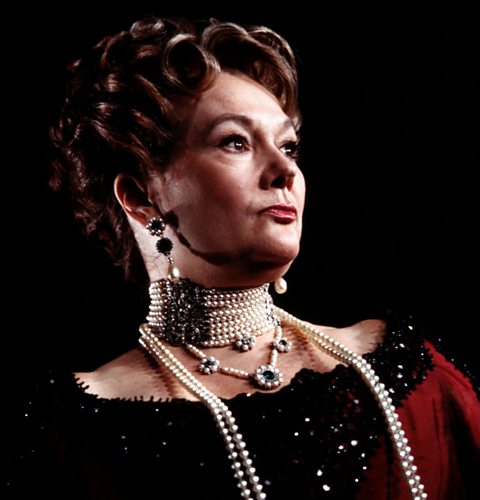
Mrs Sybil Birling is Arthur Birling's wife and right from the opening of the play she is cold-hearted and snobbish despite being a prominent member of local women's charity.
Throughout dinner she tells Sheila and Eric off for things that she considers impolite whilst ignorantly turning a blind eye to her son drinking too much. It is clear that, despite Eric being old enough to drink and Sheila getting married, she sees them both as children, not as a young man and woman.
Her cold, uncaring nature leads to her downfall as the Inspector forces her to unknowingly condemn her own son.
| How is Mrs Birling like this? | Evidence | Analysis |
|---|---|---|
| Cold | ||
| Mrs Birling is very unsympathetic when describing Eva Smith's position. Sybil assumes instantly that because Eva is pregnant and single she is a bad person. | "She was claiming elaborate fine feelings and scruples that were simply absurd in a girl in her position." | She assumes that just because Eva is unmarried and pregnant that she is unable to have "fine feelings", a very cruel and cold opinion to have. |
| Ignorant | ||
| When the Inspector suggests that Eric is used to drinking, Mrs Birling jumps quickly to Eric's defence. | "No, of course not. He's only a boy." And later "(staggered) it isn’t true." | She shows her ignorance in two ways, first by defending Eric "of course not" when the Inspector suggests that he is used to drinking. Secondly by stating that Eric is only "a boy". He is not a boy but a young man, Sybil refuses to see this. Her shock at this revelation "(staggered)" is further evidence of this. |
| Snobbish | ||
| Sybil shows that she is snobbish when she criticises members of her family for their behaviour. | "What an expression, Sheila! Really, the things you girls pick up these days!" | Sybil shouts at Sheila for using the word 'squiffy' - meaning drunk. Sybil has snobbish opinions that people should speak and behave 'properly', not doing so would make her look down upon them. |
Sheila Birling
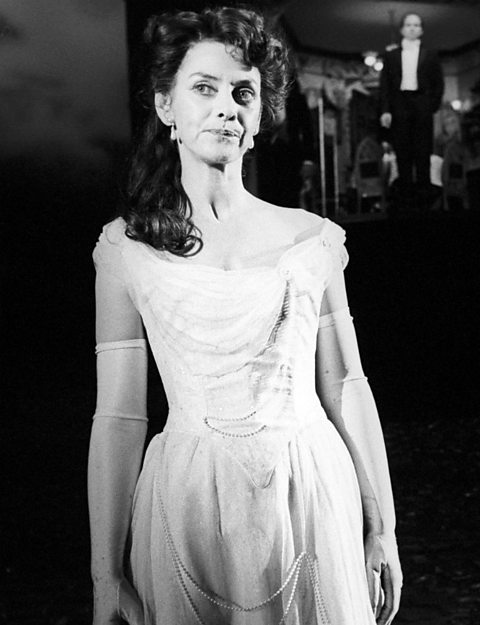
Sheila Birling is Arthur and Sybil's daughter and is in her early twenties. At the start of the play she is celebrating her engagement to Gerald Croft and she is a giddy, Innocent or lacking experience. and childish young lady.
The Inspector arrives and she is very shocked by the news of Eva Smith's death, she is also very regretful of her own involvement in the suicide.
As the play continues, she matures, admiring Gerald's honesty, even though he cheated on her. She shows an assertive side by standing up to her mother and father and she also shows that she is insightful and intelligent – she can see where the Inspector's investigation is going and tries to warn the others.
By the end of the play she has grown up and has realised that her actions can have grave consequences.
| How is Sheila Birling like this? | Evidence | Analysis |
|---|---|---|
| Naïve | ||
| At the opening of the play she appears to be a little immature and easily led. Her behaviour is childish and she very much does what her parents tell her. | "I'm sorry Daddy actually I was listening." | Sheila shows her naivety and lack of maturity in the way she reacts to her father. She is quick to apologise, it is clear that she is keen to behave well. She also refers to her father as "Daddy", a childish term. |
| Assertive | ||
| As the play progresses, Sheila’s character develops and she begins to stand up for herself. | "I tell you - whoever that inspector was, it was anything but a joke." | The change in Sheila here is clear. She has become more assertive, using phrases such as "I tell you". The events of the evening have made her aware of the serious impact one's actions can have. |
| Insightful | ||
| At a number of points, Sheila shows that she can see things that the other characters cannot. | "Yes, of course it is. That's what I meant when I talked about building up a wall that's sure to be knocked flat. It makes it all harder to bear." | Sheila uses the A metaphor is a word or a phrase used for dramatic effect, to describe something as if it were something else. of a wall that the Inspector will knock down to show her insightful understanding of his methods. She knows that if they try to keep anything from him, it will make things worse. The other characters don’t realise this as quickly as Sheila does. |
Eric Birling

Eric is the Birlings' son and is in his early twenties.
He is described as being "not quite at ease, half shy, half assertive". In other words, he lacks confidence. At points he tries to stand up to his father but is talked down. It becomes clear that he is drunk at the dinner table and later it is revealed that he has been drinking too much for quite some time.
It turns out that Eric had an affair with Eva Smith and that she was pregnant with Eric's baby when she took her own life. Eric stole money from his father's business to help Eva.
In the final act Eric makes an emotional attack on his parents and their values and shows that he can be assertive.
| How is Eric Birling like this? | Evidence | Analysis |
|---|---|---|
| Lacking confidence | ||
| At the start of the play Eric is very unsure of himself. He tries to speak up but is often talked down by his father. His behaviour is awkward and stilted. | "I don't know - really. Suddenly I felt I just had to laugh." | The stage directions describe Eric as being "half shy, half assertive" and this comes across in his dialogue. He is awkward and unsure of himself. Here he cannot explain his sudden laughter. |
| Assertive | ||
| Like Sheila he can be assertive as well. Even early on in the play he tries to stand up to his father. | "No, I mean about this girl - Eva Smith. Why shouldn't they try for higher wages? We try for the highest possible prices. And I don't see why she should have been sacked just because she'd a bit more spirit than the others." | At the start of the play, Eric shows that he can be assertive. Here he questions his father's decision to sack Eva Smith. He backs up his point with a well-reasoned argument. His father quickly shouts him down though. |
| Emotional | ||
| Eric’s experience with the Inspector causes him great emotional turmoil, unlike some of the other characters. | "(bursting out) What's the use of talking about behaving sensibly. You're beginning to pretend now that nothing's really happened at all. And I can't see it like that. This girl's still dead, isn't she? Nobody's brought her to life, have they?" | Eric suddenly shows how he has been affected emotionally by Eva's death. He asks the stark question "This girl's still dead, isn't she?" He is clearly distressed and understands the gravity of the situation, he can’t understand why the others don’t. |
Gerald Croft

Gerald is described as "an attractive chap about thirty, rather too manly to be a dandy but very much the easy well-bred young man-about-town".
Mr Birling is very pleased that Gerald is getting engaged to Sheila because his family are upper-class business owners, Mr Birling hopes they can join forces in business.
At the beginning of the play, Gerald comes across as being confident and charming. This changes after his affair with Eva Smith is revealed. Gerald gives himself away when he hears that Eva changed her name to Daisy Renton. He initially is evasive and tries not to talk too much about it, but redeems himself in the eyes of the audience by being more open and honest about it as he talks to Sheila.
He lets himself down in the final act by trying to get the family out of trouble. He doesn't seem to have learned from his mistakes.
| How is Gerald Croft like this? | Evidence | Analysis |
|---|---|---|
| Confident | ||
| At the start of the play he seems very comfortable – making himself at home and behaving like a member of the Birling family he even makes fun of Eric. | "Sure to be, unless Eric’s been up to something." | Mr Birling suggests that he is in line for a knighthood so long as the family have behaved themselves. Gerald confidently makes a joke at Eric's expense which is full of irony. |
| Evasive | ||
| At first, when the truth comes out about his affair with Eva Smith he tries to avoid the subject. | "All right. I knew her. Let’s leave it at that." | This abrupt line of dialogue shows how initially Gerald is very evasive about his involvement with Eva Smith and wants to close down the topic as soon as possible. |
| Honest | ||
| Eventually Gerald gains some respect from Sheila and the audience for being honest about his affair. | "The girl saw me looking at her and then gave me a glance that was nothing less than a cry for help." | Gerald honestly tells the story of how he met Eva. He was in the wrong to have an affair and then abandon Eva but, his use of emotive language "cry for help" makes us realise that he genuinely felt sorry for her and wanted to help her. |
Inspector Goole
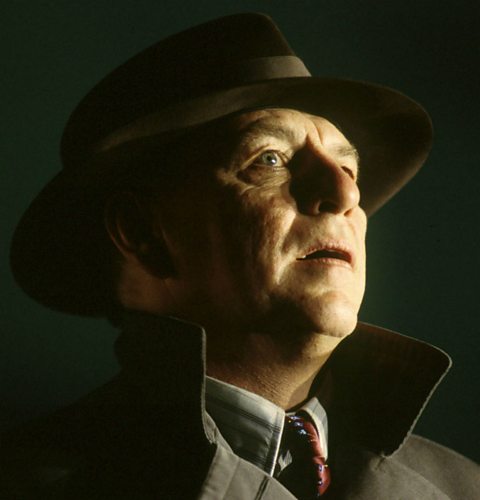
The Inspector arrives whilst the Birling family are celebrating the engagement of Sheila and Gerald. The stage directions state that he "need not be a big man" but that he must create an "impression of massiveness, solidity and purposefulness".
The Inspector investigates each family member one at a time and in doing so, reveals the consequences of their behaviour. He drives forward the drama, with his questions creating shocking moments and gripping cliff-hangers for the audience.
By the end of the play it is revealed that he isn’t actually an Inspector. It is not entirely clear who he is, Priestley leaves it up to the audience to decide. His name, 'Goole', suggests a supernatural or ghost-like element, and he seems to know what the characters will say before they do – is he the conscience of the audience? Is he the voice of Priestley?
Either way he delivers a frightening message when he leaves – that, if people do not take responsibility for each other, the world is doomed.
Inspector Goole
Inspector Goole:"Stop!"
Narrator:"They are suddenly quiet, staring at him."
Inspector Goole:"Be quiet for a moment and listen to me."
"This girl killed herself – and died a horrible death."
"But each of you helped to kill her. Remember that. Never forget it."
When Inspector Goole interrupts an argument between the Birlings in Act 3, his use of blunt, commanding language demonstrates his narrative role. He forces the other characters to confront the consequences of their actions and accept a sense of social responsibility.
From the moment the imposing Goole appears in An Inspector Calls, his "impression of massiveness, solidity and purposefulness" is established through Priestley's stage directions.
After announcing the death of Eva Smith, a young factory worker employed by the Birlings, he questions each family member about their relationship with her. Throughout these exchanges, Priestley gives Goole short, sharp sentences that are often declarative and frequently political.
When Goole says:
Inspector Goole:"We don't live alone. We are members of one body. We are responsible for each other."
his message reflects Priestley's socialist beliefs. The tension between Goole and the Birlings represents one of the play's central conflicts: socialism versus capitalism. Goole's socialist vision of people being "responsible for each other" contrasts with Arthur Birling's capitalist belief that:
Mr Birling:"A man has to mind his own business and look after himself and his own."
Goole's final speech warns of the consequences if people fail to learn the importance of social responsibility. He says:
Inspector Goole:"If men will not learn that lesson, then they will be taught it in fire and blood and anguish."
This is a prophetic warning. Priestley uses metaphorical language to foreshadow the global conflicts that followed, including the First World War, which began in 1914, two years after the play is set.
Towards the end of the play, it is revealed that Inspector Goole may not be who he appears to be. Priestley leaves the audience with an unanswered question. Who is Goole, and what does he represent?
Is he the conscience of the audience? Or is he the voice of Priestley himself?
| How is Inspector Goole like this? | Evidence | Analysis |
|---|---|---|
| Imposing | ||
| The stage directions that describe the Inspector give the impression that he is an imposing figure. His tendency to interrupt and control the conversation adds to this impression too. | “…he creates at once an impression of massiveness, solidity and purposefulness.” | The fact that his presence combines "massiveness" with "purposefulness" suggests that the Inspector would be a very imposing figure. |
| Emotive | ||
| When he tells the others about Eva Smith's death he leaves in the gruesome details. | "Her position now is that she lies with a burnt out inside on a slab." | This is such a shocking image presented in plain language, it is not surprising that it impacts upon the emotions of the other characters and the audience. The Inspector uses this language intentionally to make the family more likely to confess. |
| Prophetic | ||
| As the Inspector delivers his closing speech, he prophesises a terrible future. | "And I tell you that the time will soon come when, if men will not learn that lesson, then they will be taught it in fire and blood and anguish. Good night." | The Inspector predicts a hell like future, filled with a nightmarish vision of "fire and blood". Priestley experienced war first hand, so some suspect that what he saw in wartime influenced the Inspector's final speech. |
Eva Smith / Daisy Renton
We never meet Eva Smith during the course of the play, but she is a very important character. It is her death that is the cause of the Inspector’s investigation which in turn drives the drama.
The audience learns about Eva through the Inspector, who has read a letter and a diary she kept. They also learn about her through the characters she came into contact with. A lot of the information about her is inferred - from the incident at Mr Birling’s factory we can infer that she was strong willed.
From her interaction with Sheila the audience can see that Eva had a sense of humour. Her relationship with Gerald, when she changed her name to Daisy Renton, reveals her sensitivity. By the time she reaches Eric and Sybil, Eva is desperate and resourceful in trying to get herself help.
Eva is always referred to in a positive light by the characters that met her but the Inspector never lets the audience or the Birlings and Gerald forget her gruesome death. The Inspector's final speech reveals Priestley's lesson that there are millions of Eva Smiths being exploited and this must not continue.
| How is Eva Smith like this? | Evidence | Analysis |
|---|---|---|
| Strong willed | ||
| Eva Smith shows that she is strong willed when she organises a strike for higher wages. This shows that she is not afraid to stand up to 'hard-headed' business men like Mr Birling. | "Birling: …she'd been working in one of our machine shops for over a year. A good worker too. In fact, the foreman there told me he was ready to promote her into what we call a leading operator - head of a small group of girls. But after they came back from their holidays that August, they were all rather restless, and they suddenly decided to ask for more money." | Even by Mr Birling's own admission, Eva Smith had lots of qualities that showed her strong will – she was lively, worked well and was in line for a promotion. He sees her asking for more money as a bad thing, as Eric later states "I don't see why she should have been sacked just because she'd a bit more spirit than the others. You said yourself she was a good worker." The same strong will that made her stand out as a good worker eventually got her the sack. |
| Sense of humour | ||
| Eva shows that she has a sense of humour when she smiles as Sheila tries on a dress that doesn’t suit her. The audience warm to Eva and see her as human. | "Well, when I tried the thing on and looked at myself and knew that it was all wrong, I caught sight of this girl smiling at Miss Francis - as if to say: 'doesn't she look awful' - and I was absolutely furious." | Here the audience would empathise with Eva and see her laughing at Sheila as showing that she has a good sense of humour and a human side. If Priestley had not shown this side to Eva then she might have come across as 'too good to be true' and would not be believable as a character. |
| Sensitive | ||
| The diary Eva kept after her affair with Gerald ended shows that she felt emotions very deeply and the audience empathises with her as a result. | "Inspector: She kept a rough sort of diary. And she said there that she had to go away and be quiet and remember 'just to make it last longer'. She felt there'd never be anything as good again for her - so she had to make it last longer." | The Inspector explains how Eva Smith went away to be "quiet" and to "remember". These words clearly show that Eva was emotionally sensitive. The fact she also felt that "there'd never be anything as good again for her" make us realise how devastated she was when Gerald ended their relationship. The fact that Gerald just got back on with his life and relationship with Sheila makes the audience empathise even more with the sensitive Eva. |
Test yourself
Further study
Watch: An Inspector Calls (2015) video
The mysterious 'Inspector Goole' interrupts a wealthy family's family party to tell them a young woman died of suicide that night. But what's that got to do with them?

Great Lives: JB Priestly (2011) audio
Comedian Barry Cryer chooses the playwright JB Priestley as someone who inspired him. With Martin Wainwright.

Priestley's Postscripts (2010) audio
Martin Wainwright explores the Second World War broadcasts of the influential playwright JB Priestley.

More on An Inspector Calls
Find out more by working through a topic
- count3 of 5
- count1 of 5