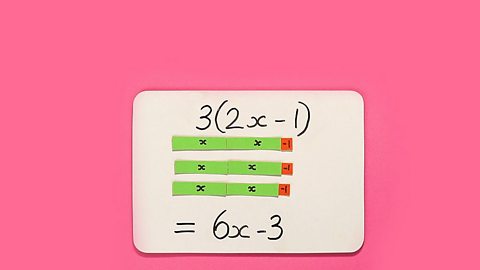
How to use the grid multiplication method
You are probably familiar with the grid method to multiply a two digit number by another two digit number.
We can also use a grid method in algebra to multiply a bracket with two terms by a second bracket with two terms.
Example \((x + 3)(x + 2)\).
\((x + 3)(x + 2)\)
\(= x^2 + 2x + 3x + 6\)
\(= x^2 + 5x + 6\)
Have a go
\((x + 5)(x - 1)\)
Work out what goes in each cell and check the answer below.
Answer
\((x + 5)(x -1)\) \(= x^2 - x + 5x - 5\)
\(= x^2 + 4x - 5\)
How to use the expansion method
Look again at the result we got for \((x + 3)(x + 2)\) using the grid method.
\((x + 3)(x + 2) = x^2 + 2x + 3x + 6\)
\(= x^2 + 5x + 6\)
You can see that \((x + 2)\) is first multiplied by \(x\)
\(x (x + 2) = x^2 + 2x\)
and then by \(3\).
\(3(x + 2) = 3x + 6\)
These are added together.
\(x^2 + 2x + 3x + 6\)
\(= x^2 + 5x + 6\).
Let’s check the second example using the same method.
\((x + 5)(x - 1) = x (x - 1) + 5(x - 1)\)
\(= x^2 - x + 5x - 5\)
\(= x^2 + 4x - 5\)
Have a go
Follow the example above to expand \((2x - 2)(x - 3)\)
Answer
\((2x - 2)(x - 3)\)
\(= 2x (x - 3) - 2(x - 3)\)
\(= 2x^2 - 6x - 2x + 6\)
\(= 2x^2 - 8x + 6\)
How to multiply expressions in brackets
When multiplying expressions in brackets, make sure that everything inside the bracket is multiplied by the term (or number) outside the bracket.
Method 1 - Boxes
Example
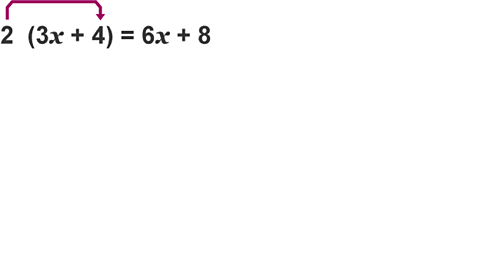
Expand \(2(3x + 4)\).
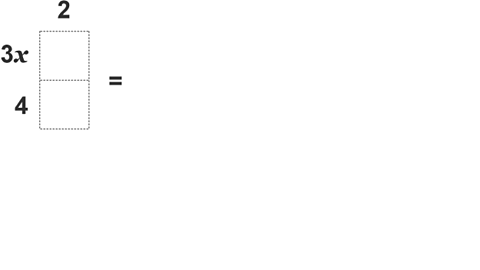
Image caption, What is 2(3x + 4)?
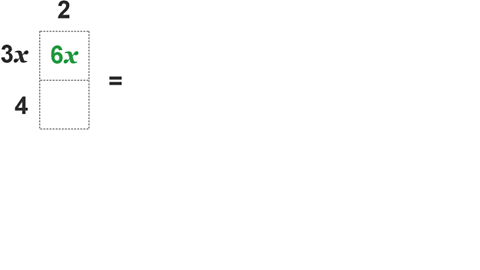
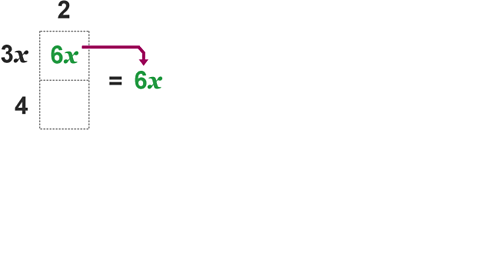
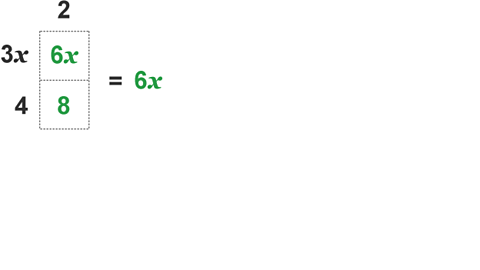
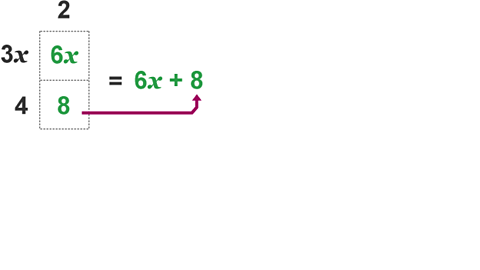
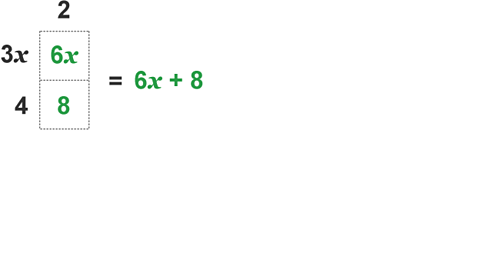
1 of 6
Method 2 - Lines
Example
Expand \(2(3x + 4)\).
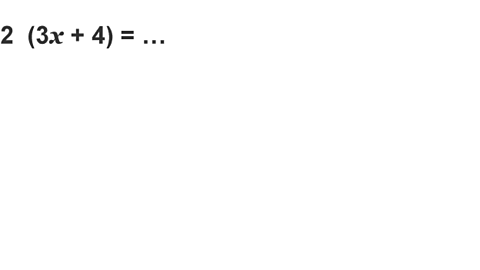
Image caption, What is 2(3x + 4)?

1 of 3
Use either method, but remember that everything inside the bracket must be multiplied by the term (or number) outside the bracket.
What happens when we have more than a single term or number outside the bracket?
What happens when we have another bracket?
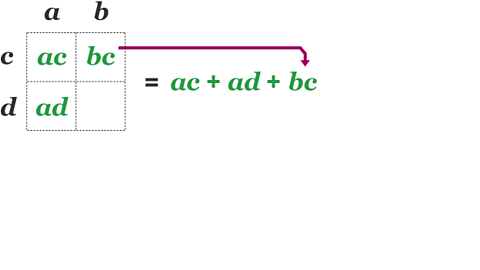
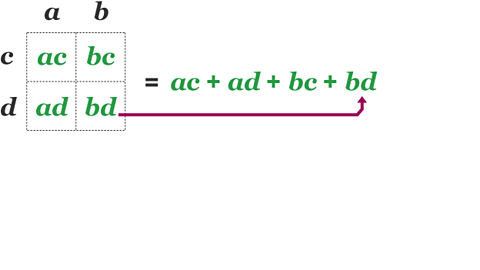
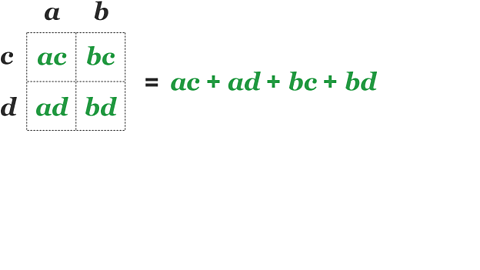
For example, if we want to expand \((a + b)(c + d)\), we need to make sure that everything in the first bracket is multiplied by everything in the second bracket.
We can do this in two ways, using boxes or lines.
Method 1 - Boxes
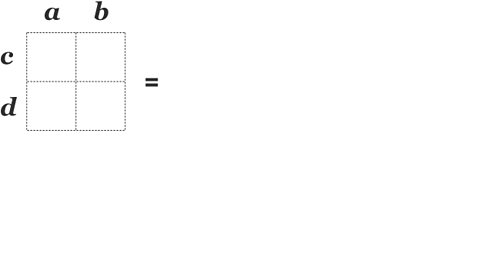
Image caption, Expand (a + b)(c + d)
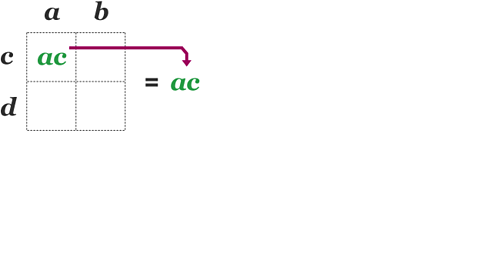
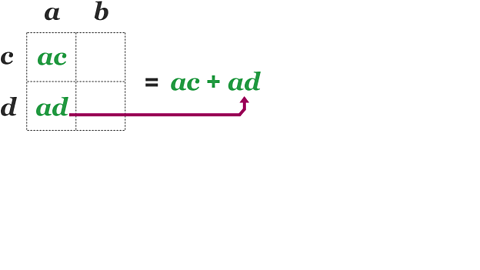
1 of 6
Method 2 - Lines
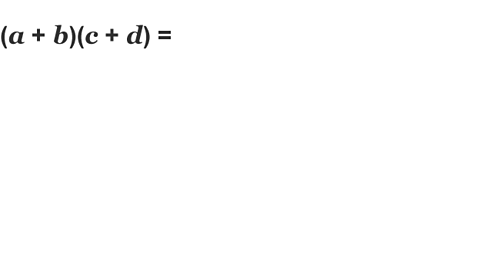
Image caption, Expand (a + b)(c + d)
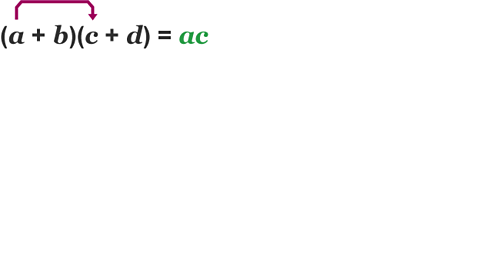
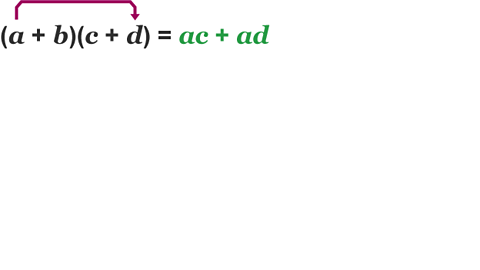
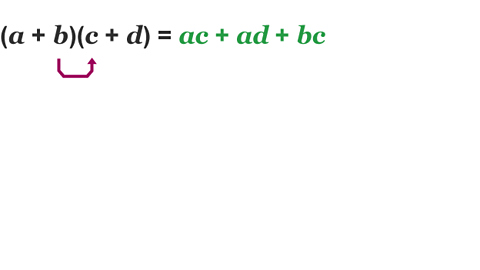


1 of 6
You can choose either method, boxes or lines, but make sure that you multiply everything.
Also remember that a + or - sign belongs to the number or term immediately after it.
What is an example of using both methods?
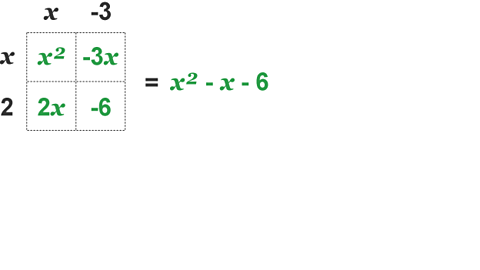
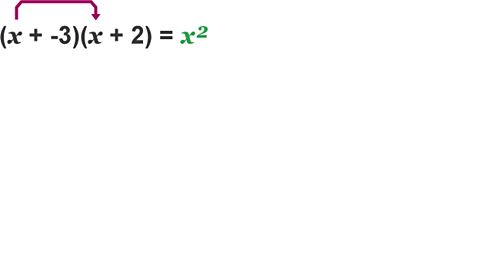
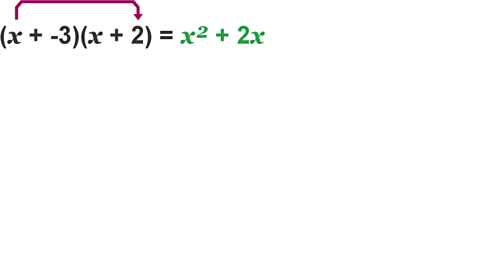
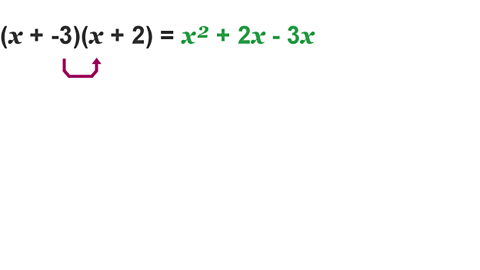
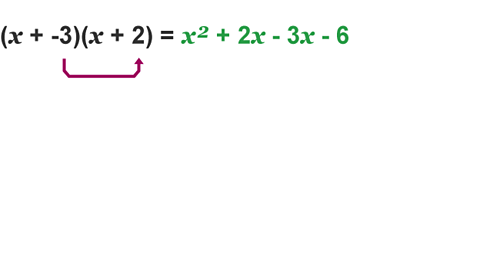
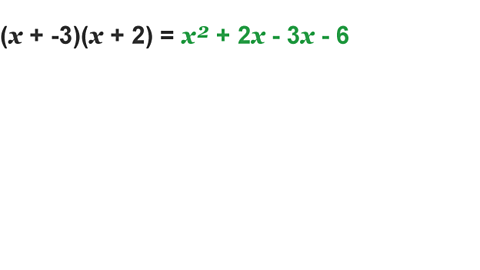
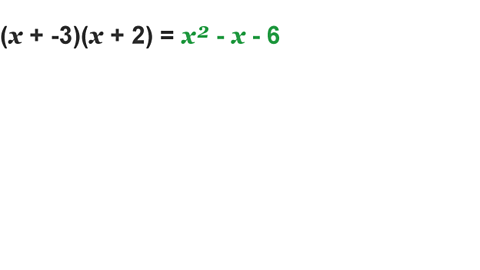
Expand \((x - 3)(x + 2)\)
Here are both methods, using boxes and lines:
Method 1 - Boxes
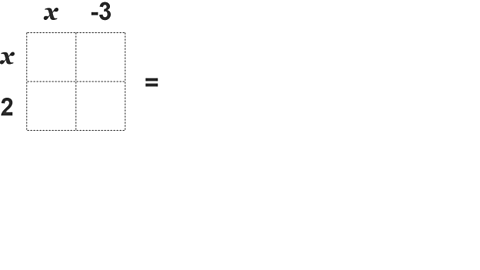
Image caption, Expand (x - 3)(x + 2)

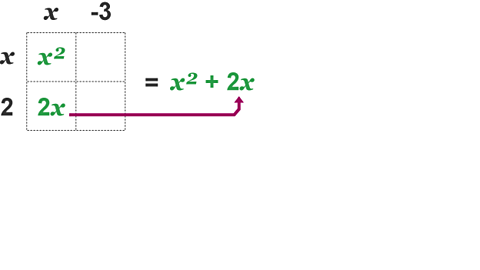
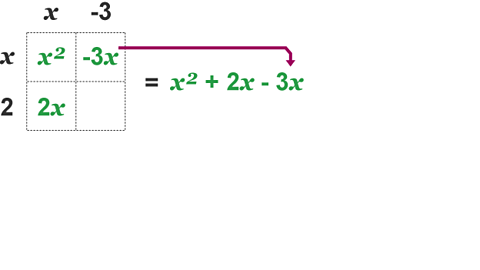
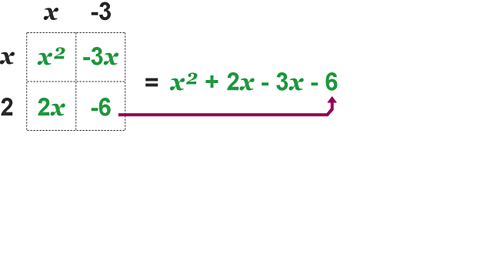
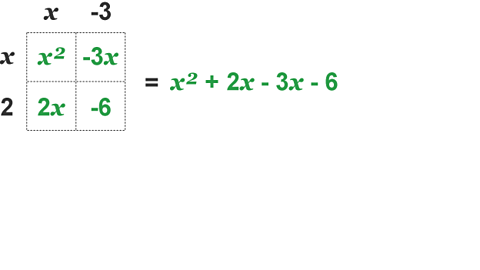
1 of 7
Method 2 - Lines

Image caption, Expand (x - 3)(x + 2)
1 of 7
Test section
Question 1
What is \({4}({7}+{2}{a})\)?
Answer
You need to multiply both terms in the brackets by \({4}\).
So, the correct answer is: \({28}+{8}{a}\)
Question 2
What is \({-x}({x}-{y})\)?
Answer
\(-x(x – y) = -x^2 + xy\)
Be careful with the signs: \({(-)}\times{(-)}={+}\).
Question 3
Expand \(({y}+{1})({y}-{4})\)
Answer
\(({y}+{1})({y}-{4})\)
\(=y^2-4y+y-4\)
\(=y^2-3y-4\)
Question 4
\((x + 10)(x + 1) =\)?
a) \(x (x +10) +x(x + 1)\)
b) \(x (x + 10) + 10(x + 10)\)
c) \(x (x + 1) +10(x + 1)\)
Answer
The correct answer is c) \(x (x + 1) +10(x + 1)\)
Question 5
\((x + 5)(2x -3) =\)?
a) \(x (2x - 3) - x(2x - 3)\)
b) \(x (2x - 3) + 5(2x - 3)\)
c) \(x (2x - 3) +2(x + 5)\)
Answer
The correct answer is b) \(x (2x - 3) + 5(2x - 3)\)
Question 6
\((x - 7)(x +5 ) = \)?
a) \(x^2 -12x + 35\)
b) \(x^2 -2x + 35\)
c) \(x^2 -2x - 35\)
Answer
The correct answer is c) \(x^2 -2x - 35\)
Question 7
\((3x - 2)(2x -3) = \)?
a) \(6x^2 -13x + 6\)
b) \(6x^2 +12x + 6\)
c) \(6x^2 - 13x - 6\)
Answer
The correct answer is a) \(6x^2 -13x + 6\)
More on Brackets and factorising
Find out more by working through a topic
- count2 of 2