What strategies or policies are there for dealing with abuse?
Children and Young People’s Strategy 2020-2030
The Children and Young People’s Strategy 2020-2030 is a framework for government to improve the health and well-being of all children in Northern Ireland.
Co-operating to safeguard children and young people in Northern Ireland - August 2017
This policy is for safeguarding children and young people in the statutory, private, independent, community, voluntary and faith sectors.
It outlines how communities, organisations and individuals must work both individually and in partnership to ensure children and young people are safeguarded as effectively as possible.
Domestic and sexual abuse strategy for 2023-2030
The strategy makes clear that domestic and/or sexual abuse cannot be tackled in isolation, and that a whole society approach is required.
Central to this is ensuring the voices of victims, including children and young people, are valued and at the core of decision making.
It was also announced that a Children’s Sexual Offences Legal Advisers (SOLA) scheme will provide free legal advice to children and young people affected by sexual crime, as well as a small grant scheme to support the invaluable work provided by the community and voluntary sector.
Adult safeguarding: Prevention and Protection in Partnership
This policy was published by the former The Department of Health, Social Services and Public Safety (DHSSPS) was a government organisation in Northern Ireland that worked to help people stay healthy and safe. (now the Part of the Northern Ireland government. It works to keep the population healthy and safe by looking after hospitals, doctors, and social care services. ) and the It is part of the Northern Ireland government and looks after the justice system, which includes -the police, courts, prisons, and helping victims of crime., on behalf of the Northern Ireland Executive in July 2015.
A key objective is to reduce the incidence of harm from abuse, exploitation or neglect of adults who are at risk in Northern Ireland and to provide effective support and, where necessary, protective responses and access to justice for victims and their families.
Child protection and safeguarding policy and procedures
This policy has been prepared to provide a governance framework for the Education Authority (EA) in relation to its child protection and safeguarding responsibilities.
It is intended that the policy will promote the welfare for the child and young person; prevent harm occurring through early identification of risk and appropriate, timely intervention; and protect children and young people from harm when this is required.
What is Operation Encompass?
Operation Encompass is a partnership between the Police Service of Northern Ireland, Safeguarding Board Northern Ireland, the Education Authority and schools aimed at supporting children who witness domestic violence or abuse in the home.
How it works
If Police attend a domestic abuse call, and children are present, Operation Encompass allows the officers to pass on relevant information to the safeguarding team at the child’s school before 9am the following morning, so the right support can be put in place.
The information shared by Police is treated in strict confidence.
What personal strategies deal with abuse and bullying?
- talk to family and friends
- talk to a teacher
- seek advice online
- join a self-help group
- speak to a doctor - they can refer on to a counsellor
- talk to a voluntary organisation that deals with abuse
- speak to the police
- setting boundaries
- become educated on abuse
- reach out to a therapist
- discreetly document everything that’s happened
Strategies to deal with bullying
Bullying, including cyberbullying, is another persistent challenge that requires both personal strategies and government intervention.
Schools must foster an environment where bullying is not tolerated and where victims feel safe to speak out. Additionally, promoting emotional resilience and conflict resolution skills can empower young people to stand against bullying behaviours.
Watch: Personal safety
Recap on the key points about personal safety
Narrator:
Personal safety.
It's not possible to stay completely safe all of the time.
I mean, what would be the point of just staying at home, not doing anything in case something bad happened?
But some people just don't know when to stop.
Taking drugs, drinking, playing dangerous games and causing trouble.
Teenagers in particular seem to like living a risky life.
Most of us want to have new experiences, and sometimes we take risks because we want some extra excitement in our lives.
And when we are in danger, we get an adrenaline rush and that gives us a bit of a buzz.
Then there are times when your mates want you to do something and you do it just to be popular, even though you are sick to the stomach with fear.
We call this peer pressure.
And of course, some people will do absolutely anything just to get attention.
Naturally, if you are drunk or off your head on drugs, you won't even think about danger, and you're even more likely to damage yourself.
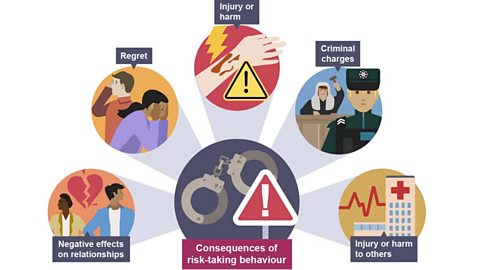
The trouble is, all of your actions have consequences.
You will almost certainly regret your behaviour, and that might last a long time.
Don't be surprised if other people think you're stupid.
They will trust you less and less, and your family will worry.
You or others may suffer injury or harm. It could even be life threatening. And you may face criminal charges causing problems at school and at home.
So before you do something risky.
Think about the consequences of your actions to you and others.
Review who you're spending time with.
Talk to people you trust, if you're not sure and know how to stay safe.
Try to be aware of who you are and what you're doing.
If you're going to regret it - then don't do it.
More on Personal safety
Find out more by working through a topic
- count4 of 4
- count1 of 4
- count2 of 4