The miners’ strike 1984-1985 was an attempt by miners to stop the National Coal Board and the Prime Minister, Margaret Thatcher, from closing coal mines across Britain.
The strike was one of Britain’s most significant industrial A disagreement or argument over something..
Why did the strike start?
By the early 1980s, many coal mines were losing money and the number of people the coal industry employed was falling. On 6 March 1984, the government announced the closure of 20 coal mines making at least 20,000 miners redundant.
This meant that many mining communities would lose their main means of earning money.
The strike began in Yorkshire, where miners at Cortonwood coal mine left their work following a local vote. As a result of this, the president of the National Union of Mineworkers, Arthur Scargill, announced a national strike on 12 March 1984, although an official ballot was not held among miners about this.
The strike, which lasted a year, changed the political, economic and social history of Wales.
Although most of the strike was conducted peacefully, clashes between police and the striking miners did occur. The Orgreave coking plant in Yorkshire, supplied fuel for the steelworks in Scunthorpe. Striking miners started to picket the plant at Orgreave in an attempt to prevent the fuel from reaching the steelworks.
What became known as The Battle of Orgreave happened on 18 June 1984. A mass picket was called for that day and more than 5,000 miners from all over the country gathered there to try to prevent the coking coal from leaving the plant. There were violent clashes between the miners and the 6,000 policemen who were there to stop them.
Video - The miners' strike
The 80s - a decade of new fashion, BMX bikes and mobile phones the size of a brick. It was also a very interesting period politically, and in 1984 a pretty significant event happened.
Arthur Scargill has just declared the national miners’ strike due to the plans of the government to close 20 pits in the UK because they cost too much money to run.
The miners’ strike caused so much upheaval. The closure of the pits broke a generation of workers across Britain. This was down to Margaret Thatcher, the UK’s first female prime minister, who was known as ‘the Iron Lady’.
Thousands of people lost their jobs, shattering over 150 years of heritage, as coal mining had shaped Welsh identity for many generations.
No job equals no money, so there was no going out and buying the latest fashion. But for thousands of families they couldn’t even afford to put food on the table.
The strike divided communities. Some were adamant that they wouldn't cross the picket line, while others were desperate to earn again. This caused a rift within families and communities such as the valleys in south Wales and Point of Ayr, in Flintshire.
However, it also brought some communities together. The ‘Lesbian and Gays Support the Miners’ group came from big cities like London to back them. They raised over £20,000 for the families of the Neath, Dulais and Swansea Valley Miners Support Group.
Homophobia was rife at the time, so this camaraderie came as a surprise to many. After the strike ended, the miners supported the LGBT community in their mission to gain equal rights.
But, despite receiving support from within and outside their communities, many people opposed the miners and their decision to go on strike.
This was the beginning of the end of the coal industry in the UK. It’s taken a long time for areas such as the Welsh valleys to rebuild themselves. Unemployment is still high today, and even after more than 30 years, these communities find it hard to forget the legacy of the miners' strike.
Support for the strike in Wales
The support for the strike in Wales varied. There was strong support for it in the communities of south Wales, where over 99% of the workforce supported a strike at the outset. However, only 35% of the workforce supported the strike in the coal mines in north-east Wales.
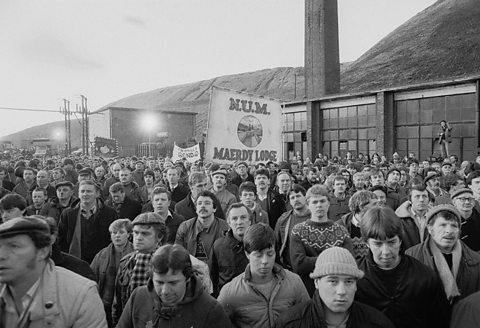
Most miners in Yorkshire, north east England and south Wales went on strike. There was less support in the Midlands, and Nottinghamshire was specifically targeted by pickets. Miners stood at the entrances to the pits to protest against the miners who were still working, and try to stop them from entering.
The strike also caused disagreement and conflict within communities. Many people found it difficult to forgive those who were prepared to break the strike and go to work.
Government response
The miners’ strikes in the 1970s had caused a great deal of problems for the public as a result of power cuts, but the government had prepared for the strikes in the 1980s. Anticipating that strike action could start, the government had already stockpiled six months’ supply of coal.
In addition, specialist police units had been set up by Margaret Thatcher’s government. These aimed to move quickly to the areas where strike action was taking place to stop any attempts to prevent coal from being transported to the country’s power stations.
Impact of the strike on communities in Wales
The mining communities supported the strikers. Wives and partners of striking miners also played an important part in the dispute, collecting money and arranging for food to be distributed.
Money to buy things such as food and clothes was scarce and many in the communities faced financial difficulties. The women in the communities also stood alongside their partners, brothers, fathers and sons on the picket line.
Striking miners in south Wales received support from north Wales quarry workers and farmers in mid Wales - many collected money and food to send to them.
Tension leading to violence
As strike action continued, it became very difficult for miners and their families. They were not earning a wage or able to receive Money to support people, eg because of unemployment, illness or disability. as the strike had been ruled to be illegal.
Some families found it so difficult they felt they had no choice but to return to work and break the strike, but others considered them to be ‘traitors’ for doing so.
In November 1984, David Wilkie, a 35-year-old taxi driver from Treforest was driving a miner, who was breaking the strike, to work at the Merthyr Vale colliery.
As he drove under a bridge along the Heads of the Valleys Road, a block of concrete was thrown onto the taxi by two striking miners from Rhymney, Caerphilly.
David Wilkie was killed but his passenger avoided serious injury.
Support beyond the coal-mining areas
During this time, community groups were set up across Britain to collect money and resources for the mining communities that were on strike.
One community that benefited from this was Onllwyn near Neath.
Realising that the police were no longer disrupting LGBTQ+ communities as their attention had been diverted, activist Mark Ashton set up the group Lesbians and Gays Support the Miners.
Starting by collecting money for the mining communities at London Pride, the organisation grew, and by the end of the strike in March 1985 over 60 people were involved and £20,000 was collected for the Onllwyn community.
Official end of the strike
The strike officially ended on 3 March 1985. The miners returned to work two days later. Many mines were closed during the following years. This led to economic decline in Wales as unemployment increased in the coalfield areas, and some shops and businesses had to close as a result.
There were over 20,000 coal miners in Wales in 1984 and only 3,700 were left by the end of the 1980s.
Quiz - The miners' strike
More on Conflict and peace
Find out more by working through a topic
- count3 of 3

- count1 of 3