Does helping with your teen’s maths homework or revision fill you with dread? If so, you’re not alone. According to the maths skills organisation, National Numeracy, 23% of parents and carers say that having to help with their child’s maths homework makes them feel anxious.
When exam time comes around, trying to help them with tricky maths topics may feel overwhelming, so BBC Bitesize has created step-by-step guidance to help them - and you - work through them.
1. Watch maths videos together
The way maths is taught might have changed a bit since you were in school. Curriculum changes over the last few decades have moved the focus from getting the answer correct to understanding how the process of working out should be done. But this doesn’t mean that helping your child with their maths studies should feel impossible.
Take a look at this BBC Bitesize video that shows how to solve inequalities (and reveals how relevant this is in daily life)!
Solving inequalities.
In some real-world situations, values like your age or height must be within a given range of numbers.
Let's look at how to use inequality symbols to represent a set of values. First, you need a variable, which is a letter that can take a range of values.
Let's say 𝑆 represents the score in a video game. The rule in the game is that you must score more than 8 to advance to the next level. This means your score, 𝑆, must be greater than 8.
Remember, the smaller pointed end of the inequality symbol always points to the smaller of the two values.
Here, 𝑆 must be greater than 8, so 8 is the smaller value, and the big gap points to the larger of the two values, which in this case is 𝑆.
How about a travelcard for people between and including the age of 16 and 25? A person's age, 𝐴, must be greater than or equal to 16, and it must be less than or equal to 25.
Notice that the inequality symbols have horizontal lines underneath. This indicates that 𝐴 can equal 16 or 25, as well as all the values in between.
And how might we show a cinema ticket discount available to under 18s, as well as those who are 65 or over? This needs two inequalities. A person's age, 𝐴, must be less than 18 or greater than or equal to 65 to qualify for the discount.
We can also represent the solutions to inequalities on number lines.
For ‘𝑆 is greater than 8’, draw a circle at 8 and then a horizontal arrow stretching to the edge of the number line in the direction of the larger values. The arrowhead shows that this continues forever. This inequality is true for all numbers larger than 8. The circle should be empty to show that 8 itself is not a solution.
To check the arrow is on the correct side of the circle, we can check a value either side of the circle. 13 is greater than 8, which means it's a valid solution, while 6 is not greater than 8, so the arrow is on the correct side.
For ‘𝐴 must be between 16 and 25’, draw filled circles at 16 and 25, and then a horizontal line between them to represent the possible solutions to the inequality. Notice the circles are filled because the values 16 and 25 are included in the solution.
And finally, if ‘𝐴 must be less than 18 or greater than or equal to 65’, you can show both inequalities on the same number line.
First, draw two circles at 18 and 65. But be careful! 𝐴 must be less than 18, which means the circle at 18 needs to be empty, but the 65 circle is filled because 65 is included. A horizontal arrow to the left represents values under 18 and an arrow to the right represents values over 65, so none of the values between the circles solve either inequality.
BBC Bitesize has new GCSE maths study guides - expertly designed to make maths feel more digestible. Look out for videos as these are a helpful recap of topics, whether it is one you find particularly challenging or if you just need to double-check the facts.
You can pause the video at any point if you need to take your time with a subject. It is also very useful to stop the video and have a go yourself – especially if there's a question being asked.
This is a great way to encourage your teen to work out the process of an equation for themselves. By playing the next steps of the video, they then have the opportunity to see a clear visual representation of which steps they have understood or not.
2. Use slideshows to explain maths concepts
A great way to study maths is by working through examples. Sometimes it can be hard to explain to your child where they've gone wrong if you're using a different technique, or if you don’t know yourself.
BBC Bitesize uses slideshows to show each step in a maths problem, so that the working out is clearly explained.
You can also use the ‘show answer’ button on our questions as a way to practise sums. These interactive maths examples will help both you and your teen understand the steps involved in getting to the right answer.
Try now by seeing if you know the answer to the question below. Click show answer when you are ready.
- Write these numbers in order from smallest to largest:
0·3, 0·33, 0·303, 0·033.
0·033, 0·3, 0·303, 0·33.
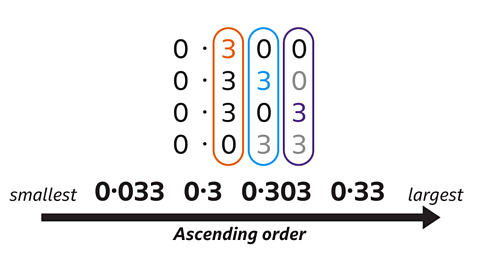
- List the numbers, on top of each other, lining up the decimal points.
- Write in additional zeros so all the numbers have the same number of decimal places (3).
- Compare the digits one column at a time, working from left to right.
3. Challenge each other with fun revision quizzes
Trying a quiz is a good way to figure out how much you know already. You might not be sure of what areas you need to check over before helping your child, so you can use a quiz to test your knowledge.
BBC Bitesize has specially designed quizzes with questions that change every time. Keep playing to try out all the questions.
There are also 'check your understanding' activities in the Bitesize maths guides to help as a quick test on specific topics.
As well as those appearing in revision guides, there are additional specially designed quizzes available for exam practice, with questions that change every time.
4. Interactive activities
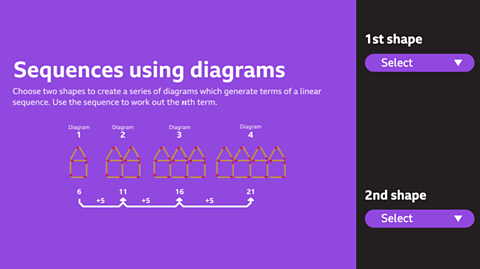
Maths is full of abstract concepts that can be challenging to visualise. Use BBC Bitesize’s interactive activities as a way to show your child (and yourself) how different variables affect maths equations.
Although it can be difficult to help your teen prepare for their exams, BBC Bitesize is here to make maths easier to understand so that GCSE preparation doesn’t need to feel quite so daunting for them - or for you.
BBC Bitesize covers maths curriculum from these exam boards:

More from BBC Bitesize Parents' Toolkit…
Bitesize Parenting
Fun activities, real-life stories, wellbeing support and loads of helpful advice - we're here for you and your child.

How to stay positive about maths when teaching your kids
Advice for parents from the National Numeracy charity

How to support your teen as they decide on their future career
Career coach Mark Anderson has advice for parents of teens who are choosing their options at GCSE or are nearing the world of work.
Helping with homework for the first time?
Three ways you can support your child when they start bringing homework back from school.
What is dyslexia and how can I help my child?
Parents can face worry and uncertainty when they suspect their child is dyslexic. We have advice on diagnosis, schooling and support.

Dear Parents’ Toolkit: Talking to your child about future jobs and their GCSE options
BBC Bitesize Parents’ Toolkit has spoken to parents on a UK-wide panel about their child’s future career, and what they’d encourage them to think about when choosing their GCSE and Nationals options at school.