What is in space?
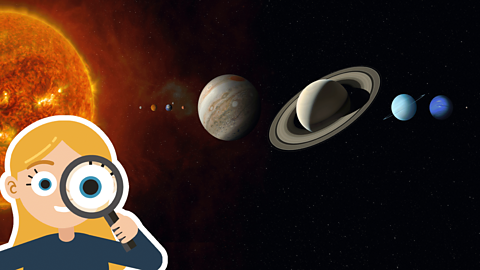
Space is enormous! It’s filled with amazing things like stars, planets, moons, asteroids, and meteoroids.
We live on planet Earth, and the closest star to us is the Sun. When you look up at the night sky, you can see lots of stars and sometimes even planets shining.
A long time ago, people believed Earth was at the centre of the Universe. Scientists later discovered that this isn’t true. In fact, nobody knows the exact size of the Universe because it’s so vast!
Our Solar System is just one part of a galaxy called the Milky Way – and there are billions of galaxies in the Universe.
Watch – A journey through space
Travel through billions of kilometres of space, all the way from cold icy Neptune to the burning heat of the Sun.
Explore the wonders of our Solar System.
Sometimes, I look out at the stars and I wonder, “what's really out there?”
Hey! Follow me.
Oh ! Whoa! It's getting pretty hot now
First stop, the Sun. Our very own star. It's so bright and so big that you could fit a million Earths inside it.
Look over there. That's Jupiter. Can you see that giant red spot? That's a storm. That's just like a hurricane. That storm is bigger than our whole planet, and it's been raging for hundreds of years.
We can't just hang here. Lots more to see.
Saturn's rings are so pretty. From far away, they look solid, but they're not. They're made of billions of bits of ice and rock. Some are tiny, like grains of sand. And some are as big as a house.
Hmm. Where should we go now? Let's travel even further.
This is Neptune. It's the windiest planet, and it's so far away.
A year here lasts for 165 Earth years. I reckon it's time to head home.
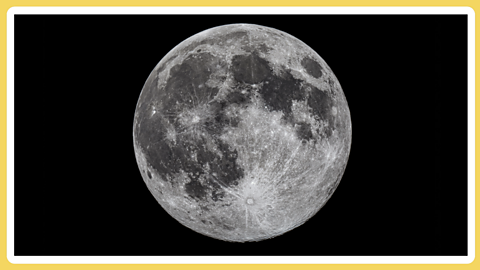
Oh, look, there's the Moon. I've heard that because there's no wind up there, the footprints left by the astronauts in 1969 are still there. Perfectly saved.
There's so much out there to see. What will you discover?
Science

Space has fascinated people for many years.
As space is so huge, scientists continue to discover new things about the Universe.
Have a look at the information, videos and activities below to learn more.
Watch – The Solar System
The Solar System is the name we use to describe the Sun and the eight planets that orbit around it, along with their moons and other objects like asteroids and comets.
Starting with the planet closest to the Sun, they are:
Mercury
Venus
Earth
Mars
Jupiter
Saturn
Uranus
Neptune
Watch this video to learn how we get more information about these planets.
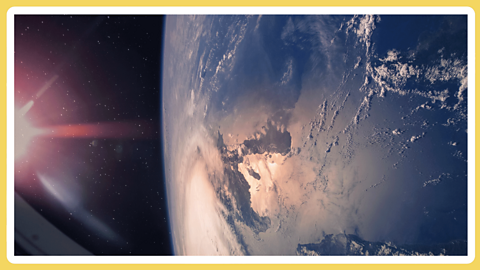
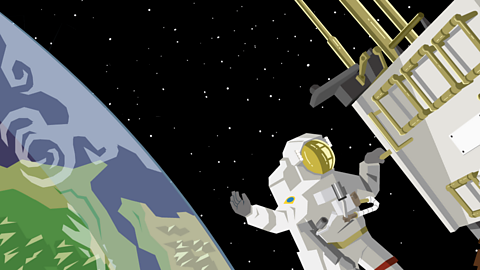
From up here on the International Space Station I get a great view of Earth.
Our planet is just the right distance from the Sun for life to exist.
We call it a Goldilocks planet because the Earth’s temperature, like the porridge in the Goldilocks fairy tale, is not too hot and not too cold.
This is because the Earth has an atmosphere which holds onto the Sun’s warmth whilst also protecting us from the Sun’s rays.
But what’s it like on other planets?
There are eight planets in our Solar System. The closest one to the Sun is Mercury, then it’s Venus, Earth, Mars, Jupiter, Saturn, Uranus, and Neptune.
The eight planets travel around the Sun at different speeds. These lines show us the paths they take which we call orbits.
On a clear night from Earth we can sometimes see the five planets which are closest to us - Mercury, Venus, Mars, Jupiter and Saturn.
Using a powerful telescope can also see Uranus and Neptune but to get an even clearer view we send telescopes into space, like this one - the Hubble space telescope.
We have also sent probes into space.
Probes are space crafts with cameras to send images back to Earth. This allows us to compare the planets in even more detail.
Mercury and Venus are both rocky planets. Mercury is closest to the Sun, so it gets very hot during the day. But it has a very thin atmosphere which does not hold on to any heat, so it gets very cold at night in the shade.
Venus, on the other hand, has a thick atmosphere which holds onto heat from the Sun. So, even though Mercury is closer to the Sun, Venus is the hottest planet in the Solar System.
Mars has a hard, rocky surface with lots of iron in the soil which rusts, making the surface and atmosphere look red. This is why we call Mars, the Red Planet.
Mars is most like Earth.
Both have valleys and mountains, weather and seasons, ice caps and volcanoes.
Robotic vehicles called rovers have been sent to Mars to collect information. The Perseverance rover is up there now, studying the Martian climate and weather.
It tests technologies that could help humans survive on Mars.
The two largest planets are Jupiter and Saturn.
They are called Gas Giants as they don't have hard surfaces, but instead have swirling gases above a solid core.
On the surface of Jupiter there is a huge red spot twice as wide as planet Earth.
When the Voyager 1 probe flew past Jupiter, the images it sent back showed that this Great Red Spot is a huge storm which has been raging for over three hundred years.
Saturn is best known for its rings, which are made of chunks of ice and rock.
Uranus and Neptune are the furthest planets from the Sun. They are known as the Ice Giants.
Uranus is the coldest planet in the Solar System. Unlike the other planets, Uranus spins on its side.
Neptune is the furthest planet from the Sun, thirty times further than Earth. Its orbit is so huge that one year on Neptune takes almost 'one hundred and sixty five' Earth years.
The James Webb space telescope is currently one million miles from Earth. It is being used to explore the beginning of the Universe, study how stars are born, and look for Goldilocks planets in other solar systems.
The Sun, Earth and Moon
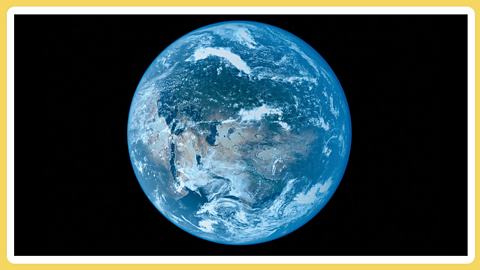
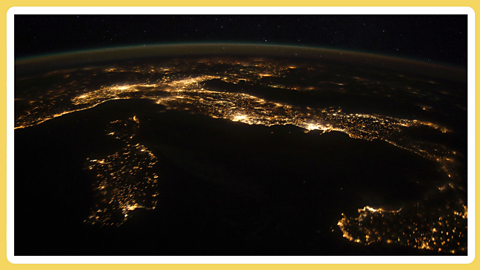
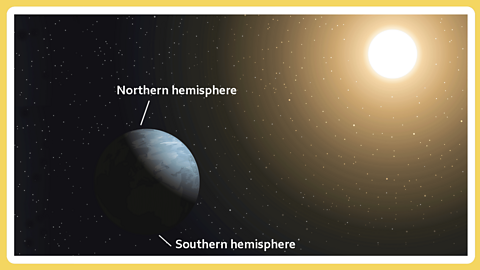
The Sun, Earth, and Moon all play important roles in creating day and night on Earth. Day and night happen because the Earth spins on its axis, turning toward and away from the Sun.
Have a look at this slideshow to learn more.
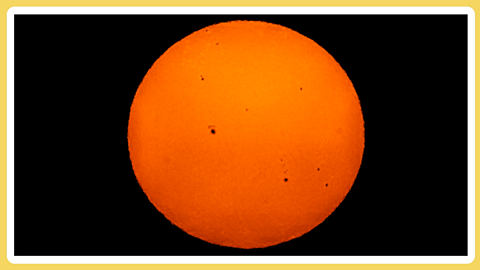
Image caption, The Sun
The Sun is the star at the centre of our Solar System. It is orbited by all of the planets, including the Earth.
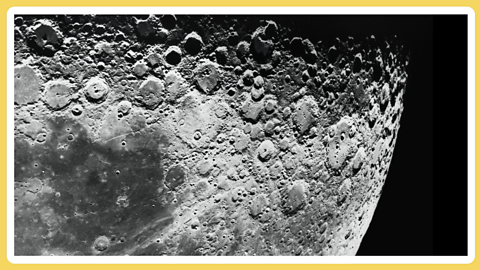
1 of 7
Activity - Horrible Science: Stinky Space game
Play this game and learn some revolting facts about the planets in our Solar System!
Horrible Science: Stinky Space. game
KS2 Science game
Discover more on KS2 Science
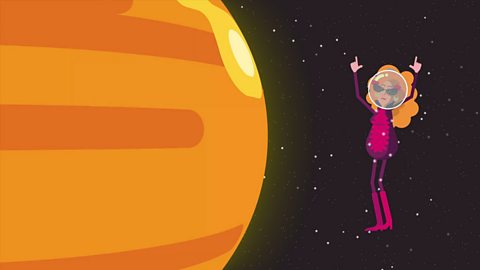
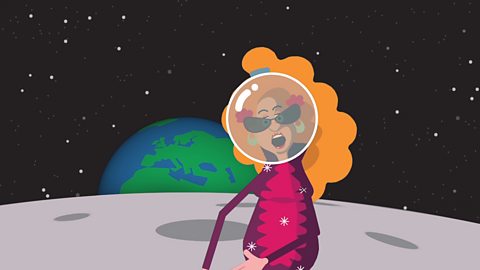
Have a look at these articles to learn more about the Sun, Earth and Moon.
History

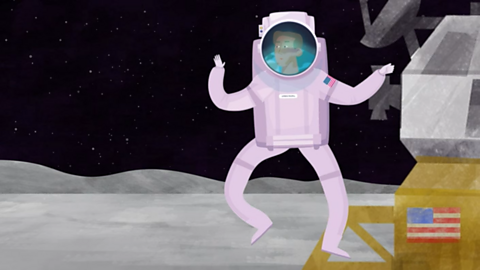
Neil Armstrong was the first person to walk on the Moon in 1969.
Today, astronauts continue to travel into space to learn more about our Solar System and the wider Universe.
Have a look at the information, videos and activities below to learn more about some famous astronauts and important space missions.
Neil Armstrong
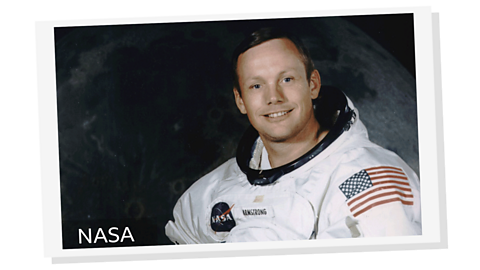
Neil Armstrong was born in Ohio, USA in 1930.
Before becoming an astronaut, he served as a pilot in the U.S. navy.
In July 1969, Neil, along with two other astronauts - Buzz Aldrin and Michael Collins - flew on the Apollo 11 mission to the Moon.
Neil Armstrong was the first person ever to walk on the Moon.
As he stepped onto its surface, he famously said:
"That’s one small step for man, one giant leap for mankind."
Watch – The Moon landing
Watch this video and learn more about Neil Armstrong and his historic mission to the Moon.
FATIMA: Which explorer shall we talk to today, Ollie?
OLLIE: What about someone who has been to the final frontier, Fatima?
FATIMA: Where’s the final frontier?
OLLIE: Space.
FATIMA: Oh yeah. Let’s talk to somebody who’s been to the Moon!
OLLIE: Great idea. Holo-Lab, find the first person to set foot on the Moon.
HOLO-LAB: Searching, Searching… Found. First person to set foot on the Moon: Neil Armstrong.
FATIMA: The Holo-Lab is going back in time, before mobile phones.
OLLIE: Before the internet?
NEIL ARMSTRONG: Hi, I’m Neil Armstrong. In 1969, I was the first person on the Moon.
FATIMA: Hi Neil, we’re Fatima and Ollie and we want to ask you a few questions about the Moon landings.
NEIL ARMSTRONG: Okay, sure. Nice to meet you guys. Shoot.
OLLIE: How did you get to the Moon, Neil?
NEIL ARMSTRONG: I got to the Moon as part of the Apollo 11 mission, aboard the Saturn V rocket.
OLLIE: Why did you go to the Moon?
NEIL ARMSTRONG: Because no one had been there before and we wanted America to be the first country to do so. The President asked NASA to design and build a rocket to take us to the Moon.
FATIMA: How did you get ready to go to the Moon?
NEIL ARMSTRONG: I and the other two astronauts spent months training. We had to understand how to fly the rocket and land the lunar module, and how to get home again.
FATIMA: Was training hard work?
NEIL ARMSTRONG: It was really hard work. It was great fun too. It was a real adventure into the unknown. No one had ever been to the Moon before. NASA had to develop most of the technology we needed for this trip from scratch.
OLLIE: Was it scary?
NEIL ARMSTRONG: Between me and you, it was scary. Sitting in the huge rocket, waiting for take-off, I was super excited and super scared. We were sitting on nearly a million litres of rocket fuel, which could explode at any moment if something went wrong. But I tried to be brave – this was it. The moment we’d been training so hard for.
NASA: Three, two, one… Zero… Lift-off.
FATIMA: Wow! Look at that!
NEIL ARMSTRONG: The Earth is moving around the Sun at 70,000 miles per hour and the Moon is orbiting the Earth at 2,288 miles per hour. The maths that allowed us to calculate the route to the Moon was so complicated that NASA had to get some of the best mathematicians in the world to figure it out. Like Katherine Johnson. She was very, very clever and got us there safely. If she’d made a single mistake in the calculations, we might not have come home at all. Our lives were in her hands.
NEIL ARMSTRONG: One small step for man. One giant leap for mankind.
FATIMA: How did you know what to say?
NEIL ARMSTRONG: We knew it was going to be a big moment and that the whole world would be watching, so we thought really hard about it.
OLLIE: How come you’re so bouncy?
NEIL ARMSTRONG: When you’re on the Moon, gravity is just one sixth of what it is on Earth so on the Moon, I only weighed about fifteen kilograms.
FATIMA: What did it feel like being on the Moon?
NEIL ARMSTRONG: When I was on the Moon, I looked back at the Earth where everyone I knew and loved lived, and it looked so small, like a beautiful marble.
FATIMA: Wow!
OLLIE: Thank you very much for answering all our questions, Neil Armstrong.
NEIL ARMSTRONG: Thanks guys. Maybe one day, one of you will go to Mars. Whatever you do, good luck!
FATIMA: Mars! That would be so cool. Thanks, Neil.
Helen Sharman
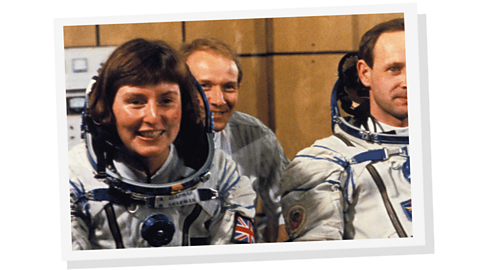
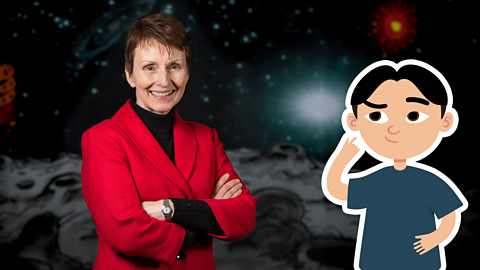
Dr Helen Sharman, a scientist from Sheffield, is the first British person to travel into space.
When she was 27, she was chosen to be part of Project Juno, a mission that funded a British astronaut to join a spaceflight.
On 18 May 1991, Dr Helen travelled with a team of Russian astronauts, or cosmonauts, to the Soviet space station, Mir on an eight-day mission.
She later said that one of her favourite things was floating around on the space station and the feeling of weightlessness.
Tim Peake
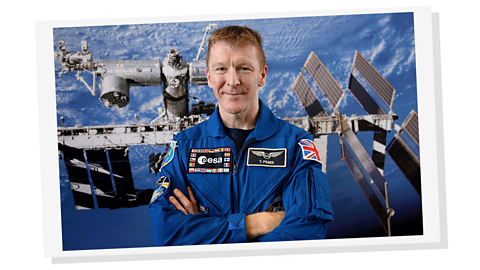
Tim Peake was born on 7th April 1972 in Chichester, England.
Before becoming an astronaut, he served as a helicopter pilot and a Major in the British Army.
He joined the European Space Agency (ESA) in 2009 after being selected from over 8,000 applicants.
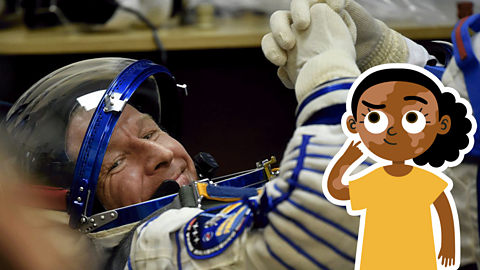
He was the first British ESA astronaut to visit the International Space Station (ISS), staying there for six months.
Tim said that one of the best things about space was being able to look at Planet Earth.
Have you ever wondered?
There are so many questions we can ask about space.
Follow these links to watch Helen and Tim answer some very interesting questions. What question would you ask them?
Discover more about space
You can also check out these articles to find out even more amazing facts about space.
How do you stay alive in space?
KS2 Science
Can you make outer space in your kitchen?
Bitesize: KS2 Science
How do astronauts get home?
KS2 Science
English

As there is still so much about space that we don't know, it is a great subject to write and read about.
Have a look at the information and activities below to learn more.
Dr Maggie Aderin-Pocock
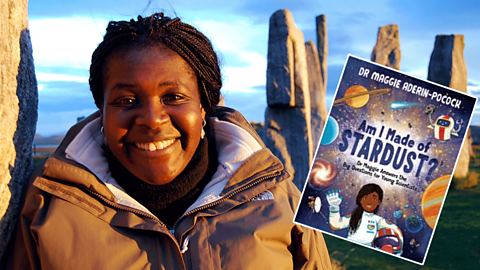
Dr Maggie Aderin-Pocock is a space scientist and television presenter.
She once said that she fell in love with the idea of space travel as a young girl, and always asked a lot of questions, which is important as a scientist.
Dr. Maggie has written a non-fiction book called Am I Made of Stardust? which answers lots of interesting questions about space and the Universe.
Watch – Am I Made of Stardust?
Watch this Blue Peter Book Club video for a sneak peek of Dr Maggie's book.
Scientist, Doctor Maggie Pocock answers some of her all time favourite questions about the universe.
Like what would happen if I fell into a black hole?
And are there rainbows on other planets?
Packed full of facts, explanations and mind blowing insights, Doctor Maggie and robot assistant, IQ, take us on a journey of space discovery.
Activity - Write a letter to an astronaut
If you could ask an astronaut anything, what would you ask them?
Your task is to write a letter to an astronaut. Think about what questions you would want to ask them.
Do you want to find out more about living in a rocket or the views from space?
Maybe you want to know what the training is like to become an astronaut, or what they would say if they met an alien!
Discover more on KS2 English
Have a look at these articles for more tips on how to make your writing even better.
How to write a letter
KS2 English
How to plan your story
KS2 English
How to write a science fiction story
KS2 English
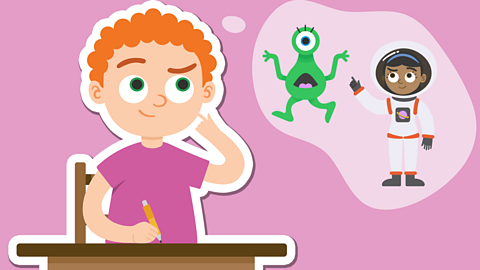
Activity - Create an alien
Have a go at this activity and see what weird and wonderful aliens you can create!
More resources from Bitesize for teachers
You can find many more amazing resources on space from Bitesize for teachers.
The Solar System from the TARDIS
Super Movers
Dr Who, Space and Light
Live Lessons
Katherine Johnson
KS2 History
More resources from the BBC
Discover even more useful resources on space from around the BBC.
Moon Mayhem - The Moon Landing
CBBC - Horrible Histories
Space World Records
Blue Peter
Leonid meteor shower
Newsround
Where next?
Play Bitesize Primary games. game
Fun and educational primary games in science, maths, English, history, geography, art and design, computing and modern languages.