An age-old question...
A blue sky is a sign of good weather and can even boost our mood – although we might not see it as often as we’d like to. But why is the sky blue?
It’s a question you’ve probably heard before – you may even have asked it yourself. Common explanations include that the sky reflects the colour of the ocean, or that oxygen is a blue gas.
If you’ve always wanted to impress everyone around you with the correct answer to this question, look no further! Here, BBC Bitesize takes you through it step by step, as well as some other cool facts about the solar system you might not know.

So, why is the sky blue?
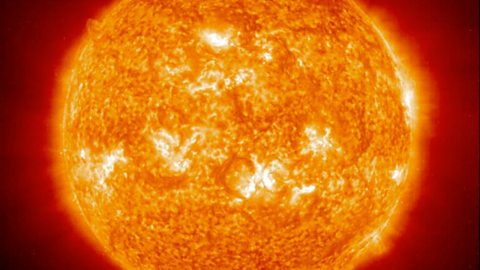
You might already know that the Sun gives off light in all the colours of the rainbow, even though it looks white to our eyes. Sir Isaac Newton proved this in a famous experiment when he shone sunlight through a glass prism, which separated out all these colours.
The colours in sunlight all have different wavelengths – the distance between the peaks of two light waves. Violet and blue have the shortest wavelengths and red has the longest.
When the wavelengths reach Earth’s atmosphere, they get ‘scattered’ by air molecules, meaning they are sent in different directions. The shorter the wavelength, the more it is scattered.
That means blue light is scattered across the sky more than red light. But in that case, why isn’t the sky violet?
Violet does have shorter wavelengths than blue. But more of the light that reaches Earth’s atmosphere to begin with is blue rather than violet, and our eyes are actually better at detecting blue light.
Why do we get red skies?
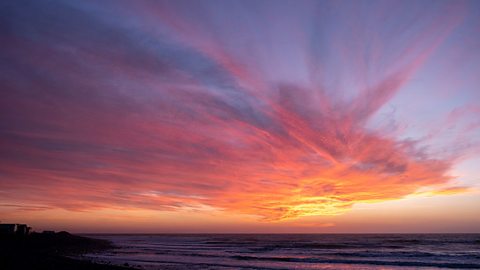
You might have heard the poem, ‘Red sky at night, shepherd’s delight; red sky in the morning, shepherd’s warning.’
It’s a centuries-old rhyme for weather forecasting. It suggests a red sky in the evening means good weather, whereas a red sky in the morning means a storm is coming. It first appeared in the Bible and was used to help shepherds prepare for the next day.
But is it true – and what causes red skies?
During sunrise and sunset, the sun is low in the sky. That means light has to travel further to get through Earth’s atmosphere.
The blue light gets scattered away, but because it has a longer wavelength, red light isn’t scattered as far. This makes the sky appear red.
It turns out the red sky rhyme is often scientifically accurate in the UK. The Met Office explains that high pressure can trap dust and other particles in Earth’s atmosphere, which contributes to blue light being scattered.
A red sky at sunset means the high pressure is coming in from the west, so the next day will probably be dry. But if the sky is red in the morning, high pressure has already moved east – so the good weather is over, making way for rain.
Forget earth - what colour is the sky on other planets?
Most of us have thought about what life looks like on other planets. But have you ever thought about what the sky looks like?
For example, the Moon has such a thin atmosphere that sunlight isn’t scattered, so the sky appears black regardless of whether it’s day or night.
In contrast, Venus has an atmosphere 90 times denser than Earth’s. That means it’s harder for sunlight to get through, so the colours with longer wavelengths win out. The sky appears orange, like a constant sunrise or sunset.
What about the ‘Red Planet’? Mars has a thinner atmosphere than Earth’s, so scattering has less of an impact. Because there’s so much dust in the air, short-wavelength blue light is absorbed and longer-wavelength colours are scattered. The result is a reddish-yellow sky during the daytime.
Why is the sea blue?
We now know that Earth’s sky isn’t blue because it reflects the colour of the oceans. But the sea isn’t reflecting the sky, either.
The sea is blue because water molecules absorb light with longer wavelengths, like red and orange. When sunlight hits the water, these colours are absorbed and what’s left of the blue light is reflected back at us.
What are the Northern Lights?
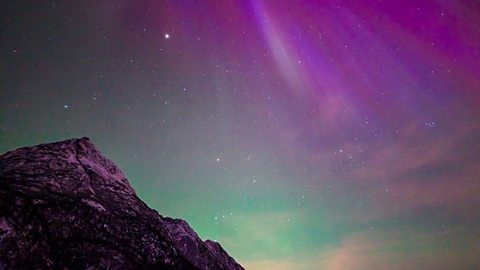
The sky doesn’t always stick to these rules. You might have seen bright lights called the Northern Lights, or ‘aurora borealis’, or heard scientists talking about them. But what are they?
An aurora is caused when the magnetic fields around the Sun and Earth interact with each other. This creates intense energy, sending charged particles into space in all directions
Earth’s magnetic field deflects most of them, but some get into the atmosphere and cause auroras. The charged particles hit molecules and atoms in Earth’s atmosphere, passing some of their energy to them.
But the atoms and molecules can’t hold this energy for long – so they release it as light. Each element lets off a different colour.
For example, green is usually the main colour in the Northern Lights. That’s because oxygen 100-200 kilometres above Earth lets off green light. Oxygen is more likely to be hit by the charged particles because it’s more common than other elements in that part of the atmosphere. It also takes longer than other elements to release the energy as light after it’s been hit.
There are also Southern Lights that happen in the southern hemisphere – the aurora australis.
The Northern Lights can happen in different places, but generally the best countries to see them are close to the magnetic north – like Iceland, Finland and Canada, especially in March, April, September and October. When can you see the Northern Lights in 2026?
This article was written in May 2026
