What are the biggest countries in the world?
Whether it's on your phone or in a textbook, have you ever looked at a map and wondered which country is actually the biggest?
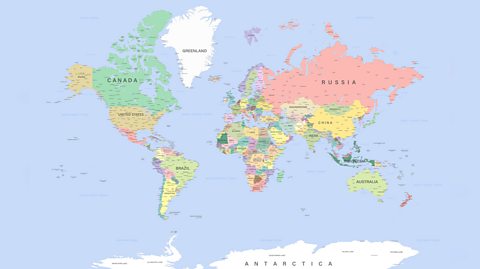
Well, most maps use something called the Mercator projection, which makes landmasses further from the equator, and closer to the poles, distorted in size. This means that on a map, somewhere like Greenland looks much bigger than Algeria, even though this isn't actually the case.
So which country can truly claim the crown of the most colossus, and which sit at the smaller end of the scale? Read the rest of this article to find out!
What is the biggest country in the world?
By area, Russia is the biggest country in the world, almost double the size of the next biggest nation.
Russia spans a total area of 17,098,242 km², making up around 11% of the Earth's total landmass. Despite this, Russia only ranks 9th when it comes to total population, due to large areas of the country being completely uninhabitable.
Top 10 biggest countries in the world
There's a few different ways to measure the size of a nation, whether it's the total area of Earth it covers, or the number of people who call it home. For this, we're mostly going to focus on the total land area of each country (measured in kilometres squared).
Curious about what countries make up the smallest list? Read on to find out!
- Russia – 17,098,242 km²
- Canada – 9,984,670 km²
- The USA – 9,833,517 km²
- China – 9,596,960 km²
- Brazil – 8,515,770 km²
- Australia – 7,741,220 km²
- India – 3,287,263 km²
- Argentina – 2,780,400 km²
- Kazakhstan – 2,724,900 km²
- Algeria – 2,381,740 km²
Whilst these may be the largest nations by total area, that doesn't necessarily correlate to population density, with five of the 10 nations listed having a smaller population than the UK. In some cases, this is because of vast swathes of uninhabitable land, whether that be down to desert or frosty climes.
The two most populated countries on the list are India and China, each home to over 1.4 billion people, meaning that – between them – they account for around 35% of the planet's population.
How big is the United Kingdom?
The total area of the United Kingdom is 242,945 km², with most estimates putting the UK between 78th and 80th when ranking the biggest countries in the world.
The population of the United Kingdom is estimated to be 69.3 million people, making it the 21st most populated country in the world.
This means, despite its total area being more than 9 million km² smaller than Canada, the UK has almost 30 million more occupants.
What is the smallest country in the world?
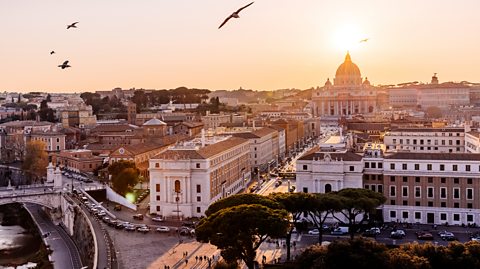
The smallest country, in both size and population, is the Vatican City.
Founded in 1929, it plays host to famous landmarks like the Sistine Chapel, St. Peter's square and St. Peter's Basilica – as well as serving as the official residence of the Pope.
The famous nation within a nation has a total land area of 0.44 sq km. Vatican City has a population of just over 500 people, including – but not limited to – the incumbent Pope, Pope Leo XIV!
Top 10 smallest countries in the world
We've been over the biggest, but what about countries on the other end of the scale. From nations within nations, to tropical islands and honeymoon hotspots, the list of smallest countries takes in the lot. So, to keep things short and sweet, here's the 10 smallest countries in the world, ranked from smallest (top) to biggest (bottom).
- Vatican City – 0.44 km²
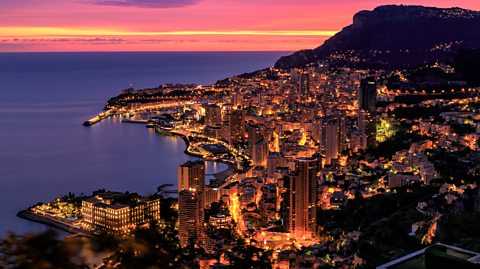
- Monaco – 2 km²
- Nauru – 21 km²
- Tuvalu – 26 km²
- San Marino – 61 km²
- Liechtenstein – 160 km²
- Marshall Islands – 181 km²
- Saint Kitts and Nevis – 261 km²
- Maldives – 298 km²
- Malta – 316 km²
Many of these countries also make up the list of least populated, with the Vatican taking the (cup?) cake, as both the smallest and least populated country on Earth. Like Monaco, which ranks second smallest, Vatican City is a country within a country, found in the city of Rome, in Italy.