Screenwriting for Playwrights
Harriet Ghost reports back from the recent event in Durham aimed at playwrights who would like to develop their work for the screen.

Earlier this month,I had the lush (and bit scary) job of cohosting the Screenwriting for Playwrights event, in partnership with New Writing North and Gala Durham.
Through Hooley Theatre, we improve arts access for underserved communities and provide talent development support, so it was exciting to collaborate with New Writing North to remove barriers to the industry for playwrights seeking opportunities for screen.
New Writing North’s Will Mackie and I introduced the event. Will coolly welcomed everyone and highlighted New Writing North’s ADAPT programme for writers looking to adapt their work for the screen. Submissions are open until 15th June and you can apply HERE.
For me, events like this are essential and applying for schemes when I didn’t think I stood a chance has paid off. The Channel 4 Writing for Television Award and BBC Writers' Voices programme have been lifelines in what can feel like a tough industry to crowbar your way into. That’s why it’s so helpful to hear insight and advice straight from the experts’ mouths.
The experts at our event were screenwriter, playwright and consulting producer, Ben Tagoe; writer and researcher, Emma Nuttall; Creative Director at FilmNation, Kirstie Macdonald; and BBC Writers Development Producer, Esther Jackson-Burton and here are some of my key takeaways.

Transitioning to Screenwriting with Emma Nuttall & Ben Tagoe
First up, Will Mackie talked to Emma and Ben about their work across stage and screen. Emma shared her journey of coming later to writing via blogging, reviewing, copywriting, PHD-ing and VR-writing. She emphasised that “all writing is writing” and everything you do is on the way to success.
Ben also came later to writing and his theatre work opened the door to TV via the BBC Writers Academy. He’s since worked in US development and writers’ rooms, as well as writing roles on Emmerdale and Coronation Street.
Ben and Emma agreed that stage and screen share core principles. Both require dramatic pull and clear stakes in every scene. Emma referenced John Yorke’s breakdown of narrative acts as a ‘rule’ for screenwriting that’s also relevant in theatre. But there is contrast, Ben described, in how theatre affords more luxury in subtle pacing and character arcs, while TV requires far more plot to sustain its audience. Emma mentioned series, like Madmen, that go against the grain with slower pacing and fewer hooks, so just lean into your own voice. Ben added that theatre can be overindulgent and TV too plotty, so there’s nothing wrong with finding both in each.
In terms of collaborating, Emma explained playwrights have more control over their writing, while a TV writers’ room is very dynamic, with everyone sculpting the story. But don’t worry if you don’t think you’ll thrive in a writers’ room, Ben reassured us, as it’s not the only way of doing it. Good news for fellow imposter syndrome sufferers!
When asked about writing a wider narrative arc for TV, it was Ben’s turn to reference John Yorke and the idea of drama being fractal. Ben starts with the bigger emotional arc across the series, then breaks down arcs within acts and scenes. It can help to decide where you want the character at the start and at the end, then work out what happens in between.
In the final audience questions, Ben advised that you can be the best playwright in the world but you really need a spec script to prove you can write for screen. Emma agreed that spec scripts are the currency but if you’ve got a play on, you should invite TV execs, producers and script editors you want to work with. So, whether you have a play you’d like to show off, or a new concept for screen, there’s a way in for you…
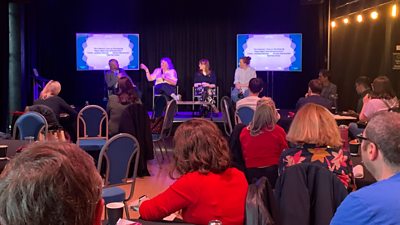
Playwright Perks and Pitfalls with Kirstie Macdonald & Esther Jackson-Burton
Next up was Kirstie & Esther. I’d I say I chaired it, but they naturally covered all my questions so I could stop sweating and enjoy the chat.
As a BBC Writers development producer, Esther often works with playwrights coming to screen and sees real value in watching a writer’s work on stage. Kirstie also works with writers who’ve come from theatre and finds that reading plays gives you a great sense of character and dialogue without all the written action you get in a TV script.
Esther encourages writers to think about the scale and story engine that’ll take you across multiple episodes. She acknowledged that the demand for story and plot can take over when you start writing for TV. The tricky part is learning to dramatise the story through action. So much can be conveyed in close-ups and small responses without needing to verbalise the emotional journey.
Kirstie added that the concept for your series needs to be really clear, giving examples like The Sopranos - a show about a gangster with anxiety, or Madmen - an ad man who can’t feel emotion. Lay out your story in the first ten minutes and set up the premise right away. There’s so much choice for TV audiences, you want them choose yours and go “Oh, I know what this is!”. Esther pushes writers to lean into the wildest ideas and “just go more batshit”. Kirstie also encourages playwrights to use their superpower of originality and find the way into that world that we’ve not seen before.
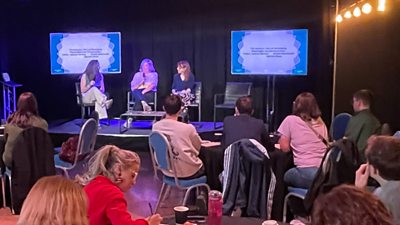
On the subject of specs, Esther clarified that it’s more difficult to take a punt on someone without a screenplay, but Kirstie urged playwrights who don’t yet have a TV spec: “Never wait because you’ll never do it. Just send the thing”. If that doesn’t make you go for it, nothing will!
Esther did, very politely, argue that if you want to work in TV, you need to watch TV, read TV scripts (see the BBC Writers' Script Library) and show you can write for TV. People have busy lives and it may take a while but it’s important to show you’re passionate about writing for TV.
Both agreed that it’s hard to define the *thing* they look for when reading scripts, but the ones that stand out usually have an unexpected way into the story. Kirstie admits that’s hard, “because how do you know what we expect?” But the consensus is to not second-guess what you think people want, as your idea might not suit Esther but might suit Kirstie.
Sharing top tips, Kirstie ‘nerdily’ used to watch ER and write down what happened in each scene, because picking apart a TV script helps you see how it works. On BBC Voices, they encourage writers to answer John Yorke’s 10 Questions (also available on BBC Writers site). I can confirm it’s a challenging but helpful way to dig into your character and, as Esther explained, the more layers you can give them, the stronger the foundation for your script.
Rounding off the afternoon, Kirstie and Esther's parting advice was to check out BBC Writers resources, read TV scripts, collaborate, talk about your ideas and keep writing and entering opportunities.
In an industry that can feel faceless and full of rejection, it was inspiring to hear from such a generous panel who were happy to demystify the process.

Writing talent is everywhere. But opportunities are not. That’s why New Writing North exists. To identify and nurture talent. To inspire a love for creative writing and reading. New Writing North has been supporting screenwriters with a broad programme of activity since 2014. Their current programme offers awards, mentoring, placements with production companies, writers’ rooms, script hubs, workshops, roadshows and one-to-one surgeries. Their growing network includes those who are totally new to screenwriting; emerging television and film writers; and writers who are experienced in different forms, but are looking to move into screenwriting.
Related Links
- Discover Screenwriting Opportunities from New Writing Northon the New Writing North website
- Explore writing opportunitieson the BBC Writers website
