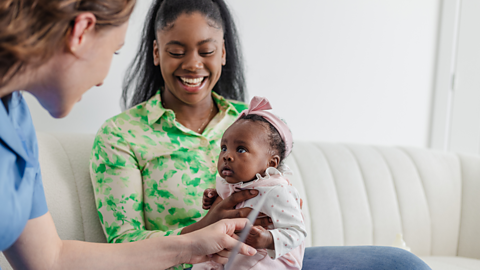
Plenty of parents talk about 'baby brain', but have you ever heard of matrescence?
It's a word increasingly used to describe the physical, psychological and emotional changes a new mum can go through as they become a mother.
BBC Health and Science Reporter Smitha Mundasad spoke to Katie Thistleton and Guvna B on the CBeebies Parenting Download podcast about matrescence.
She also talked about the 'Be Mother' project in Spain, which scanned the brains of 127 pregnant volunteers - the largest project of its kind.
They looked at the changes in the brain and they saw this really interesting pattern.” - Smitha Mundasad

1. Pregnant women lose grey matter volume, then regain some
"So the volume of the grey matter - a nerve rich layer in the brain - decreases during pregnancy before starting to come back up," Smitha says.
"I know it sounds pretty bad intuitively, but actually what these researchers are saying is, it is likely to be a case where less actually means more."
Smitha explains that grey matter in the brain is involved in “things like processing information, emotions, empathy."
She continues, "Researchers found grey matter dips by about 5% before gradually starting to come back up during pregnancy and after pregnancy. The researchers think this process is a way of the brain "fine tuning" itself to prepare itself to work more efficiently for motherhood.
"One of the lead researchers, Professor Susana Carmona, told me she likes to think of it like the process of pruning a tree."
"You have to get rid of some of the branches to make it more efficient." - Professor Susana Carmona
2. Brain changes could help mums bond with babies
Losing grey cells sounds scary, but it could actually be a positive thing, explains Smitha.
"What they (researchers) think is happening is the brain is kind of fine tuning, rewiring to adapt for motherhood.”
She adds that mums were asked to fill out questionnaires about how they felt, and researchers discovered that mums with more neurological changes felt more bonded with their babies.
"The greater the changes that those women had on their brains during pregnancy, the better they felt and the more bonded they felt with their babies."
"There's also lots of research on brain changes in adolescence that shows the brain goes through a similar period of change as it matures into adulthood. So the researchers think these brain changes could be positive, as mothers brains adapt for motherhood."
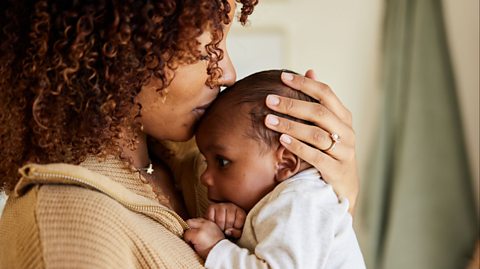
3. 'Matrescence' can be more positive than 'baby brain'
Smitha says “using words like 'baby brain' can be a “really negative way of thinking about what happens to the brain in pregnancy”.
She says that talking and thinking about 'matrescence' could make it easier for new mums to navigate a period of intense transition - it could give them a word to start discussing the changes they are experiencing in a more positive and all-encompassing way.
Even as a trained medical professional, Smitha says she was unprepared for the identity shifts she experienced as a new mum.
“I wasn't ready for the intensity with which it changed me,” says Smitha.
“As the women, the volunteers in Spain said to me, knowing about the research on the brain and being able to talk to other mothers about the changes they were experiencing, made them cherish who they were becoming."
"I kind of wish I'd had that word, matrescence, to help me through all of that."

4. Matrescence could be similar to adolescence
Zoe Blaskey, author, podcast, host, and founder of Mother Kind, says that "adolescence is often thought of as a time of physical, neurological and emotional change."
“Typically our teenagers are given quite a lot of grace and space, and hopefully support… as [they] go through that process.”
Like teenagers, new parents can experience emotional upheaval, sleep disruption and changes to their social life.
Zoe adds: “What matrescence tells us is that actually, no, there's this huge transition actually - every single element of your life gets changed.”
She adds that matrescence can be a “really bumpy ride.”
"And no woman will experience it the same, just as no human experiences adolescence the same.”
5. When does it start and how long does matrescence last?
Some mums can begin to experience matrescence well before pregnancy, says Zoe.
“I started changing from the moment I even thought about getting pregnant and if you had fertility struggles, loss, there's so much that we go through before we even get to the point of being pregnant, let alone through the birth and having a baby.”
She adds that matrescence can last for up to a decade, and that “every time that you become a mother again, you experience your matrescence again”.
Each version of it might be different, and “it's not got an end point,” says Zoe.

6. Experiencing upheaval and uncertainty is normal for mums-to-be.
“I think it's okay to feel different when you're pregnant and when you have a baby,” Smitha says.
"It's okay to slightly not recognise yourself. It's okay to be kind to yourself, to give yourself time to kind of sit in this new space and work out who you are.”
Read more about your brain during pregnancy with BBC News.