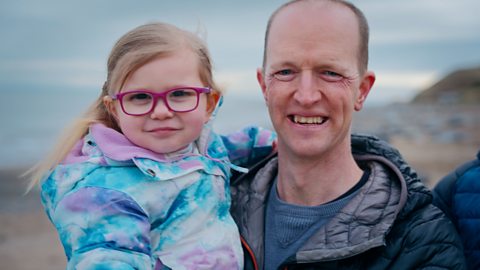
Souleyman is a father to three young children, which includes caring for his daughter who has diabetes.
When Souleyman was a child, he was diagnosed with Retinitis Pigmentosa, an inherited condition that causes cells in the retina (the light-sensitive layer at the back of the eye made up of rods and cones), to deteriorate over time.
In this video, he talks about parenting with a vision impairment.
Watch Souleyman's story of parenting with a vision impairment
“I want to see my children’s faces. I want to be able to play with them. I want to make memories…” - Souleyman
CBeebies Parenting spoke to Dr Louise Gow and Karen Hirst from the Royal National Institute of Blind People, to find out more about the challenges parents with vision impairments can face and the support available to them.
What’s it like living with Retinitis Pigmentosa?
There are many different vision impairments that range in their cause and severity.
One of the most common eye conditions is Retinitis Pigmentosa (or RP) – an inherited vision impairment that Souleyman lives with.
RP primarily causes peripheral vision loss, affecting the ability to see things at the edge of your main focus.
It progresses with time as Louise explains: “The first thing that someone will notice is that their night vision starts to get bad. Then they start to lose some of their peripheral vision.
"Then ultimately most people with RP will have some impact on their central vision. That might create a kind of 'tunnel effect'.
"Over time, a lot of people may eventually be left with a very narrow field of vision. Their central vision can remain intact for many years - but ultimately, most people will have some loss of their central vision too."
As Retinitis Pigmentosa refers to a range of conditions, its effects will differ from person-to-person.
Retina UK is an organisation that provides specific advice and support about RP.
What support might a parent with a vision impairment need?
Karen and Louise’s advice for people wanting to support new parents who have a visual impairment, is to start with the understanding that vision impairment is a spectrum.
Karen: “It starts with someone understanding the actual nature of the eye condition.
"As a family member or friend, assume someone can do something until it becomes apparent that it's going to be a challenge for them. At that point, have the conversation about what it is that they need.
"There is a such a different range of experiences. We do hear people coming to us saying, ‘Even within my closest family group, people still don't understand my eye condition, and therefore make a lot of assumptions.’”
Louise adds: “Sometimes, family members assume that the parent can't do something, but what someone really needs is some support to do it for themselves.
"So, it's about asking someone with a vision impairment what support they might want - and that will vary from person to person.”
“We can do the job, we just need a bit of breathing room from society to get the job done.” - Souleyman
How can a parent with a vision impairment support their child’s learning?
Karen and Louise say that a parent with a vision impairment might place an emphasis on verbalising the world around them to their child.
“You probably find that becomes part of the parent’s relationship with the child – a lot of talk, a lot of description,” Karen says.
“So reading a story might not always be just about reading the words on the page, but it might be interpreting that story and having a conversation about it.
"A parent with a vision impairment might also find they rely more on verbal interaction with their child when out and about. If the parent can't see where the child is, they can ensure they hear them - so a 'call and response' comes in really handy for that."
Karen adds, "Talking and narrating about what's going on around you is a big part of people's lives anyway. For a parent with a vision impairment, if their child is sighted, the child will probably end up doing that for the parent as well.
"So using words rather than visual information becomes a little bit more of their natural relationship and interaction."
Louise says, "I think you do tend to find that kids are really, really adaptable and very accepting as well, because it will be normal to them.
"The parents will learn alongside the children and the children will naturally step into that sort of role.’
"Using words rather than visual information becomes a little bit more of their natural relationship and interaction."

What other support is out there?
Karen and Louise are keen to emphasise that there is support available to parents who have a vision impairment, like Souleyman.
Karen says, “The first step is to have the confidence to actually say ‘I am going to need help. And by asking for help, that doesn't make me any less of a parent.'"
She adds, "Parenthood is very much a journey for anybody, and it doesn't come with a set of rules. It doesn't come with a road map. It is about finding your own journey and adapting."
"In the delivery room, there was an opportunity for me to cut my daughter's umbilical cord. They held my hand and put the scissors in place. That was the first time something in me lit up and I thought, 'I can do this'." - Souleyman
Karen and Louise say there's help online, for example communities and support groups, for people with eye conditions.
There are also local sight loss organisations that help people to maintain independence and have social connection.
Karen: "It helps parents to be within a community that understands them, and who they can share experiences with.
Just have confidence in the fact that you, like any other parent, are going to be learning from scratch. But there's help out there.
Don't ever feel like you’re doing it on your own.”
"It is about finding your own journey and adapting."
The following organisations are some of those offering support to people with a vision impairment: