Summary

Send us your views

  1. Best match - BBC reporters on the World Cup so farpublished at 14:18 BST

    Uruguay 2-2 Cape Verde & England 4-2 Croatia

    Opinions very much split on this one, with Cape Verde's shock draw against Uruguay and England's encouraging opening win over Croatia both earning two votes apiece.

    Alex Howell, BBC Sport's England reporter: England's second-half performance against Croatia was really exciting and showed how the Three Lions could play when they're at their best. They haven't replicated it yet, but that showing proves they could be a threat in this tournament. They produced free-flowing attacking football and it was arguably the best 45 minutes of this tournament.

    John Bennett, BBC World Service: Cape Verde's 2-2 draw with Uruguay was not a game I saw live from the stadium, but watching on from afar on TV it brought back great memories of covering this very likeable team in their journey to the quarter-finals of the Africa Cup of Nations in 2013 and 2023. From Kevin Pina making history with Cape Verde's first World Cup goal with that long range free-kick, to the side's fightback from 2-1 down and then the chaos of the final stages when both teams had chances to win it. To add to the fun, the cameras kept picking out Luis Suarez in the crowd going through all the possible emotions and looking like he was desperate for this experience to end. More Cape Verde chaos, please.

    Media caption,

    Cape Verde continue to surprise with entertaining Uruguay draw
  2. Best player - BBC reporters on the World Cup so farpublished at 14:17 BST

    Lionel Messi

    Honourable mentions here to France's Michael Olise and Kylian Mbappe, but Lionel Messi just about gets the nod.

    Ian Dennis and Phil McNulty were on the same page again here, as was BBC Sport's Spanish football expert Liz Conway.

    Liz Conway, BBC Sport journalist: Six goals in three World Cup games and Lionel Messi is looking as sharp as ever. His humility with press off the pitch is equally as admirable, while on the pitch he has an aura that few sportspeople in history have possessed. Every time he plays, it feels like you're watching something special.

    Media caption,

    All of Messi's record-breaking 18 World Cup goals

  3. Best team - BBC reporters on the World Cup so farpublished at 14:16 BST

    France

    Responses to this question were pretty universal from the BBC World Cup team, with five of the seven asked in a feature for BBC Sport picking France:

    Ian Dennis, BBC Radio 5 Live: They've made it three wins from three for the first time since they won the World Cup in 1998. They're still not perfect, so room to improve as they get stronger under a manager who has the experience to draw on, as Didier Deschamps seeks a third successive World Cup final.
    Phil McNulty, BBC Sport's chief football writer: Just looking at their attack with Kylian Mbappe, Michael Olise and Ousmane Dembele and what it can do when it clicks - and the strength of Didier Deschamps' squad as a whole - makes me think they will be very difficult to stop. There are other strong contenders, but they are the most dangerous team in the tournament.

    For the record, BBC World Service's John Bennett, BBC Sport's England reporter Alex Howell and BBC Sport journalist Neil Johnston also plumped for France.

    Media caption,

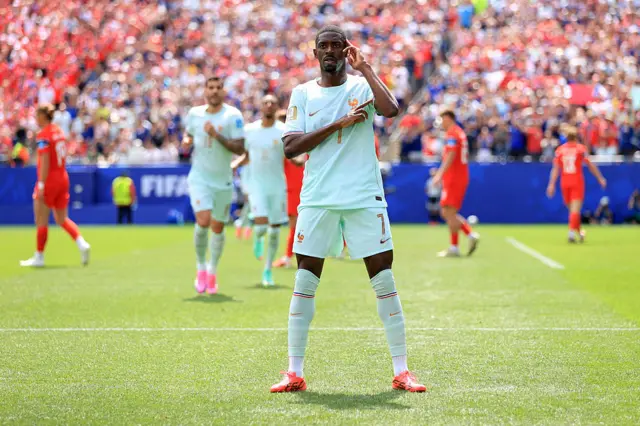
    17 passes, all 11 players - Dembele scores 'magic' goal for France

  4. Postpublished at 14:14 BST

    Vozinha had 50,000 followers on Instagram before the 2026 World Cup began.

    He has 17.2 million now.

  5. Best moment - BBC reporters on the World Cup so farpublished at 14:13 BST

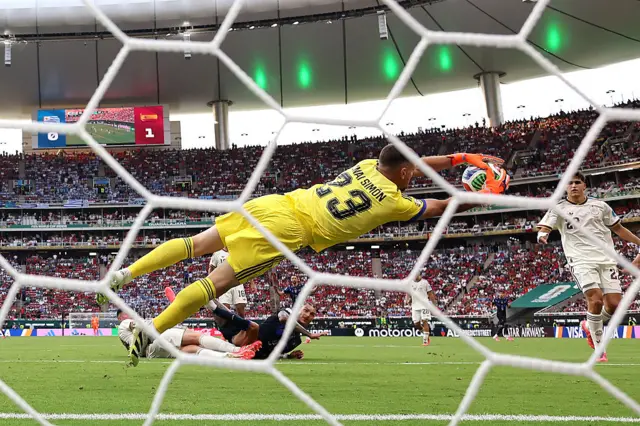
    Vozinha's clean sheet against Spain

    With so many moments so far in an extended group stage, it's not surprising that there is a spread on this one, but two reporters picked out Vozinha's man-of-the-match display in goal for Cape Verde in their shock draw against European champions Spain.
    Ian Dennis, BBC Radio 5 Live: Cape Verde surprising Spain on their World Cup debut and the subsequent reaction of their goalkeeper Vozinha. His emotions post-match after his sparkling display of seven saves was so touching - and what a moment for the entire nation. A reminder not all heroes wear capes…sometimes they come in a yellow jersey.

    Liz Conway, BBC Sport journalist: Not many people would have imagined that Cape Verde's 40-year-old goalkeeper, Vozinha, would become the hero of his country's World Cup debut against Spain. His performance, which was backed by incredible support from the fans, turned Cape Verde into everyone's second team. It's the kind of underdog story that makes the World Cup so special, and now they've topped it off by reaching the knockout stages.

    Media caption,

    'He's the story' - Vozinha's goalkeeping heroics thwart Spain

  6. Postpublished at 14:12 BST

    I love stats as much as the next man, but sometimes it's less about numbers and more about moments.

    Things that don't necessarily jump out on a spreadsheet but become memorable in their own right. Think Tshabala's goal in the opener for South Africa in 2010, or Roger Milla's iconic corner flag dance in 1990.

    Our reporters have been having their say on the key moments from the 2026 World Cup so far.

  7. Opta’s World Cup team of the group stagepublished at 14:06 BST

    Prudent Nsengiyumva
    BBC Sport journalist

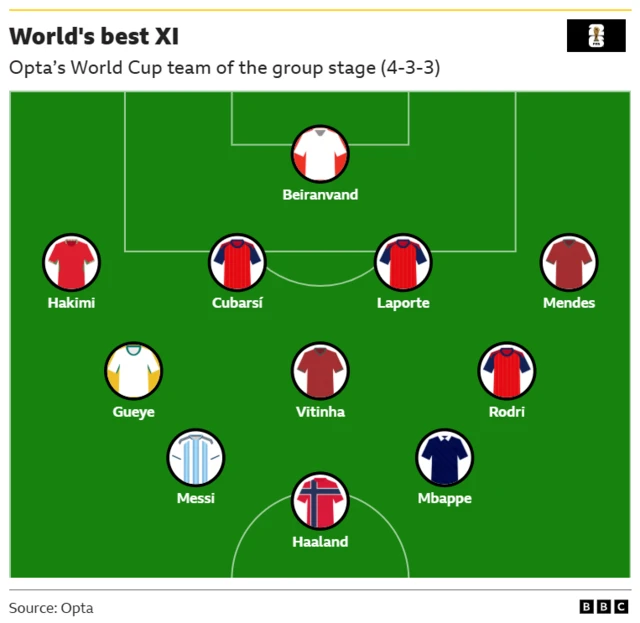
    Messi tops Opta’s group‑stage ratings with a standout 93.3, leading a star‑studded best XI.

    The team, set out in a 4‑3‑3 and based on player ratings, is dominated by Spain and Portugal, whose control and consistency form the backbone of the side. Spain provide centre‑backs Pau Cubarsi and Aymeric Laporte, with Rodri anchoring midfield — his influence central to their ability to dictate tempo and manage games.

    Portugal match that strength, with Nuno Mendes and Vitinha both included after standout displays. Morocco’s Achraf Hakimi adds pace and attacking thrust on the right, while Senegal’s Pape Gueye completes a midfield built on energy, balance and defensive discipline.

    In goal, Iran’s Alireza Beiranvand earns his place after a series of key interventions under pressure.

    Up front, there are no surprises. Lionel Messi, Erling Haaland and Kylian Mbappé lead the line, combining elite finishing with consistent end product. Messi, the highest‑rated player in the XI, stands out in particular.

    England miss out after a flat group stage. Harry Kane may have three goals, but he hasn’t hit his usual heights, and England’s displays were steady rather than convincing, Croatia aside.

    Graphic showing 11 best players in World Cup group stage
  8. Postpublished at 14:06 BST

    We mentioned that Lionel Messi is the highest-rated player from the World Cup group stage, but he's not alone in impressing early on in the competition.

    Opta have also created a 'team of the group stage' which features the best performers so far.

  9. The bench is making the differencepublished at 14:00 BST

    Mohamed Moallim
    BBC Sport

    The group stage has underlined the value of strength in depth.

    Substitutes have scored 37 goals, the highest total recorded at a men’s World Cup since replacements were introduced in 1970.

    Just as important has been when those goals have arrived. Thirteen have either earned a team a point from a losing position or turned a draw into a victory, already exceeding the totals from 2022 (11) and 2018 (seven). Only the 2014 World Cup (17) has seen more.

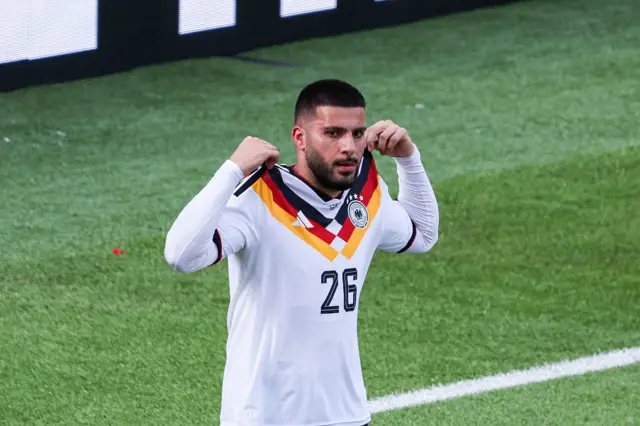
    Germany’s Deniz Undav provided perhaps the best example. Introduced with his side trailing Ivory Coast 1-0, he struck twice to complete the turnaround, becoming only the sixth substitute to score two match-changing goals at a World Cup since 1970.

    The figures reflect how international football has evolved. Coaches now have 26-man squads and five substitutions to call upon, allowing them to reshape games long after the starting XI has left the biggest imprint.

    As the knockout stage begins, matches are only likely to become tighter, making those contributions from the bench even more valuable.

    Germany’s Deniz Undav celebrates after completing a two-goal turnaround against Ivory Coast, becoming only the sixth substitute to score twice and change the result of a men’s World Cup match since 1970Image source, Getty Images
    Image caption,

    Deniz Undav celebrates after coming off the bench to score twice in the comeback victory over Ivory Coast

  10. Hot shots, cold streaks: Group stage finisherspublished at 13:57 BST

    Prudent Nsengiyumva
    BBC Sport journalist

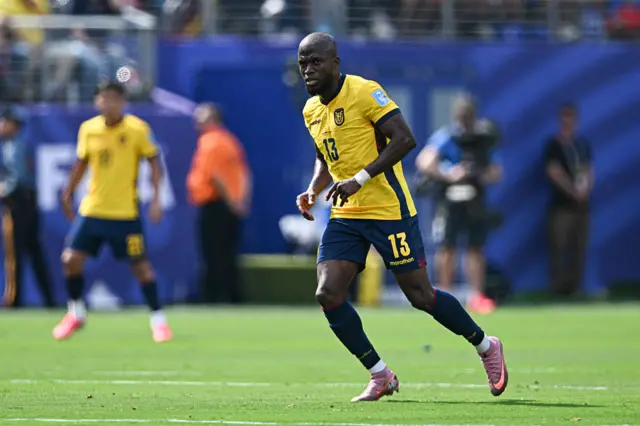
    Enner ValenciaImage source, Getty Images

    The group stage has exposed a clear divide between the tournament’s most clinical forwards and those struggling to convert. Erling Haaland and Lionel Messi have led the way, both scoring with 40% of their shots, while Kylian Mbappé also ranks among the most efficient, with four goals in the group stage.

    Messi, though, stands apart for his ruthlessness — his six goals have come from just 2.69 expected goals, highlighting a remarkable level of overperformance. Even at 39 and now playing in MLS, he remains one of the most clinical players in the game.

    Elsewhere, players such as Vinicius Junior, Ismaïla Sarr and Ismael Saibari have also made their chances count, underlining the importance of precision in tight group-stage matches where opportunities can be limited.

    At the opposite end, several high-profile names have found finishing far more difficult. Enner Valencia, Federico Valverde and Hakan Çalhanoglu are among those to register 10 or more shots without scoring, a costly lack of cutting edge at a stage where fine margins often define progress.

    Notably, no England players feature at either extreme, reflecting a more balanced, if less decisive, attacking output — with Thomas Tuchel likely keen for greater cutting edge from his forwards, including Harry Kane, in the knockout stages.

  11. Errors have been punishedpublished at 13:53 BST

    Mohamed Moallim
    BBC Sport

    Building from the back has carried a heavy price at this World Cup.

    There have been 157 errors leading to shots across the opening 72 matches, more than the previous two tournaments combined.

    The first came just nine minutes into the tournament, when South Africa’s Sphephelo Sithole was dispossessed on the edge of his own area before Julián Quiñones scored for Mexico.

    The expanded 48-team format has created more mismatches between the world’s strongest sides and emerging nations. There were 30 group-stage games featuring teams separated by at least 30 places in the FIFA rankings, compared with 12 in 2022.

    Many underdogs have remained committed to playing out from the back, but against elite pressing sides even the smallest mistake has often resulted in a chance at goal.

    Julián Quiñones celebrates after scoring for Mexico against South Africa following a turnover on the edge of the areaImage source, Getty Images
    Image caption,

    Julián Quiñones celebrates Mexico’s opener after South Africa lost possession high up

  12. Own goals are piling uppublished at 13:48 BST

    Mohamed Moallim
    BBC Sport

    Twelve own goals have already been scored at the 2026 World Cup, equalling the tournament record set in 2018.

    Even allowing for the expanded 48-team format, they have arrived at a remarkable rate.

    Some have come from desperate attempts to cut out crosses, others from unfortunate deflections, highlighting how little margin for error there has been inside the penalty area.

    Whether that pace continues into the knockout rounds remains to be seen, but 2026 has already matched one of the tournament’s more unusual records.

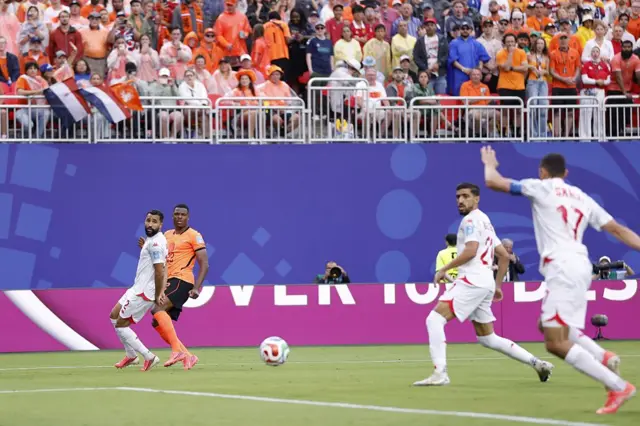
    Tunisia midfielder Ellyes Skhiri inadvertently scores an own goal during his side’s World Cup group-stage match against the NetherlandsImage source, Getty Images
    Image caption,

    Tunisia’s Ellyes Skhiri turns the ball into his own net against the Netherlands. Own goals have already matched the World Cup record for a single tournament

  13. Postpublished at 13:46 BST

    And it's not just the attacking players who are contributing to this increase in goals either...

  14. Finishing is beating the numberspublished at 13:44 BST

    Mohamed Moallim
    BBC Sport

    Goals have been flowing at this World Cup, and not just because teams are creating more chances.

    The group stage produced 215 goals from around 185 expected goals (xG), meaning players scored roughly 30 more goals than the quality of chances alone would suggest.

    That cannot simply be explained by more long-range efforts, with the proportion of shots from outside the penalty area (38%) unchanged from 2022 and lower than in 2018. Nor has there been a significant increase in headed goals, which account for 14% of all goals this summer.

    Perhaps the best example came from Ousmane Dembélé, who completed his hat-trick against Norway from chances worth just 0.19 xG. Since records began in 1966, only Hungary’s László Kiss produced a World Cup hat-trick from a lower xG total (0.17 in 1982).

    The numbers suggest finishing has simply been far more efficient than the quality of chances alone would predict.

    France forward Ousmane Dembélé celebrates after scoring against Norway during a 2026 World Cup group-stage matchImage source, Getty Images
    Image caption,

    Ousmane Dembélé completed his hat-trick against Norway from chances worth just 0.19 expected goals, the second-lowest xG total for a men’s World Cup hat-trick since 1966

  15. Postpublished at 13:44 BST

    It does feel like the goals have been flying in this World Cup.

    To have more than 10 players scoring three goals or higher at this stage of the competition feels unheard of compared to previous competitions.

    Of course, 48 teams allows for an increased chance of goals simply by more games taking place overall.

  16. More red cards despite fewer foulspublished at 13:37 BST

    Mohamed Moallim
    BBC Sport

    This World Cup has not exactly been dirty.

    Across the opening 72 games, there have been 22.3 fouls per match, down from 25 per game in 2022 and 27 per game in 2018.

    And yet there have already been 10 red cards, more than the previous two World Cups combined, with four shown in 2022 and another four in 2018.

    There are some caveats. The expanded 48-team format means there are more matches, and two games account for half the dismissals: Mexico’s opener against South Africa had three red cards, while Qatar had two players sent off against Canada on Matchday Two.

    The record remains some distance away, with 28 red cards shown in 2006, including Zinedine Zidane’s dismissal for headbutting Marco Materazzi in the final.

    Still, it is an interesting contrast. The group stage has been cleaner by foul count than the previous two editions, but the biggest offences have been punished severely.

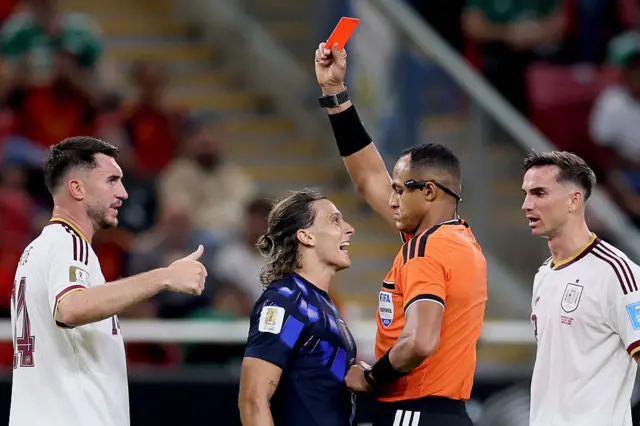
    The most unusual dismissal came when Paraguay’s Miguel Almiron became the first player to be sent off for covering his mouth during a “confrontational situation” against Turkey, following the introduction of the new rule this summer.

    Referee Ismail Elfath shows Uruguay’s Agustín Canobbio a red card during the Group H match against Spain as players look onImage source, Getty Images
    Image caption,

    Uruguay’s Agustín Canobbio is shown a straight red card against Spain, becoming the 10th player sent off at the 2026 World Cup

  17. Spain and Mexico remain unbreachedpublished at 13:34 BST

    Mohamed Moallim
    BBC Sport

    Mexico and Spain were the only teams to progress through the group stage without conceding a goal. It is the first time Spain have completed a World Cup group campaign with a perfect defensive record.

    Unai Simon has now gone 430 consecutive World Cup minutes without conceding, moving closer to Walter Zenga’s tournament record of 517 minutes for Italy in 1990. Thibaut Courtois and Alisson also continued their impressive World Cup records, taking their career clean-sheet totals to eight and seven respectively. The all-time record is 10, jointly held by England’s Peter Shilton and France’s Fabien Barthez.

    Spain goalkeeper Unai Simón dives to make a save during the Group H match against Uruguay at the 2026 World CupImage source, Getty Images
    Image caption,

    Unai Simón makes a save against Uruguay as he moved closer to Walter Zenga’s World Cup record

  18. Messi tops Opta ratings after outstanding group stagepublished at 13:30 BST

    Mohamed Moallim
    BBC Sport

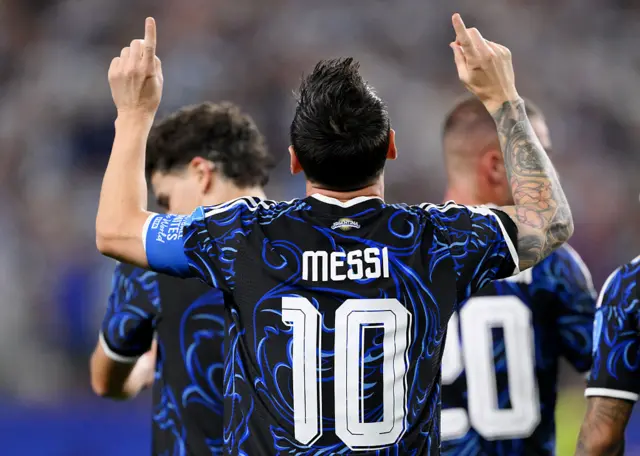
    Six goals, the highest Opta rating and the biggest positive expected goals difference. Lionel Messi has once again set the standard.

    The Argentina captain finished the group stage with an Opta rating of 93.3, the highest of any player at the tournament. His six goals also lead the Golden Boot race, while his +3.31 xG overperformance is the best in the competition, highlighting just how clinical he has been in front of goal.

    Messi’s performances helped Argentina become one of only three teams to finish the group stage with a maximum nine points, alongside France and Mexico.

    Argentina captain Lionel Messi celebrates after scoring during Argentina’s World Cup group-stage win over JordanImage source, Getty Images
    Image caption,

    Lionel Messi celebrates after becoming the first player to score in seven consecutive World Cup appearances and extending his lead in the Golden Boot race with his sixth goal of the tournament

  19. Let's delve into the statspublished at 13:28 BST

    Opta have been keeping track of all of the statistics from the 2026 World Cup so far, from xG performance to number of fouls, and everything in between.

    It's time to look at some of the key stats from the group stage, and there's no prize for guessing which player has the highest overall rating...

  20. 'We are no longer minnows, we've closed the gap'published at 13:24 BST

    England v DR Congo (Wed, 17:00 BST)

    BBC Radio 5 Live

    Former DR Congo defender Gabriel Zukuani speaking to BBC Radio 5 Live: "Our strength has been the players who play in top leagues. We are no longer minnows. Players with dual nationality are choosing to play for the DRC now. Top players are used to playing in front of big teams and it's helped close that gap."

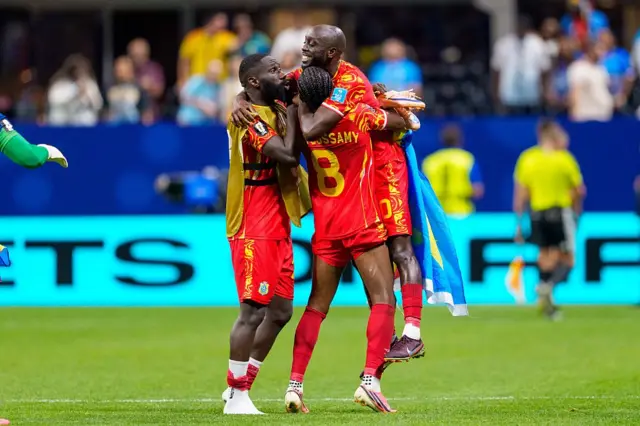
    Arthur Masuaku #26 and Yoane Wissa #20 of Congo DR celebrate a win with teammates after the FIFA World Cup 2026 Group K match between Congo DR and Uzbekistan at Atlanta Stadium on June 27, 2026 in Atlanta, Georgia.Image source, Getty Images