How the weather can shape the tactics of a football nation
- Published
Much has been made of the heat in which matches will be played at this World Cup, and that will naturally impact tactical approaches and performances on the pitch.
But the effect of the weather goes beyond just conditions on matchday.
Some of football's top minds - former managers Arsene Wenger and Fabio Capello, for example - have made the argument the climate of a country directly affects the type of football they play, impacting the players they develop.
Weather can therefore shape football on two levels: immediately, by altering what teams are able to do during a match; and over time, by influencing how generations of players train and develop.
The impact of heat on World Cup tactics
In a 2024 study, the impact of air temperature, relative humidity and wind speed on teams' technical performances in the Champions League was assessed, with data collected over five seasons.
Higher temperatures, the study found, led to fewer shots following counter-attacks, fewer completed dribbles, and an increase in shots from distance. Higher humidity was also associated with fewer completed dribbles.
In the Premier League this season, there has been a rise in the use of powerful wingers capable of playing one against one as a way of breaking defensive shapes down.
Looking at the England squad, that helps explain the inclusion of players such as Marcus Rashford, Anthony Gordon, Noni Madueke and Bukayo Saka.
Such wingers are also tasked with pressing intensely from the front - and it is something England boss Thomas Tuchel is likely to persist with on both fronts.
But given those tactics are harder to execute in the heat, it will be interesting to see how those players cope.
This season we have also seen a rise in runs from deep from full-backs to arrive in dangerous attacking positions. Think Manchester City's Nico O'Reilly, and Paris St-Germain pair Nuno Mendes and Achraf Hakimi.
But higher temperatures being associated with fewer counter-attacks resulting in shots suggests team may run out of steam towards the end of more vertical attacks, and such players may struggle to execute these more dynamic movements.
If they are to, it may have to only be in certain phases of the game - built on a game model that prioritises possession and rest while on the ball.

Thomas Tuchel has opted to use full-backs to make dynamic runs from deep into central attacking positions - a trend seen in club football at the highest level
How will the weather affect the opening games of the World Cup?
- Published11 June
How Chelsea adapted at the Club World Cup
The phase-based approach won't only be something to look out for when teams are in possession. It impacts them off the ball, too, including how they press.
In last summer's Club World Cup - in a hot and humid United States - then Chelsea boss Enzo Maresca masterminded victory over PSG in the final.
"The idea was to go man-to-man," he said.
"PSG are so good that if you give them time, you are going to struggle. You have to press them very intensely. In the first 10 minutes, we were able to do it. It probably set a little bit the tone of the game."
Chelsea's ability to go man-to-man as intensely dwindled as the game went on but starting so intensely meant they opened an unassailable 3-0 lead.
For England, the decision to bring similar profiles of players in specific positions, Rashford and Gordon for example, does however provide them the option to rotate readily and preserve energy whilst retaining the style and balance of the starting eleven.
Echoed again by Maresca, who last June said "it's not easy because of the temperature, and this is one of the reasons why we try to rotate players."

An example of Chelsea's man-to-man press against PSG early in the game. Centre-back Trevor Chalobah tracked striker Ousmane Dembele as far as Chelsea's attacking line.
Why the wind helps explain England's style of play
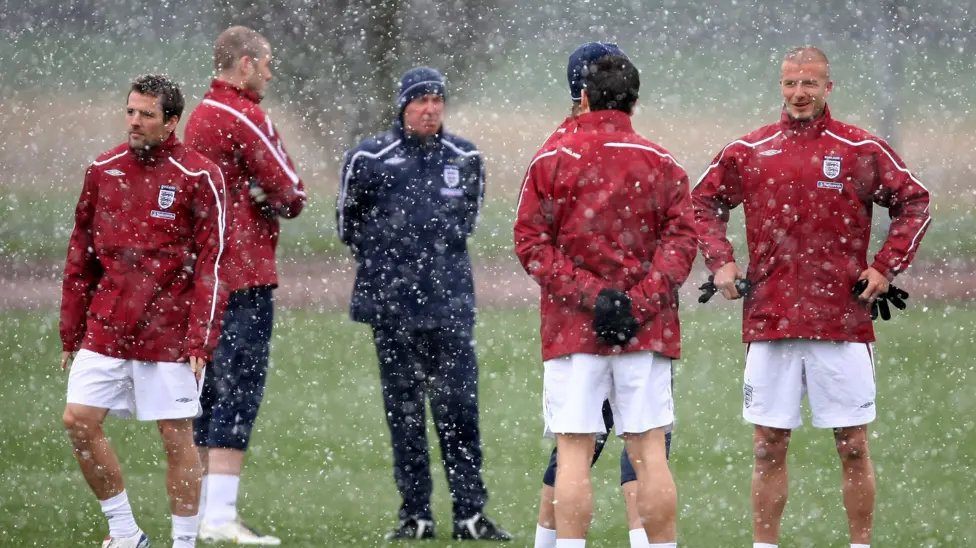
While the weather obviously impacts the performances of individual players during a match, its implications are wider reaching.
Former Chelsea boss Gianluca Vialli explored the impact of weather conditions on a nation's footballing philosophy in his book The Italian Job.
In it, a quote from ex-England boss Capello stands out.
"It's all about the climate," he said. "I had a long discussion about it when I went to Scotland to see [former national boss] Andy Roxburgh. I worked with a Scottish youth side and had them do the same drills I would do in Italy.
"I realised that between the wind, the rain and the cold, there was no way they could do it. How can you possibly teach anybody anything in those conditions?
"To me, it's pretty obvious and explains why Brazilians are more technical than Europeans and, in Italy, the further south you go the more technical they are."
Vialli then looked at the average temperature in three English and three Italian cities across a season, but there wasn't a clear enough difference in temperature to make any conclusions.
Players and managers have, however, spoken about the harsh cold of England - and that experience is best explained by looking at the difference in wind speed.
At the time Vialli wrote his book - more than 20 years ago - the average speed of wind in England was 50% greater than in Italy, and may have unknowingly informed the football education of its playing population.
Speaking in 2015, it was something new Liverpool boss Jurgen Klopp had noticed.
"The English game is not faster than the German game," he said. "Perhaps there are a few more sprints. But there is a different style of football here, partially due to the weather.
"The wind can be quite extreme in England. We are not familiar with that in Germany and you have to keep things simple. Players who are not from the UK have to get used to the winds.
"I have to adapt my style of football as a result as well. Often, you are forced to keep things simple. And there are a lot more duels for the second ball here, and more duels in general. That makes the game even more intense."
At a more granular level, former Arsenal boss Wenger believed the wind and perception of cold prevented players in England from focusing on tactical instructions while training.
"One of the first things I had to get accustomed to as soon as I arrived in England was the weather," he said.
"I don't mean the temperature or the rain but - most of all - the wind. The wind ruins everything. It forces you to do only one type of exercise. It forces you to work on either speed or continuous movement.
"It's very rare that you get the chance to sit calmly and work on technique or on tactics. You have to keep the players moving, otherwise they get cold. And this is something which begins way back when they are children."
There has naturally been a shift and greater focus on the tactical game in England - particularly through the likes of Klopp, departing Manchester City manager Pep Guardiola, and former Chelsea and Tottenham boss Antonio Conte.
Tuchel will be hoping that league-wide education of Premier League players will have helped bridge any tactical gaps - but having grown up in the cold, wind and rain, if England are to achieve football greatness, it will be in a very unfamiliar climate.
