Tactical analysis: England look exciting but how can they tighten up?
Highlights: A six-goal thriller ends England 4-2 Croatia
- Published
England's 4-2 win against Croatia was full of exciting attacking football but the defensive part of the game raised some eyebrows with them looking open on a number of occasions.
In football, what a team does in attack impacts how they defend and vice versa so it is important to assess both the on-the-ball and off-the-ball tactics together.
In this piece, we analyse the reasons why England looked less defensively secure in their World Cup opener compared with previous games under Thomas Tuchel.
This was an England we haven't seen for years - and it was fun
- Published18 June
From one to 48 - every World Cup team ranked after first game
- Published18 June
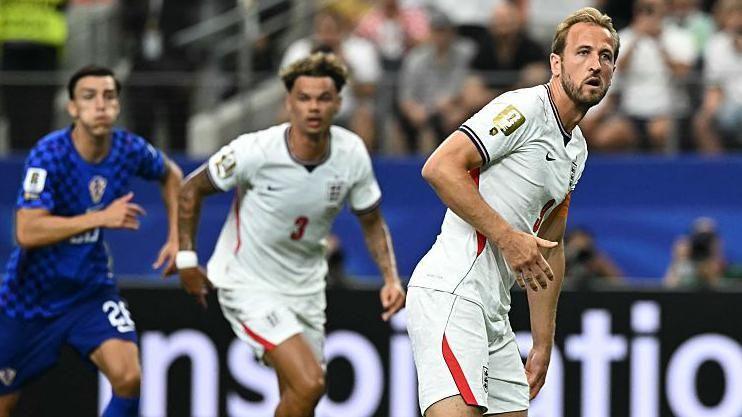
Kane stuck in midfield when England lost the ball
In the first half, England launched numerous dangerous direct attacks.
They did this by first looking to pass the ball back hoping to entice the opposition to press high.
Declan Rice pulled into a wide position, vacating his central midfield position, leaving space into which Harry Kane would drop deep.
With Croatia pressing high in numbers, Kane then looked to launch long passes into England's runners – Anthony Gordon, Jude Bellingham and Noni Madueke - who found themselves three against three at times.
This resulted in England creating big chances but it also meant that if they were to lose the ball in earlier parts of their build-up play, Kane rather than Rice would be in central defensive areas.
This partly explains some of their defensive instability and can be seen in the example below.

Nico O'Reilly misplaces a pass in-field for Harry Kane (yellow) and England lose the ball. Kane's position here makes him a weakness defensively. Top right of the picture, Declan Rice (white) is far from where he can make an impact defensively.
Frequent turnovers when playing too direct
In looking to pass the ball backwards to entice pressure from Croatia, before looking to play long into the space, England at times got the balance wrong.
Anthony Barry, England's assistant coach, spoke at half-time about this issue.
"I think a lot of nervous energy early on," he said. "Then we made some decisions, playing long when we should play short, playing short when we should play long, not playing through the gaps to accelerate our game the way we wanted to."
By playing too direct early and often, England turned the ball over perhaps more than they would have liked. This created a first half that was more end-to-end, leaving spaces for the opponents to attack.

After dropping deep, Kane plays a long pass that doesn't find a team-mate. The ball falls to a Croatia midfielder in space as England's runners track back. Kane (yellow) is now, momentarily, in a holding midfield position defensively.
Another factor that contributed to England turning the ball over was Croatia's deliberate effort to press Jordan Pickford when he got on the ball.
Using him as a pressing trigger forced the Everton goalkeeper to punt it long on occasion, giving control back to Croatia.

After pressing Konsa, the Croatian attacker continues to press Pickford, forcing the keeper to kick long, resulting in England losing the ball.
Pressing over large distances left England open
Having explored reasons why England's on-the-ball tactics contributed to defensive frailties, it makes sense to look at how they set up off the ball.
In the first half, Gordon, Kane and Madueke looked to press Croatia's back three.
When the ball went out to Croatia's right wing-back, Nico O'Reilly had to cover large distances to get up the pitch and apply pressure. This gave their wing-backs time and space to progress the ball up the pitch.

England's front three lock on to Croatia's back three. Nico O'Reilly is forced to make a long-distance run to close down the wing-back but is unable to do so quickly enough.
Man-marking habits costly when defending deep
England's willingness to press led to a few issues when they defended closer to their own goal.
When pressing high, players tend to lock on to a specific opposition player in a man-to-man fashion. When dropping into a lower defensive shape, the England players were caught in two minds, often choosing to track their man rather than defending in a more traditional zonal manner.
In the build-up to Croatia's second goal, Kane tracks a run from Modric, finding himself in what looks like a holding midfield position.
Madueke goes into central midfield and Bellingham compensates by defending out wide. These roles don't suit any of those players.

Because Kane tracks Modric (centre of the pitch), England find themselves with Jude Bellingham defending on the right of midfield and Noni Madueke in a central midfield position.
Throughout the game, we saw England move from a back four into a back five when defending, with Elliot Anderson or Rice dropping in.
In theory, this would have been to match up numerically with Croatia's front five. The extra defender minimised the space between England's back line.
For Croatia's second goal, however, this situational back five was disrupted, likely because England's players were too reactive to the movement of individual opposition players.
Both Anderson and Bellingham were dragged towards Martin Baturina who dropped deep, which opened up space in the back line between Reece James and Ezri Konsa.
With no pressure on the ball, a dinked pass was able to find Ivan Perisic running into that space between England's defenders. His flick-on assisted Petar Musa's goal.

Martin Baturina pulls the England midfielders out of the defensive line. With the back five now a back four, the gap between Konsa and James is exploited by the run of Perisic before Croatia score.
In the second half, instead of looking to press the entire back line of Croatia, England appeared to angle their press, forcing them towards one side.
This allowed England to step up in a more aggressive manner.

In the second half, Kane stepped up higher, with the attackers angling their press. Kane's body shape cuts off the pass to the far-side centre-back which allows England to press three against three – despite Croatia having four players deep.
Room for improvement but positive signs
High pressing teams have generally struggled in the World Cup so far but it is encouraging that Tuchel was able to tweak his defensive approach mid-game.
When defending in a block, closer to their own goal, England still require work, to ensure they don't get pulled apart by off-the-ball movement. Rice or Anderson dropping in to form a back five also left space in the heart of midfield that, on another day, could have been punished.
The biggest positive was their improvement on the ball. Ultimately, if England are able to control the tempo of the game, dominating the ball for large parts, they will be hoping that the time they spend close to their own goal will be lessened.
Related topics
- Published18 June
- Published17 June
- Published17 June