| 13 November 2014 |

| |
| BBC Homepage | | |
| |||
| Contact Us | | |
Your StoriesYou are in: Somerset > People > Your Stories > Storyteller's trip to Nepal 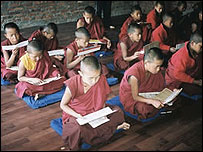 Storyteller's trip to NepalA storyteller from Thorncombe is visiting an orphanage in Nepal he helped to set up three years ago. It's the first time Adrian Beckingham has gone there, and he will be writing a web diary of his trip for BBC Somerset. Friday 24 April 2009We had promised ourselves if possible another day in Jomsom and kept to it. Following our winding ride down the mountainsides in our dust-kicking 4x4, we arrived in Jomsom with one whole day to while away before our 7am flight the next morning. The call of the wild was too much to beat so we walked one of many beaten tracks that wander out of Jomsom - cutting this way and that across wide expansive dry river beds towards the traditional Tibetan village of Thini. The name derives from the Tibetan word 'thin', which means base or root. This tiny village was in fact the stronghold for a famous historical local king Thang Mig Chen, and all surrounding villages had to give a tribute of produce or labour to Thini. Even today the village keeps an arsenal of traditional weaponry locked away in safe keeping. 'Gorgeous oasis'Thini is a gorgeous oasis surrounded by green fertile crops planted in rising tiers that edge up the mountain slope and peer down across the barren landing strip of Jomson below. The land is dry and rugged, all below the gaze of the high snowy peaks, but in Thini there is water singing in long man made canals around the village edge. Apple trees hug much of the perimeter. Stray dogs mooch harmlessly about, totally ignoring any visitors. Women in traditional dress of long colourful robes stretch out asleep in the sun, some curled up against wooden ladders, others in doorways, or on the flat white rooftops. 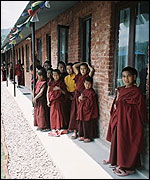 The children come from poor backgrounds I have never seen so much chopped wood anywhere, it is piled high in every winding lane through the town, and across every rooftop. Is this preparation for the bitter winter ahead? While pondering this the sky behind the mountains grew black, and suddenly a rainstorm was upon us, chasing us home down a dirt track as the powerful wind howled in, carrying fistfuls of stony grit from the mountain passes above that beat against our faces. We saw children in school uniform heading up the pass toward us, coming from Jomsom, still a good hike below. From the heavy tread in the dirt track it appeared this would become a hard surface road some time soon, allowing travellers - those who do not wish to walk - to drive to Thini and explore this tiny Tibetan village for themselves. 'Flesh and blood'Our last two days were busy indeed , involving more meetings with Tenzin, the main administrator at the Siddhartha School in Kathmandu - plus a day trip with Llama Khenpo to see the construction site on land purchased to provide a permanent school complete with classrooms and living facilities for all the children supported by Siddhartha Foundation. And Llama Khenpo had a surprise in store, taking us also to visit another site where he has begun clearing land to build a school for girls.
I think my most lasting memory of my trip to Nepal will be the first moment I emerged onto the rooftop of the rented building that is, for now at least, the temporary site for our Siddhartha Foundation School. Images of this and other moments are in the photo gallery accompanying this website. All 105 boys sat patiently in long rows and fully uniformed, awaiting our arrival. It is so memorable because in that moment three years of fundraising events to create the school became, for me, flesh and blood. So many of the faces peering toward Dechen and I were already familiar to us. For in those three years, wherever I have travelled as The Man From Story Mountain, bringing ancient mythology and folklore into schools, libraries, museums, castles and festivals, I have always had a clutch of leaflets and individual sponsorship forms. Why? To show the faces and details of each of these boys, in the hope that in every port of call one person at least will open their hearts, dip into their wallet, and offer a one-off donation or better still, a monthly donation to help sponsor one of the boys in our school. Offering a home and education to one of the world's poorest children, a child of the Himalayas, which in our case are mainly orphans and of Tibetan lineage. 'Dream into reality'Having been chairman of our charity The Siddhartha Foundation UK since setting it up in 2006, myself and the three other trustees (Somerset residents Dechen Chodron of North Cadbury, and Michael and Lynne Orchard of Glastonbury) have continuously put time and energy into carving a dream into reality. Our aim is to help Buddhist Rinpoche Llama Khenpo to realise his noble dream of providing a safe home and school for some of the world's poorest children. 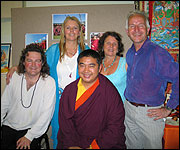 Adrian with trustees and Llama Khenpo Llama Khenpo hopes to provide residential school settings for 1,000 children, and when we first met him some years ago he was yet to commence on that ambitious plan. So having decided to throw our weight behind him we set up The Siddhartha Foundation UK as a registered charity. As a very small charity with just four volunteer trustees it has always been far easier to ensure the vast bulk of money donated goes straight to the children and their school home, a great advantage we felt over giving to major international charities who have often hundreds of paid staff, director, co-ordinators, office spaces etc. And here, just three years after we began, Dechen and I had arrived on our first reconnaissance trip to check out, on site, how things were actually going for the children now under our wing. When we arrived there were 98 boys and 2 girls under our wing. By the time we left there were 105 boys in the school, and another 50 girls on file for placement in schools. The trustees of our foundation are all volunteers. We do not do this for financial gain. But it helps us sleep full dreams at night, knowing the small step we are taking in making this world a better place. Thanks again for the kindness of one of our main private sponsors for financing Dechen's trip, and to Chard T.A.G.B and Parrett & Axe primary school in Mosterton, for their specific fundraising initiatives helping me. And to Yeti Holidays in Nepal, Hotel Tulsi in Pokhara, Om's Home in Jomsom, The Royal Mustang in Muktinath, and the New Hotel Plaza in Jharkot, all of whom gave time and helped with our travels without payment. Monday 19 April 2009That afternoon we walked down to the village of Jharkot. We chose to walk alone and in silence so we could take in the fantastic magnitude of the landscape surrounding us, without interruption. As I passed below the strong stone arch that leads out of Muktinath and began a steep descent to the village below, it was like walking into a film set - perhaps a cross between a wild west epic and 'The Lord of the Rings'. Snow laden peaks surrounded every edge of the high fisted, rugged horizon. Below me the path dipped down into a wide brightly coloured canyon, dry and barren but rich with a variety of shapes and colours that stretched on into the distance, dipping ever lower, till suddenly blossoming in the misty blue haze of mountains, faded one against the other into a distant haze, which in turn then suddenly stretched bolt upright into a tower of glistening stone crowned with the shimmer of virgin snow. As I rounded a corner in the trail, the village of Jharkot appeared, like some medieval set thrown together by the winds of some long lost history, and planted scantily atop a tall blood coloured island of rock surrounded by sheer precipices that yawned into the lower valley to all sides. Oh my…
'Ancient line'In this small traditional village we also satisfied our search for a worthy endeavour where girls could perhaps be sponsored to receive an education. For Jharkot is home to the Muktinath Tibetan Traditional Medical Centre which serves both as a medical drop-in facility for locals and travellers, and a residential school teaching children the ancient practice of the Amchee. Amchees are traditional herbal doctors, and until recently this ancient line of practical and highly specialised knowledge was all but gone in this valley. But today, 14 children attend the school. Fourteen threads to help keep a vital lifeline of knowledge alive, if only the thread can be woven unbroken - for the school has suffered from irregular financial backing. The staff are very keen to thank their western sponsors (based in Germany) but reality dictates the whole project is made vulnerable if nothing can be done to secure a more steady flow of basic finance to meet the school's meagre needs. With Chuni as our guide Dechen and I visited the school, and met the head teacher, other staff, and all the children. It seems these children are all local to the surrounding villages, meaning their families are close to hand when need be. However each child has a shared bedroom at the school, perhaps as transport is all pretty much on foot, and the terrain is very mountainous and can be dangerous at times. We saw the classroom facilities - just a single room with several long wooden desks and educational charts of various topics on the walls. The 105 boys in our Siddhartha Foundation School have only mats to sit on at present and no desks at all (not yet!). Here, the mealtime we witnessed consisted of a simple bowl of rice. 'Shimmering light'I imagine, from what I have learned about this country, that some of the parents will have found it a huge relief to have one less mouth to feed. More than 10 children die every hour from malnutrition in Nepal. And that the parents can rejoice their child is receiving something far more long term, an education. The first vital step that breaks the cycle of poverty so many families are trapped in. The school is rightly proud that a handful of their children have already passed through the system and successfully graduated into tertiary education. It is hoped that once their qualification as fully-fledged amchees is complete, they will return to the valley, to tend to local patients' needs, help foster further learning, and keep this worthwhile tradition alive. We had just one last sunrise in the mountains before returning to Jomsom, and it did not disappoint. In this part of the world you almost get used to spectacular snow capped mountain views out your bedroom window, but my final dawn in Jharkot was a real winner. Imagine, if you can, laying curled up in bed below a soft ,thick, warm blanket. As you rise out of dreamy sleep into wakefulness, above you the sun steps in soft gradual footfall over a towering giant of mountainous stone, mantled by a crown of snow that edges, slowly, from soft pre-dawn shadow into a glistening sea of shimmering light. So it was for me as I awoke to see the steel grey of the snowy peak looming before me receive its first kiss of golden sunlight. A kiss that widened until it stretched, slowly, slowly, right down the mountainside, and embraced the fields within which my hotel was nestled. Ah, thank ye to the gods and goddesses and deities that gave me this fine, fine morn. With that, and a full breakfast of toast and scrambled eggs washed down with a pot of steaming coffee in the sunny dining room, we were back on our travels and beginning the first leg of our long return home to the UK. Thursday 16 April 2009For centuries pilgrims have come to Muktinath, beginning their often barefoot journey in India and finishing by walking up the dangerous Kali Gandaki Gorge from Pokhara, prone to landslides and deadly precipices, until reaching Muktinath. Nowadays there are several helipads dotted around Muktinath, for those Hindus wealthy enough to fly in and satisfy their religious commitments by helicopter. Others come by the bus load or on motorbike. Some still walk. Above the town, encircled in a white wall, amid Tibetan prayer flags and prayer wheels, is a Shiva temple. Here natural spring waters rising out of the mountainside have been channelled into 108 showerheads, each carved from stone and shaped as a boar's head, plus some cooling pools for bathing in where Hindus wash themselves. In this holy place where different religious traditions find harmony together, pilgrims of various faiths shower below the running water. It is said anyone who runs under all 108 boar's head for 108 full cycles will be blessed with a speedy rebirth. The water, as I experienced, is freezing cold, so one round of 108 was enough for me and I will take my chances on the rebirth. Sharing the space at the southern end of the enclosure is the Buddhist Jwala Mai temple - known to Tibetan Buddhists as Mebar Lha Khan Gompa - meaning 'temple of the miraculous fire'. Until quite recently three natural gas flames burned here, emitting from the rockbed. Extraordinary perhaps, but made truly exceptional by the fact these flames burn within a river. In 1954, about the year the first western travellers started to trickle into the area, one of the flames went out, but the other two burn on still. To see them you need to take off your shoes, enter the temple which is attended by a Buddhist nun, bow down to your knees, and peer through a small altar window into the darkness where the flames are burning, accompanied by the clear sound of running water. 'Tallest mountains'If this amazing combination of fire and water where not enough to secure holy status for pilgrims (who come in their thousands to honour and behold) there are also fossils here, which can be purchased as souvenirs from any number of vendors who line the steep walk up to the temple. The fossils, known as sacred saligrams, are ammonites risen from the prehistoric Tethys Sea, formed before the Himalayas rose from the seabed to become the tallest mountains upon the Earth. My favourite things at this temple of sensory delights included the constant sea of brightly coloured prayer flags woven between the trees, the long lines of cylindrical prayer wheels set into the outer wall. Prayers flags, for those who do not known, are strings of brightly coloured flags with Tibetan Buddhist prayers printed on them. The idea is that as the wind catches these flags and they flutter in the breeze, the prayers are carried around the world. Prayer wheels operate in a similar vein, though they are carved cylinders spinning on a vertical shaft. The Buddhist prayer for compassion, Om mani padme hum, is written on a scroll inside the wheel, and as the wheel spins the pray is scattered outward, with each single revolution of the wheel representing a full recitation of how ever many times the prayer is written inside the wheel. High up the steep mountainside, more prayer flags were woven against the cliffs like sparking enormous spider webs, glistening in the breeze. Saturday 9 April 2009The green fields of Somerset and Dorset seem so much greener after the dust and pollution of Kathmandu. After a city where hundreds of tall temples are a thin veil shielding scenes of terrible poverty, pollution and disease, where the water running from taps is often diseased, and electricity is only available about five hours every 24, the richness of our English lifestyles even in times of deep recession brings a sigh of relief. How grateful I am for my good fortune of being born in a developed country where we have sanitized water running from our taps, electric power, wardrobes full of clothes, mod cons such as cookers and washing machines, free healthcare and an education available to all. But despite being in the unenviable list of holding a place in the top five for poorest countries in the world, a visit to Nepal offers visitors many wonderful sights and experiences. It holds its own as an awe inspiring destination, with a presence of natural beauty so majestic it makes our hearts sing and humbles the onlooker by the pure magnificence of creation. Thus it was that while studiously undertaking our vital roles with the children in our school and orphanage as trustees of The Siddhartha Foundation UK, we were itching to get into the mountains and experience a taste of the Himalayas proper. Despite its sad decline from spiritual mecca into a place of abject poverty and over crowding, Kathmandu offers some sites of great historical and spiritual interest. My personal favourite is Bodhnath Stupor. A stupor is a bell shaped Buddhist temple, originally built to hold sacred relics from the Buddha. The stupor at Bodhnath, a suburb of Kathmandu, is a delightful retreat from the general madness of the city. Fully pedestrianised, just retreating from the general chaos of Kathmandu traffic brings a sigh of relief. Small shops offer a clutter of Nepali and Tibetan wares and souvenirs, with most shops displaying a variety of these openly on the pavement outside the entrance of their premises. There are also music stores, internet cafes, restaurants and monastries, all of which create a circle around the pedestrian zone that circles the stupor itself. 'Educating girls'But sight-seeing was never too high on our agenda. Those of you who have been checking on the previous diary entries are aware that our main mission in going to Nepal was to experience hands on the school and orphanage for Himalayan boys I helped establish in Kathmandu. We also hoped to look into setting up a sponsorship scheme for educating girls, who - as every Nepali citizen will agree - do not get the same opportunities as boys in this impoverished country. (Many of our experiences undertaking these important tasks are outlined in my initial BBC SOMERSET diary entries, which appear below this one). Having spent two weeks in Kathmandu at The Siddhartha Foundation School - and a day trip to the rural village of Bhotspia, where we received a heroes ' welcome for trying to arrange sponsorship for some of the girls to attend school - we finally decided to follow our third, less arduous, agenda. It was, we felt, time to escape the city and get out into the high Himalayan mountains. To do what every holidaymaker we had seen thus far was doing - walk amidst the beauty of snow capped mountains. We also hoped to explore the possibility of providing education for girls in the high Himalayas. Wednesday 8 April 2009Our quest to provide an education for some of the world's poorest children in Nepal continues to be a very amazing experience filled with adventure and emotion. Yesterday was rather tense as here in Kathmandu the news was of a protest with warnings that any vehicles on the roads would be trashed and set alight. Private cars, apparently a rarity just 20 years ago, usually cram the streets like a hive of ants darting amongst themselves but this day was different. The result of the unrest was that the streets were unusually busy with bicycle led rickshaws (normally hard to find except in certain parts of the city centre) though taxis were still everywhere. Plenty of tension on the streets today, heavily armed guards, police and soldiers line the streets regularly as different factions in the government muscle up to each other. There are armed soldiers patrolling the streets in pairs. Everything apart from that seems as normal, with life rolling on as per usual - shops open and people walking the streets. 'Endless madness'A few days back, on the day the Christian world celebrated Good Friday, Llama Khenpo took us out to meet the girls attending a school in a small tribal village called Bhotsipa, in a region called Sindhupalchok. It was with a sigh of relief that we left the smog and endless madness of Kathmandu traffic - where all the drivers weave and shuffle past each other like rolling pebbles gliding along a slope, no rhyme or reason save the endless blast of horns (perhaps the most regularly used item on any vehicle, the sound of which fills everything everywhere during daylight hours). As we left the city outskirts Llama Khenpo explained that every citizen in Nepal has a right to own a piece of land to grow crops and feed their family. Once outside Kathmandu we had several hours of an increasingly bumpy ride along paved rutted roads and then pitted bumpy tracks with potholes everywhere and some a foot deep. The terrain grew increasingly green and open, offering wide rivers lined with rich water-laden fields that will be flooded when the monsoon comes, but today the riverside is full of activity - people watering and washing themselves and their animals, water buffalo wallowing in the cool muddy banks, men, women and children labouring at their crops. Beyond looms the first of several land rises, climbing up into the proper height of the Himalayas. 'Bumpy trails'We began our ascent up the mountainside. Everywhere the bumpy trails around the mountainside are used by locals walking with huge loads on their backs - ranging from tied bundles of cut long stemmed grasses to sacks of grain. I saw one very elderly looking lady carrying a huge sack twice her size strapped to her back, and it was full of dry brown leaves. The people here no doubt know their habitat and many uses of the plants growing around them. When we arrived at the village we were met by a long line of girls and boys, men and women of every age, who had formed a long corridor - perhaps a hundred people strong passing down to the school. This was holiday season for those children attending the established village school, which has been going for some decades. However Llama Khenpo had sent ahead word that Dechen and I were coming, and that there was a chance our organisation Siddhartha Foundation UK could help find sponsorship for some of the girls. After all, the school we have helped establish in Kathmandu is for boys only, and we are keen to also offer girls an opportunity for a better life. And of course a decent education of some sort is a key tool to enhance choice. As we passed through the human corridor these people had prepared for us, we were showered with flowers - indeed every man, woman and child there had prepared an ornately woven necklace of flowers to string around our shoulders, or bundles of smaller flowers to gather in our hands. It was an amazing event, with every step there was another smiling face, another bow, another bouquet of fragrant flowers thrown joyfully upon us. Behind the claps and laughter was a clear sign of just how desperate these people are to educate their children, and how much they wished to give us a welcome that would remain with us forever. 'Bland concrete'The whole village crowded round to watch the inevitable host of long speeches in the hot sun as we sat there in our new flowered robes- including a much-demanded speech by myself and Dechen, translated by a local. I think I begun with something like "Your hearts shine like the sun..." Then all the girls bundled into one of the bland concrete school rooms, where they sat dressed in their uniforms waiting to meet us personally. Keep in mind that this is a holiday season and all the families had come from this village and surrounding villages walking sometimes for a mile or more to reach us along rocky mountain trails, with the girls in full uniform to greet and meet us. From outside the metal bars crossing each concrete window small children clamoured to peer in upon us with awe and amazement. It all seemed a bit surreal and as I watched the events unfold around me I could not help feeling a bit of a fraud. These guys had laid on a reception fit for a king and all Dechen and I could offer was to take word of their need to the UK and hopefully get some of the girls sponsored. But it just shows how much it is appreciated if you take the step and try to help a people who live on a level of poverty most westerners will only ever view on their television screens. Following the meeting we were taken to a small mud home to have a lunch of rice and garden vegetables, washed down with some pretty rancid goat's milk and, in contrast, cool delicious spring water. The kitchen was perhaps five foot square, with a floor of dry packed earth and just a raised fire-pit as the only power source for cooking. 'Refreshingly innocent'This is an area rightly referred to as tribal - everyone lives a very subsistence lifestyle, carrying water in large jugs, milking goats, and washing in the nearest river. Though their homes are very basic and their lifestyle very simple in so many ways, to me as an outsider their lives appeared both physically demanding (walking miles with heavy burdens, for example, just to gather basic necessities) and yet refreshingly innocent and rich with an increasingly difficult-to-find genuine connection to the rhythms of the earth. As an officially recognised Rainbow Warrior (having worked as national co-ordinator of Greenpeace Australia in the 1980s and 1990s) I am all too aware of the implications of Agenda 21, encouraging communities to take on and develop the challenge of localised sustainability to help ensure we all have a planet to live on in the future. These guys are gold dust in those terms. It is a dilemma I need to ponder for a while - will giving the girls an education mean that as adults they will all move away? Could the village lose its blood source and, in generations to come, village life dies with the elderly sat listlessly around, alone and waiting to die, in this once rich community? It is no easy dilemma. Certainly the villagers' enthusiasm for offering the children some form of modern education is abundantly clear, but how aware are they to the perils of modern life - losing their roots, the breakdown of families, and so on? Asking the headmaster - who was educated in the school himself and proudly claims his father and grandfather were instrumental in setting up the school some generations back. It appears that once young people have become educated they leave the village, only rarely to return. The men for work, and the women - well, they still end up marrying and settling down to become mothers and housewives, subordinate to their husbands as is the tradition in this country. Yet with no education people remain in ignorance about themselves and the larger world around them and have little chance of creating the change to move forward. Dechen and I hope to delve into various options with the aid of the other Siddhartha Foundation UK trustees and our growing network of supporters - like researching the development of an alternative educational programme, with schemes that will enhance their community toward the greater benefits of technology and 21st century life, without taking the people away from their thriving community to get lost in the faceless urban sprawl of the surrounding towns and cities. Though the school is several generations old and has over ten teachers and 700 children (yes, with over 70 children in each small concrete room) it has recently experienced a serious hurdle and needs to look for sponsorship from the developed world. We at Siddhartha Foundation UK - a tiny charity with just four volunteer trustees, of which I am chairman - shall do the best we can to find them help. Friday 3 April 2009Well here at last is my first Diary Nepal entry actually written in Nepal! I have already learnt that writing anything electronically and then submitting it via the web is a potentially slippery slope in Nepal. Why? Well for a start web access is like a jammed highway most of the time. To make matters worse the last King of Nepal (whose entire family were assassinated five years ago) sold the rights to much of the electricity generated by this country to India. This arrangement remains in place. So the local Nepali population only has electricity about 5 hours or less every 24 hours, the rest being used by India's population. There is no exact timing either for when it will go on, though the locals seem to have a rough idea. This morning it was supplied for a few hours very early, yesterday it was late afternoon. Imagine if our Royals sold our electricity to another country, and hence the British people were without it most of the time. What an uproar there would be! The electricity is actually off right now, but I am writing from a computer powered by a small battery donated through funds raised by The Siddhartha Foundation UK, a charity of which I am chairman. I am on site in Nepal, very thrilling as this is my first visit here. Thank you to everyone who helped sponsor this trip! As I write the soft sound of many children's singing voices fills the valley and resounds around the surrounding hills. The sun is shining, we have about 25 degrees Celsius heat. 'Selfish monarchy'A fellow Siddhartha Foundation UK trustee, Dechen Chodron, and I have visited here to see how the school has developed so far. The school takes in mainly Tibetan children, most of whom are orphans. Those who have parents come from very poor backgrounds where there is insufficient income generated by the family to feed or bring up children. When we first arrived at the airport we were driven straight to Parliament House to collect Llama Khenpo, who is our host and is currently working within the government as Minister For Religion. A very important and prominent individual in this country, Llama Khenpo is busy drawing up a new Constitution of laws and regulations, as part of a new national government which was voted in democratically twelve months ago (and has only been actively in power for six months). After many years ruled by a - by all accounts - selfish monarchy, a democratic government ruling Nepal is a miracle for the people in the street. It is a coalition government and despite tensions between old political and religious opponents, at present the new government remains keen to grab this historic opportunity and ensure they represent a full cross section of society. Indeed despite tensions the new Nepali government is one of the most fairly represented governments anywhere in the world. For a start, representatives sit from all the old parties and allegiances - some of which have very deep historical wounds indeed - plus from all indigenous groups within the country, members from the lowest casts such as the Untouchables, and the highest percentage of women representatives to sit in any government anywhere in the world (with over 200 women in the new government, this makes about 30 per cent) So enough of politics - and onto the school/orphanage. Llama Khenpo is really the main brain child, benefactor and driving force behind the Siddhartha Foundation School, which is in itself registered in Nepal as an NGO (non- government-organisation) and runs entirely not-for-profit. Try making a profit out of feeding, clothing, accommodating and educating a growing number of children (now over 100) who arrive without exception penniless and with nothing other than the bedraggled clothes they have on their backs and you get the general picture! 'Noble dream'It was Llama Khenpo's dream we have helped fulfil - a noble dream to supply a safe haven and education for Tibetan children whose cultural roots were uprooted and scattered to the winds when their homeland was usurped by mighty powers. Certainly since the invasion of Tibet in 1950, the rights of Tibetans have been superceded. wherein the speaking of Tibetan language or the teaching of Tibetan history and arts is strictly forbidden. Whenever and wherever an invading power wishes to eliminate the self respect and cultural nuances of the land they have entered, outlawing and demolishing local education and language are a key factor. And so it is with the greatest of pleasure that I and my colleague Dechen have spent the last two days with over 100 finely robed Tibetan children, all smiles and bows and gratitude. They had been so excited to meet us, knowing our role in giving them this new home and school. However when we arrived some were very shy at first, especially as there were - we were told - a significant number who have never seen westerners before (coming from impoverished corners far off the tourist trails). So - a bit cheeky perhaps - we handed out chocolate! Not politically correct perhaps but hey, these are kids, and some had rarely if ever had chocolate! Think of that. Everyone should have chocolate! Right? As part of a healthy balanced diet of course! Another human rights box ticked, albeit a little one. And during the welcome ceremony involving speeches and singing (by them) and the handing out of chocolate (by us, as you know) we took photos and video then showed them back to the kids. I also introduced them to an Aboriginal Australian wind instrument, a bull roarer, and how to play it. The next morning we turned up to find they had roughly fashioned versions of their own and were delightedly whirring this most ancient form of musical technology through the air. The whispered whoosh whoosh sound echoing the Australian desert seemed amazing and alive in the valley of Kathmandu, the Tibetan children laughing as they made the sound rise into a low crescendo. 'Spritual growth'We played games with the children, simple board games with rules we took a while to understand. And we feasted - the Siddhartha School is proud to supply these children four meals a day, including a lunch so tasty and nutritious that it puts any cooked school lunch in Britain near to shame (and I should know, having visited 400 schools in England). And as for anyone asking for seconds, there is always a resounding yes! These are growing boys and young men, with a future of promise ahead of them. This is their home and sanctuary, a place of educational and spiritual growth preparing them for lives full of hope where they will have their own roles of compassion to play. Oh and the look of pure delight in their eyes when they saw themselves in the photos and video - the same images you are seeing now, plus many more - bridged any remaining gap. We are to them, as the ever humble and most helpful school administrator Tenzin Khechok pointed out - not unlike helpful aliens who have just landed from a space ship, with weird looks, strange outfits and unimagined technology. Using advanced technology to startle and awe other cultures is also an old trick used by colonial invaders, before turning the tide and taking brutal control. The tide we have already set in motion is one set to raise their spirits, to give them back the gift of an education so many in the west take for granted - taught by Tibetan teachers, allowing these children to seize their heritage before it takes wing and is gone forever, so they may walk with pride again empowered by the knowledge and practise of their own cultural identity. Tonight we begin a long journey with Llama Knhenpo and Tenzin as escorts, to visit the quiet Himalayan region of Yolmo where there is a school for girls already established, some of whom we at Siddhartha Foundation UK are seeking to find sponsors for. Educating girls too - In Nepal! Very frowned upon traditionally, but remember this is a new land now with a new government creating, we hope, a new set of rules. And - Llama Khenpo sits right in the thick of the change. After that it is on to Tatopani to visit a school for girls from the under-trodden class known as Untouchables. We shall be surrounded by girls of the lowest order in a strict class system - untouchable girls - and offer some of them at least a new future. To be surrounded by "untouchable girls" and have to choose who do we help, who do we not? No enviable position. Is it playing God? Laugh out loud! Playing God? We have no money to help them. We are volunteers. But what we do have is over 100 children already fed and clothed. And a small quiet knowledge - if everyone in the developed world did their bit and helped sponsor a child, there would be quite enough resources and quite enough planet earth, for everyone. Friday 27 March 2009Hello and welcome to the first of my series of Diary entries which allows you to follow my journey from Somerset to the hidden treasures of Nepal. My name is Adrian Beckingham, perhaps known to many of you by my alias The Man From Story Mountain. I have been performing as a full-time storyteller based in Somerset for 15 years now. Doing about 300 shows a year, I have visited over 100 Somerset schools, and 300 others across the country, plus many festivals, libraries, museums and so on. So an extra big hello to all those whose path I have crossed before! 'Marvellous country'As a performer and teacher of multi-cultural stories and faiths, I have always pledged to take my own teachings from the highest level teachers available in the culture I am studying. Llama Khenpo is my main teacher of Buddhism, and of the cultures of Tibet and Nepal. My host and guide for this tour will be Llama Khenpo and his associates. Do you fancy entering the mysteries of the magnificent sites of this marvellous country guided by llamas, monks and rinpoches? You won’t need to imagine it as you can be alongside us enjoying our adventures! Llama Khenpo was, until recently, the official Minister for Religion in Nepal, who gave up this role only to fully concentrate on his dream project - developing a school for some of the world’s poorest children. In response, three other Somerset residents and I set up the Siddhartha Foundation UK, a registered charity since 2006. The other trustees are Dechen Chodron of North Cadbury, and Michael and Lynne Orchard of Glastonbury. I am chairman of this charity whose primary aim it was to build a school and residence for the children. And guess what? We did it, with the support of all those who have joined as supporters and sponsors and benefactors! We now have about 100 children, mostly Tibetan, many of them orphans, whose families fled their homeland as a consequence of China invading Tibet. 'Extremely poor'Nepal is one of the six poorest countries in the world. More than half the population has to survive on less than 40 pence (60 cents) per day. Life expectancy is ten years lower than India. More than ten children every hour die due to malnutrition and disease. Over 85% of the population is illiterate. Our initial school provided two classrooms, a series of small dormitories, an office, a kitchen and a dining hall. However for various logistical reasons we recently sold the original school to a local farmer, and moved the boys into a hostel in Kathmandu, a major city. The old school was dismantled brick by brick with materials soon ready to start reconstruction at a better site. All the students come from extremely poor backgrounds where even basic healthcare and education is not available to them. The school takes care of all the pupils’ needs - from food and clothing to medical care fees and the cost of their educational materials. However I am delighted to say Siddhartha Foundation UK has begun sponsoring girls, who thanks to our funding can study at the Shree Chandeshwaree School in a very remote district and tribal village called Sindhupalchok. With the recent execution of much of Nepal’s royal family and the ensuing fall of the previous government regime, Nepal is now a very unsettled place. The risk to children in particular is rife, particularly of children from very poor insecure backgrounds. So...we are keen to establish a safe environment for those boys and girls deemed to be most at risk as soon as we are able. My trip will include visiting the apartment block where the boys are being kept with their teachers until their school is relocated. There is much to do and many questions to ask. 'Rinpoche monks'Accompanied by fellow trustee Dechen Chodron I shall do my best to ensure facilities such as decent sanitation, clean drinking water, cooking facilities, bedding, medical supplies, educational resources and a framework offering social and emotional stability are in place for the children under our care. With Llama Khenpo as our host - who is currently busying himself with the Nepalese government drafting up that country’s new constitution - it is sure to be a trip of sharp contrasts, jostled between being courted by officials and high status rinpoche monks to my key role overseeing the future livelihood of some of the world's most impoverished children. I do hope you take the time to join me by visiting this diary, which I shall update regularly with words, photos and film. I apologise in advance if the characteristic prolonged electricity strikes in Nepal mean I miss a few installments. I shall do my best to share with you the unexpected, the godliness and the humanity of it all, bringing you the heartache, the tears and the laughter along the way. We are all volunteers at Siddhartha Foundation UK. I would like to thank everyone who has helped raise funds towards the cost of this venture - including all those many individuals who have given time or money or both. Also much thanks to Mr Nigel Evans and his staff and children attending Parrett & Axe Primary School, Mosterton; plus instructor Nina Anderson 3rd Degree blackbelt and her students at the Chard chapter of T.A.G.B Tae Kwon Do (see weblinks to the right of this page). Helping give the world a hand is a lifestyle which does not start and finish on Red Nose Day! Adrian flies to Nepal on 30 March and will return 24 April 2009 and you can read his updates here.last updated: 12/05/2009 at 10:57 SEE ALSOYou are in: Somerset > People > Your Stories > Storyteller's trip to Nepal   |
| | About the BBC | Help | Terms of Use | Privacy & Cookies Policy |