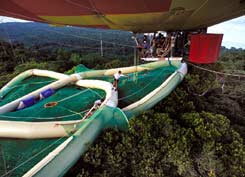
Madagascar is home to one of the last untouched rainforests and some of the rarest plants and animals on earth. 75% are found nowhere else in the world. Much of this extraordinary diversity of life is found in the forest canopy, which up until now has been virtually inaccessible to scientists. Situated off the coast of Africa, Madagascar has been cut off for 80 million years. This isolation has led to the evolution of unique animal and plant species. But the tropical rainforest, like many in the world, is under attack. Nearly 150,000km² of tropical forest is destroyed throughout the world every year, equivalent to the size of England and Wales combined. Even if it grows back, the diversity of the original forest is lost forever. A team of 70 international scientists spent three months studying the rainforest in Mashoala Peninsula. Their mission was to document the forest's extraordinary diversity and to identify new species before they are lost forever. By exploring the economic potential of the rainforest and exploiting its compounds without damaging the forest, the team could discover commercial opportunities. Their mission is to reach the canopy and try to unlock the biochemical resources of the rainforest. If they can, it could be the key to its survival for generations to come. It's a dangerous mission – and they've come up with some unusual ways to reach this unknown world including a giant inflatable raft and a habitable metal tree house. Professor Francis Hallé, the expedition's botanist from the University of Montpellier in France, is an expert on the tropical rainforest. He believes that the most diverse habitat of all is the canopy, which is over 40m above the ground. Many undiscovered species live only in the tree tops and never set foot on the forest floor. As the team's study of the forest progresses it becomes clear that the canopy is one of the most productive chemical laboratories on the planet. It contains raw materials for a wide range of industrial applications: flavourings, perfumes, medicinal substances and UV screens. Some of these molecules have already been exploited by man with remarkable results. The rosy periwinkle, a tropical rainforest plant, for example, produces anti-tumour agents that increase the survival rate of children with leukaemia from 20% to 80%. Back to top Back to the Horizon homepage |