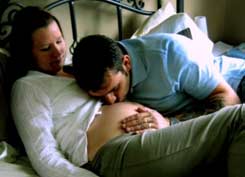
Rachel is just 25, but already she has suffered six miscarriages. She represents the 1% of women who struggle to give birth to a live baby. She is a patient at St Mary's Hospital in London where, in Europe's largest recurrent miscarriage clinic, a team of dedicated scientists offer women like Rachel the hope of a precious new life. Miscarriage is surprisingly common, with as many as half of all fertilised eggs failing to develop into a foetus that survives to birth. But recurrent miscarriage, when a woman's body hits the self-destruct button time and again, is a reproductive phenomenon that medical science is battling to understand. A woman who miscarries once may be told by her doctors that her loss was a random event, probably the result of a one-off chromosome abnormality in her foetus – unlikely be repeated – and that she and her partner should try again for a child. But the women who come to Professor Lesley Regan's Clinic at St Mary's Hospital in Paddington will usually have tried, and failed, to produce a live baby at least three times. The challenge for Professor Regan's team is to determine which of these women have simply been unlucky several times in a row, and which are carrying an underlying medical condition that could explain their losses and may, more importantly, be treatable. Over the course of a year, the Recurrent Miscarriage Clinic sees up to 1,000 new patients – patients like Joanne and Naomi. Both in their 30s, they have lost eight pregnancies between them. In the laboratories at St Mary's, their blood is put through a barrage of tests, hunting for the tell-tale signs of abnormality and any clues to explain their losses. The scientists are on the trail of genetic defects which, when passed from parent to embryo, can disrupt the blueprint of life from the very start. They look for imbalances in the hormones that drive pregnancy from conception to delivery. Blood-clotting disorders have been identified that can restrict the vital flow of oxygen and nutrients between mother and baby. And there may even be elements in a women's immune system that can attack the cells of her embryo and placenta as they develop. But the painstaking research into so many failed pregnancies, while thorough, is destined to reveal an underlying condition in fewer than 50% of cases. For Joanne the news of her test results is disappointing. Her blood has revealed nothing unusual to account for her losses. But while she feels deflated, Professor Regan is at pains to point out that being told nothing appears to be wrong should be good news. Statistically, it has been shown that patients are more likely to be successful in the future if their test results come back negative. However for Joanne and husband Dave, the prospect of embarking on another pregnancy, with no problem diagnosed, remains daunting. When Naomi and her husband Paul return to St Mary's for their blood results, they are surprised to learn that Naomi does in fact carry an antibody disorder which could explain their three losses. When lupus anticoagulant is present in a woman's blood it has a doubly negative effect in pregnancy. In the very early stages, it can attack the cells at the interface between embryo and uterus and cause the process of implantation – when the tiny embryo embeds itself into the lining of the womb – to fail, resulting in miscarriage. These antibodies also cause the woman's blood to be thicker than normal. In later pregnancy (after eight to nine weeks) this can cause blood clots to form in the tiny vessels of the placenta, restricting the flow of vital nutrients and oxygen between mother and baby. In Naomi's next pregnancy she will be given aspirin to thin the blood and daily injections of heparin, another blood-thinning drug which will also prevent the lupus anticoagulant antibodies attacking the cells of her developing pregnancy and improve the blood flow through the placenta. With treatment, Naomi and Paul's chances of having a successful pregnancy will rise from 10% to around 70%. Rachel has had six miscarriages. Three years after being referred to the clinic, she still doesn't know why. When she falls pregnant for the seventh time, she returns to St Mary's to see what her consultant, Raj Rai, can do to prevent yet another miscarriage. Although Rachel's test results have failed to identify a specific cause for her losses, Raj Rai believes that something is preventing Rachel's embryos implanting properly. In Rachel's previous two pregnancies, Raj Rai prescribed drugs to promote better implantation, but as those pregnancies also failed, this time he decides to add another drug, a steroid, to her treatment. He believes that steroids, given in the first trimester of pregnancy, will suppress the negative effects of certain chemical messengers within the lining of Rachel's womb. But the use of steroids in treating miscarriage is controversial. Their effectiveness has yet to be proven in a clinical trial and there are known side-effects. Rachel's previous pregnancies have all ended by the 11th week. As her seventh pregnancy progresses towards and past that danger zone, the realisation slowly dawns that, this time, she and her husband Gary may finally have the baby they've waited seven years for. Back to top Back to the Horizon homepage |