How did plants evolve to attract insects?
Why do some plants rely on insects to pollinate them? CrowdScience goes on the hunt for a rare flower in the Philippines to help answer a question from a listener.
Many plants need pollen from another plant of the same species in order to reproduce, but they don’t have legs so they can’t simply walk around looking for a mate.
As a result, many of them rely on animals to transfer pollen from one plant to another. They’ve developed a hugely diverse range of techniques to attract them, including their appearance, taste and smell. CrowdScience listener Alice in the UK wants to know how they have evolved to do this.
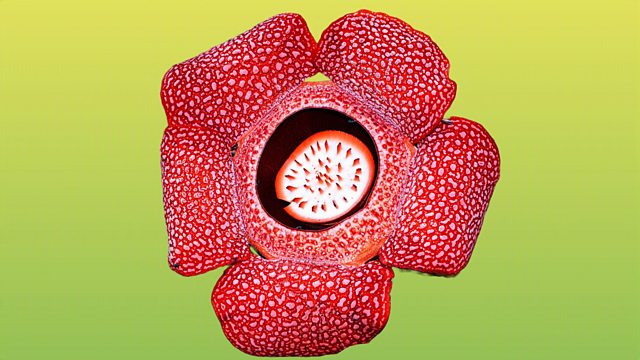
To try and answer the question, presenter Anand Jagatia goes trekking up a mountain in the Philippines, battling mud and leeches in the hunt for an incredibly rare flower. Rafflesia has evolved to look and smell like rotting meat in order to attract flies, so it’s the perfect example of a plant that goes to fascinating extremes to make sure it gets pollinated.
It only blooms for a few days each year, so to find it Anand is going to need the help of scientists at the University of the Philippines Los Baños and Lewis Barrett, Senior Botanical Propagator at the University of Oxford Botanic Garden and Arboretum.
Anand also visits the University of the Philippines Laguna Quezon Land Grant, a huge site containing more than 5,500 hectares of protected forest land. Professor Pastor Malabrigo Jr shows him a fig tree that has a fascinatingly gruesome relationship with its pollinator wasps.
So how did these amazingly diverse plants end up needing insect pollinators in the first place? Dr Kyra Krakos is a professor of biology at Maryville University and a research associate at the Missouri Botanical Garden in the United States. She explains to Anand that plants are surprisingly sexy – but how did they end up needing insects to survive?
Back in the Philippines, Anand’s guides have never actually seen the Rafflesia flower themselves, despite many attempts. So could this be the time they finally get lucky?
Presenter: Anand Jagatia
Producer: Dan Welsh
Editor: Ben Motley
With special thanks to Dr Chris Thorogood, Associate Professor of Biology at the University of Oxford and founder of the Community for the Conservation & Research of Rafflesia
(photo: Edited high angle view of Rafflesia on green gradient - Stock photo- Credit: Mohamed Tazi Cherti / 500px via Getty Images)
Last on

More episodes
Featured
.
Broadcasts
- Fri 3 Jul 202619:32GMTBBC World Service
- Mon 6 Jul 202601:32GMTBBC World Service except Americas and the Caribbean
- Mon 6 Jul 202604:32GMTBBC World Service Australasia, Americas and the Caribbean, South Asia & East Asia only
- Mon 6 Jul 202608:32GMTBBC World Service
- Mon 6 Jul 202612:32GMTBBC World Service Australasia, East and Southern Africa, News Internet & West and Central Africa only
Podcast
![]()
CrowdScience
Answering your questions about life, Earth and the universe

Related Content
