Space Weather: The Perfect Storm
The team uncover a danger that humanity is only just waking up to – space weather. They meet the dedicated people working to keep us safe from the very worst that the sun can throw at us.
Life on Earth depends on the sun for its light and its warmth. But the activity of our nearest star also poses a serious threat to all of us. In the most extreme cases, solar storms can send billions of tons of supercharged plasma hurtling at millions of miles per hour towards us, crippling our navigation and communication systems and damaging our power grids. In this episode of The Sky at Night, we uncover a danger that humanity is only just waking up to – space weather.
We begin our journey with the first scientifically recorded instance of extreme space weather. Chris Lintott meets the president of the Royal Astronomical Society, Professor Jim Wild. With privileged access to the society’s archives, Chris learns about the Carrington Event of 1859, when a massive solar storm caused aurorae as far south as the Caribbean and sparks to jump from telegraph wires, setting fires and electrocuting operators. Worryingly, if this were to hit us today, it could be a lot worse...
But to understand how space weather functions, we need to grasp how the matter spat out by the sun interacts with the Earth. Maggie Aderin drops into Warwick University to discover how Dr Ravindra Desai’s research is helping us do just that. From the magnetosphere, the vast protective bubble generated by our planet’s magnetic core, to the Van Allen Belts – dangerous layers of radiation trapped just above the Earth – Dr Desai is developing next-generation forecasting tools that will help to protect us from future risks.
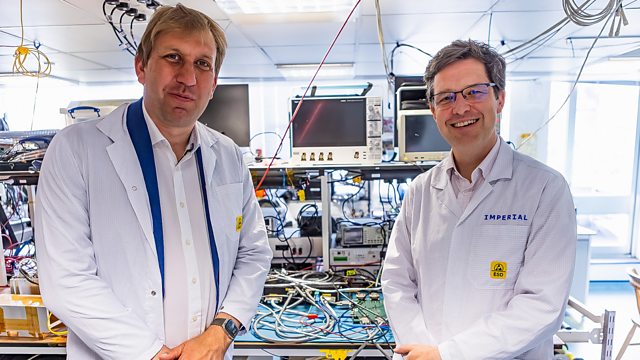
At Imperial College London, Chris Lintott gets a peek inside a groundbreaking deep space mission that will revolutionise our ability to monitor the sun’s activity and forecast solar storms. Professor Jonathan Eastwood, the magnetometer instrument lead of Vigil, takes Chris through the satellite’s capabilities. Sat 150 million kms away from Earth, Vigil will monitor the sun’s surface as it rotates towards us, giving us an extra five days’ notice of hazardous activity and a chance to avert a crisis.
In Exeter, our guest presenter, Sophia Herod, is allowed inside a very special department at the Met Office’s HQ – one of only a handful of 24/7 space weather forecasting operations in the world. There, with the help of space weather expert Krista Hammond, Sophia discovers how the Met Office is keeping a beady eye on the sun, investing in the technologies of the future, and working with government and industry to protect vital infrastructure we all rely on. Ultimately, Sophia reveals that the UK is leading the way on space weather.
Although space weather can be scary stuff, we don’t need to live through a disaster movie. This episode tells the amazing story of scientific solutions to vast and intractable problems, and how teams of people dedicate their working lives to keeping us safe from the very worst that the sun can throw at us.
Last on

More episodes
Credits
| Role | Contributor |
|---|---|
| Presenter | Chris Lintott |
| Presenter | Maggie Aderin |
| Presenter | Pete Lawrence |
| Presenter | Sophia Herod |
| Executive Producer | Eileen Inkson |
| Series Producer | Amena Hasan |
| Production Manager | Sam Breslin |
| Producer | Benjamin Smith |
Featured in...
![]()
Exploring the Cosmos
A collection of programmes exploring the mysteries of stars, Space and distant planets.
![]()
Science of Tomorrow
Discover the ideas, inventions and innovations shaping tomorrow's world.

Join our photo group

Share images, inspiration and tips with fellow photographers
