I faced leg amputation – or experimental surgery
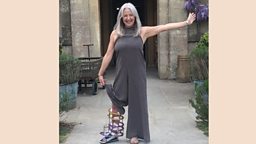
In her twenties, self-confessed speed junkie Laurie Peake was looking forward to a life full of adrenaline and excitement.
That is, until a serious motorbike crash on a wintry day in the 1980s changed everything.
Rushed to hospital, it looked as if Laurie would lose her lower leg. But a pioneering a medical experiment - only ever tried behind the iron curtain – gave her hope to walk again.
An adrenaline junkie
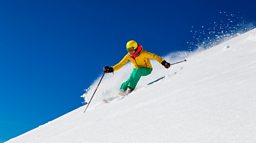
When Laurie Peake travelled to Cananda at 21, she discovered a true love – skiing.
Spending every spare second on the slopes, Laurie realised a life “in the mountains” was her dream.
Laurie decided to relocate, permanently. To do that, she had to come back to England, sort out a visa, and earn some cash.
“I got a motorbike and began to work as a motorbike messenger, which I absolutely loved and which was really, really good money,” Laurie explains.
The motorbike was the next best thing to the adrenaline thrill of the slopes – but Laurie’s dream was about to come to a shuddering halt.
A life-changing moment
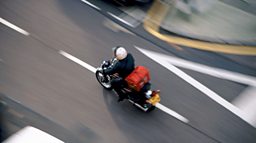
In 1981, aged 24, Laurie’s life changed forever.
"The minute I moved my right leg, that world of pain started"Laurie Peake
“It was a really cold day. It wasn't icy, but really freezing. Bright blue sky,” she recalls. “I got a job to take something up to the top of the Edgware Road.”
The bike messenger made a wrong turn onto a residential road and had to turn round.
“I was making a right turn from this crescent on the T-junction and basically the next thing I remember is a car coming towards me.”
“I don't remember the impact… I went through the air a whole block and landed and with an almighty crash.”
“The next thing I remember is my helmet, the chin of my helmet, crashing on the pavement… I went to turn over and the minute I moved my right leg, that world of pain started.”
“As I brought my leg round, it just kind of flung in the air like a rag doll.”
Rushed to hospital
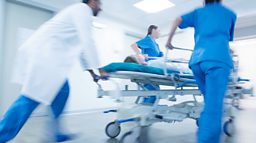
Laurie was rushed to hospital and a call was made to her mum up in Lancashire.
“The clearest memory is them cutting my [favourite] jeans off... and I remember saying, ‘Do you really have to?'"Laurie Peake
It wasn't good news: her daughter’s leg would most likely have to be amputated.
“The clearest memory is them cutting my jeans off,” Laurie says. “It was my favourite pair of jeans and I remember saying, ‘Do you really have to?’”
“I was totally oblivious to the severity of what had happened.”
Laurie’s first operations were skin grafts, where the fractured bone had come through in two places. “There was just big holes in my leg, basically.”
"There was an amazing orthopaedic team there, and they’d seemed absolutely determined to save my leg.”
They tried multiple, excruciating bone grafts – taking bone from her hip and putting it in the gap in her leg – in the hope that it might patch it together.
But a year went by and nothing had worked.
One last experimental hope
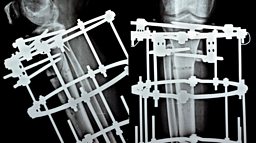
The team suggested there was one hope left – an experimental technique being tried out on a few patients at the Rowley Bristow Hospital in Surrey.
"The Iron Curtain was still down at that point so nobody here had first-hand experience of even seeing it... it was completely DIY"Laurie Peake
“When you have a normal break, both ends of the break are near enough for the little fibres of bone to make the leap, make a little bridge, across the break to start knitting,” Laurie explains.
“But when you have a traumatic break, that process is finished… After six or eight weeks, your body thinks, ‘OK, it must have healed now.’”
The Ilizarov technique is a solution to these non-union breaks, where the bone is so far apart it cannot heal. It works by forcing the two ends of the bones nearer together so there's a chance of the fibre of the bone meeting again.
“They fix either end of the broken bone with big bolts and have a bar attaching them with big screws on.” They then tighten the screws. “You're on very, very powerful painkillers.”
The procedure is named after a surgeon in Siberia who had invented it for Soviet war veterans.
“It was extraordinary because obviously the Iron Curtain was still down at that point so nobody here had first-hand experience of even seeing it.”
“It was completely DIY,” Laurie adds. They had to translate manuals from Russian, with only primitive diagrams.
'Lucky' to be a guinea pig - but would it work?
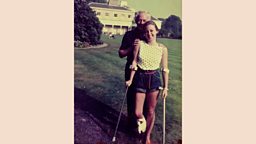
Laurie felt “fantastically lucky” to have the opportunity to be a guinea pig to such pioneering medicine.
"They'd just gone down to the local hardware store... bought a few components and made it"Laurie Peake
Alongside the ‘fixator’, which was pushing the bone together, she had to be on an electromagnetic stimulator every day, to try and kick-start the healing process.
“They'd just gone down to the local hardware store, I think, and bought a few components and made it. It was this big box, really heavy metal box, with a contraption that you put your leg through.”
“My friends were amazing. We carted this box around with us because I had to be on it 18 hours a day. And we even went on holiday with it. Took it to the beach with us in Zante and plugged it in at the beach bar.”
But six months in, Laurie’s leg still showed no signs of progress.
“It's like rotting flesh, it's smelly and horrible,” she recalls. “It had just been in the same state as it was the day I had the accident.”
Laurie admits: “I wanted to keep it, dearly... They threw everything at it and just nothing worked."
It had been nearly three years and they had got to the end of the line.
Laurie ordered a prosthetic, ahead of what felt like the inevitable amputation.
A 'tiny' sign of growth
Then, at her final consultation, something extraordinary happened.
Her doctor, Mr Simonis, had looked downcast. “I think it was as big for him, really, almost as it was for me, to admit defeat.”
“We just took another glance at yet another X-ray, which I’d seen thousands and thousands of, and it just looked the same as it always had.”
And yet, it wasn’t. This time, there was growth.
“He put his finger on the X-ray and you could just see literally a hair… I mean, so easy to miss, but that little strand of fibre crossing that chasm.”
“As tiny as that hair is, that's a sign of life… We knew we were on the path to the bone growing; to my leg healing.”
Laurie had to have lots of further operations to make it possible for her to walk.
“In the end, when I did walk out of the hospital, I did promise Mr Simonis that I would never get on a bike again.”
Still in pain
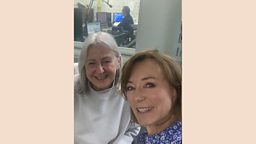
Amongst her many hospital visits, Laurie decided to study art history.
“I totally and utterly loved it,” she says. “I look back on those days and think they were heavenly, heavenly days – and couldn't have been more different to my old life.”
The keen student would stand outside the library in the morning, waiting for the doors to open, and be there until they turfed her out at night.
In the late 80s, early 90s, an extraordinary career in the art world began to develop: Laurie was part of the team that helped start Tate Liverpool.
But through it all, she was in pain from her leg.
Years later, aged 60, Laurie was having six-monthly cortisone injections. She was told something had to change or she’d lose the ability to walk.
Her options were amputation or limb reconstruction.
“For me, it was an easy decision,” she states. “Give limb reconstruction a go first.”
A broken leg again - this time on purpose
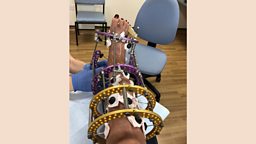
They re-broke her leg in order to kick-start the healing process again but, this time, instead of pushing the break together, they slowly pulled it apart.
"It's just given me a new lease of life completely without pain"Laurie Peake
They managed to lengthen it by an inch and a half, as well as untwisting her foot so she could walk on her sole again.
“The limb construction was amazing,” she states. “It's just given me a new lease of life completely without pain, which is phenomenal because I lived on painkillers and cortisone injections for 40 years.”
“It's amazing to get to my age and feel that I couldn't be in a better place.”
More from Life Changing
![]()
I fell 900ft to the ground - and survived
When parachute instructor Rob Bugden stepped towards the aircraft edge for a routine training jump, he had no idea that it would be the last time he ever walked.
![]()
I shook hands with the man who nearly killed me
Paul Kohler recalls the brutal assault he suffered in 2014 - and how frustration with the way his ordeal was reported inspired him to join politics.
![]()
50 years after he died at sea, I finally knew my father
The true story of Angie, who found a transformative way to remember her father.