|  | Danish Vikings settled in Norwich from the 880s AD. By 1000 Norwich was a mixture of Anglo-Saxons and Scandinavians, as part of a newly unified England.
In the reign of Ethelred the Unready, England was attacked by the Danish King Swein who sailed up the River Wensum in 1004 and 'burnt and ravaged the borough' of Norwich.
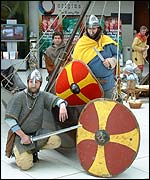
Viking warriors |
The River Wensum has provided vital links between Norwich and Europe for many years enabling the exchange of trade, skills, language and culture, as well as easy access for invaders!
A range of Viking events have been set up to mark the City's Viking history, some of which are funded by the Water City International II project, to raise awareness of the historic significance of the river, and to develop its potential for future events.
The Viking trail starts at Cow Tower and takes in Viking sites across Norwich including:
 | | Tombland, named after the Scandinavian word 'tom' meaning 'empty' or 'open', the 'open land' used as a market place in 1000AD. | | | | Calvert Street and Street and St George's Street, which mark the site of the Viking town defences. | | | | Fye Bridge, which stood near the Viking River crossing. |
Norman Mellor, of Norwich City Council said: "Vikings will be everywhere in Norwich over the next 2 weeks. Children and adults will be thrilled by the Viking trial, and the events planned for the bank holiday weekend will be spectacular.
"Please take part and let us know what you think. This really puts Norwich on the map as a great place to live as well as visit."
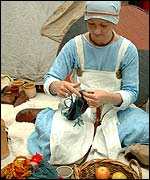
Sarah Twelftree, a Viking housewife |
The Bank Holiday special l event takes place at Cow Tower on Riverside on Sunday 30th and Monday 31st May with long ships, warriors, and traditional crafts.
There's also a chance to follow the Viking trail with the county archaeologist, Brian Ayres. Anglo-Saxons & Vikings at Norwich Castle
Gallery. Opens July 2004>>> |



 View
View