Summary

  • US Secretary of State Marco Rubio says "significant progress" has been made on Iran talks, but there is still "work to do"

  • Rubio hints at an announcement from US President Donald Trump later today, as more details from Tehran and Washington emerge

  • Trump said on Saturday an agreement with Iran has been "largely negotiated"

  • Iranian foreign ministry spokesperson Esmail Baghaei says the US and Iran's apparent convergence in the last week does not mean agreements would be reached on key issues

  • Key questions: How did we get here?Who's said what?

  • Meanwhile, there are reports that a potential deal could involve a 60-day ceasefire extension and the reopening of the Strait of Hormuz - here's why the shipping lane is important

  • Iran and the US had originally agreed to a two-week ceasefire which was later extended to facilitate peace talks

  1. 'One or two' points of disagreement remain in potential deal, Iranian media reportspublished at 11:53 BST

    Iran's semi-official Tasnim news agency reports that disagreement remains between the US and Iran over "one or two" clauses of a potential agreement.

    It says that, as a result of "obstruction by the US" on these points, the matter has not yet been finalised.

    The news agency says mediator Pakistan has been informed of Iran's stance, and that the agreement cannot be finalised if "US obstruction continues".

    Fars, an Islamic Revolutionary Guard Corps (IRGC)-linked news agency, reports these sticking points relate to frozen Iranian assets and sanctions on oil and related substances.
  2. Remind me, how did the war start?published at 11:41 BST

    The US and Israel launched a join attack on Iran on 28 February.

    They targeted Iran's missile infrastructure, military sites and leadership in the capital, Tehran, and across the country.

    Iran's Supreme Leader, Ayatollah Ali Khamenei, who had led the country since 1989, was killed during the first wave of strikes. Israel's military say dozens more senior figures in the powerful Islamic Revolutionary Guard Corps (IRGC) were also killed.

    Khamenei's son, Mojtaba Khamenei, was named as his successor on 8 March.

    Other high-ranking Iranian officials killed include security chief Ali Larijani, intelligence minister Esmail Khatib and the head of the paramilitary Basij force, Gholamreza Soleimani. Israel says it targeted them in air strikes.

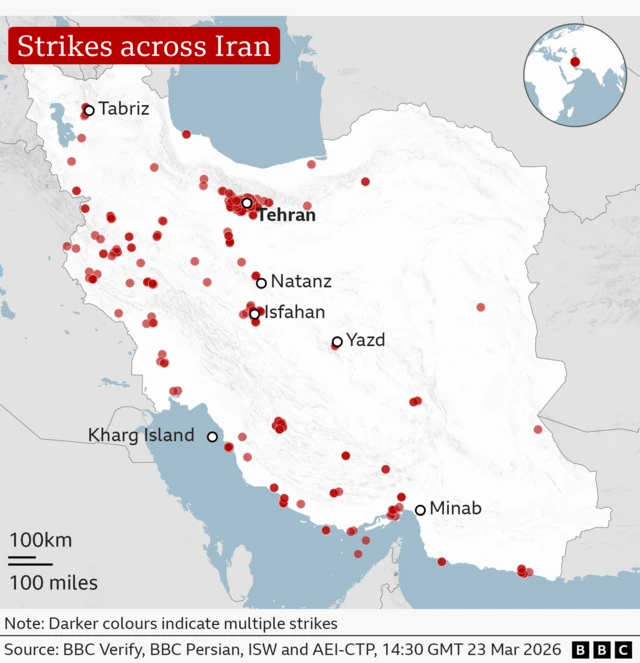
    The US and Israel have also targeted key sites linked to Iran's nuclear programme - which Iran insists is entirely peaceful - and Iranian oil and gas sites - including Kharg Island, home to a major oil terminal that is considered Iran's economic lifeline.

    Map of Iran with location of US/Israeli strikes up until 23 March 2026. Among the most targeted areas is Tehran in the north of the country, Isfahan in the centre. Also highlighted are Tabriz in the north-west and Minab in the south-east
  3. Deal could involve 60-day ceasefire extension - reportspublished at 11:18 BST

    News site Axios reports that the US-Iran deal involves a 60-day ceasefire extension, the Strait of Hormuz reopening and negotiations being held on curbing Iran's nuclear programme.

    Citing a US official, it says the deal includes:

    • The reopening of the Strait of Hormuz during this period, with no tolls and Iran agreeing to clear any mines
    • The US lifting its blockade on Iranian ports and issuing some sanction waivers on Iranian oil
    • Draft commitments from Iran to never pursue nuclear weapons, and to negotiate over its nuclear enrichment programme
    • The US to negotiate on lifting sanctions and unfreezing Iranian funds
    • US forces to stay in the region during the 60-day period, only withdrawing once a final deal is reached

    The deal could be extended beyond 60 days by mutual consent, Axios says. The BBC has not been able to independently verified these reports.

    The New York Times also reports that the proposal includes an apparent commitment by Tehran to give up its stockpile of highly enriched uranium, citing two US officials.

  4. Iran 'must not be allowed' nuclear weapon, says EU Commission president following talks 'progess'published at 10:54 BST

    European Commission President Ursula von der Leyen delivers a speech during a plenary session at the Strasbourg European Parliament, in Strasbourg, northeastern France, on May 20, 2026Image source, Getty Images

    Ursula von der Leyen, president of the EU Commission, says she welcomes "progress" in US-Iran talks, adding that "Iran must not be allowed to develop a nuclear weapon".

    She says in a statement on X that a deal must "truly de-escalate" the conflict and guarantee "toll-free full freedom of navigation" for the Strait of Hormuz.

    Von der Leyen adds that Iran must "end its destabilising actions in the region", both directly and through its proxies, and also stop its "repeated attacks" on neighbouring Gulf states.

    "Europe will continue working with international partners to seize this moment for a lasting diplomatic solution," she adds.

  5. Iran makes no commitments on nuclear in preliminary deal with US - Iranian mediapublished at 10:36 BST

    More now from Tasnim, Iran's semi-official news agency, that is reporting details of an alleged agreement between with US and Iran.

    It says Iran has made no commitments in the draft resolution to hand over any of its nuclear material, despite what is claims are western media reports to the contrary.

    The Islamic Revolutionary Guard Corps (IRGC)-related news agency reports that the negotiations on the nuclear issue have been postponed until "after the possible end of the war".

    It says the current draft is limited solely to the issue of ending the war, and does not include any details relating to Iran's nuclear programme.

  6. How did we get here?published at 10:15 BST

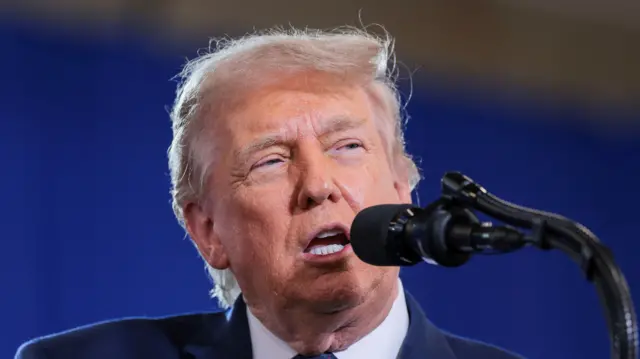
    Close up of US President Donald Trump mid-speech. He's in a dark suit, white shirt and tie, speaking into thin black micsImage source, Reuters

    As Marco Rubio says "significant progress" has been made on a possible Iran deal, here's a reminder of how negotiations have played out in recent weeks.

    8 April: Pakistan, acting as mediator, announces a two-week ceasefire between the US and Iran, initially due to end on 22 April.

    Trump says the deal is agreed on the condition that the Strait of Hormuz reopens. Pakistan says Lebanon is included. Iran agrees, but the US and Israel dispute this.

    11 April: Senior US and Iranian officials, including Vice-President JD Vance and Iran's Foreign Minister Abbas Araghchi, meet in Pakistan. After 21 hours of back and forth, Washington and Tehran remain far apart on key sticking points.

    12 April: Trump announces a blockade of Iranian shipping as Iran continues its own blockade of the Strait of Hormuz after the failure of the Islamabad talks.

    21 April: Trump agrees to extend the ceasefire for an unspecified time so negotiations can continue.

    5 May: Secretary of State Marco Rubio says that "Operation Epic Fury" - the name given to the initial US-Israeli offensive against Iran - is finished.

    8 May: Trump says the US-Iran ceasefire is still in place despite a clash between Iran and US naval destroyers in the Strait of Hormuz for which both sides blamed the other.

    10 May: Iran is reported to have sent a counter peace proposal to the US, including an immediate end to the war on all fronts and an end to the US naval blockade of Iranian ports. The US dismisses the plan as "totally unacceptable"

    15 May: The US president says he would accept a 20-year suspension by Iran to its nuclear programme.

    18 May: Trump announces on Truth Social he has called off a new attack on Iran at the request of Gulf states, adding that the US was ready to "go forward with a full, large scale assault of Iran, on a moment's notice" if there was no acceptable deal.

    23 May: Trump says an Iran deal has been "largely negotiated" and will include reopening the Strait of Hormuz.

    Iran's foreign ministry spokesman says the US and Iranian positions have been converging over the past week, but warns it does not mean key issues will be resolved.

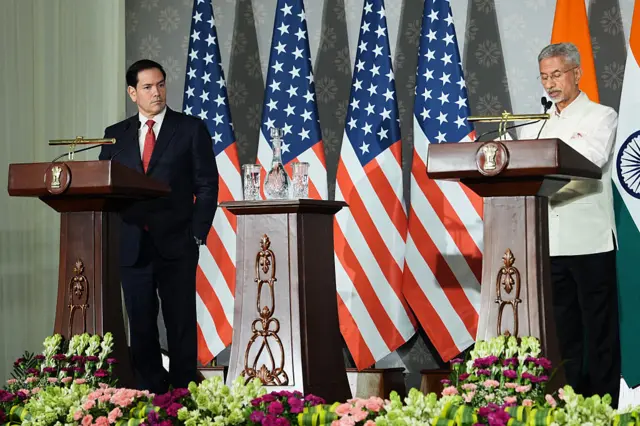
    24 May: Speaking from a press conference in New Delhi, Rubio says "significant progress" but not "final progress" has been made on a deal, hinting at further announcements later in the day.

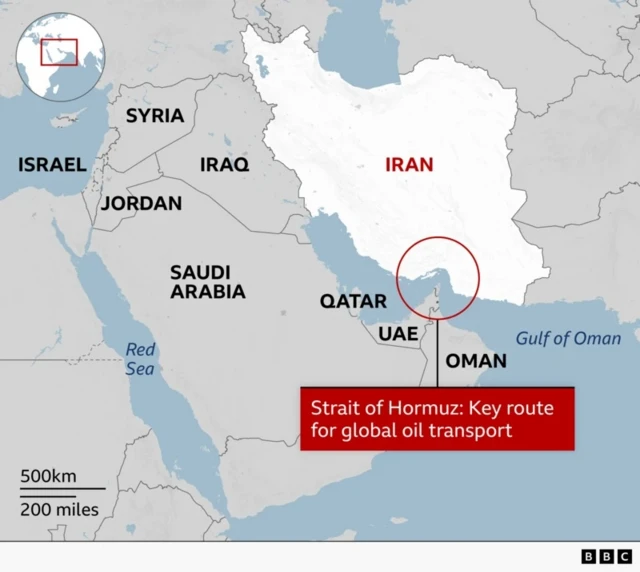
  7. What is the Strait of Hormuz, and why is it so important?published at 09:49 BST

    Map showing the location of the Strait of Hormuz in relation to other countries in the gulf

    We've just heard US Secretary of State Marco Rubio tell a news conference in India that a deal with Iran could see a "completely open" Strait of Hormuz - but why does this matter so much?

    The waterway is one of the word's key trade arteries, through which around 20% of the world's oil passes.

    Earlier in the conflict, numerous commercial ships reported attacks in the strait, as Iran blocked the passage in response to US and Israeli strikes.

    Since then, many hundreds of ships have been unable to navigate the strait, with more than 20,000 seafarers stuck in the Gulf, according to the International Maritime Organization.

    About 3,000 or so ships usually sail through the corridor each month. In 2025, about 20 million barrels of oil passed through the strait per day.

    It is deep enough for the world's biggest crude oil tankers, and is used by the major oil and gas producers in the Middle East – and their customers.

  8. Starmer welcomes progress and calls for agreement reopening Strait of Hormuzpublished at 09:28 BST

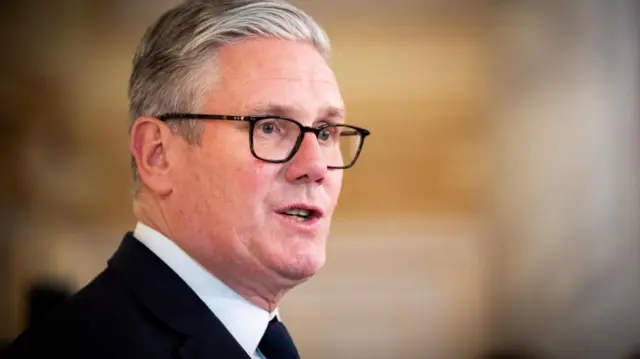
    UK PM Keir StarmerImage source, Reuters

    UK Prime Minister Keir Starmer has welcomed "the progress towards an agreement between the US and Iran", adding that it is "vital that Iran must never be allowed to develop a nuclear weapon".

    Writing on X this morning, shortly after US Secretary of State Marco Rubio spoke in India, Starmer says: "We need to see an agreement that brings the conflict to an end and reopens the Strait of Hormuz, with unconditional and unrestricted freedom of navigation."

    The PM says the UK government will do "everything we can" to protect British people from the impact of the war, adding that he would work with international partners to "seize this moment and achieve a long-term diplomatic settlement".

  9. 'Progress, but not final': What we heard from Rubio on possible Iran dealpublished at 09:15 BST

    Katie Williams
    Live reporter

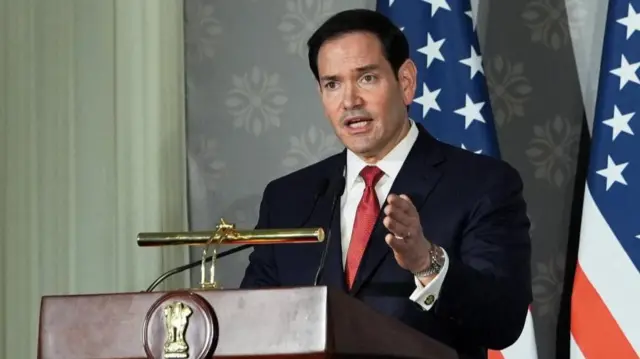
    US Secretary of State Marco Rubio speaks from press conference in New DelhiImage source, Reuters

    Speaking from a news conference in New Delhi a little earlier, US Secretary of State Marco Rubio addressed the latest on the Iran war.

    Here's what we heard:

    • Rubio said "significant progress" had been made on a potential Iran deal, but "not final progress"
    • He reiterated the US position that "Iran can never possess a nuclear weapon", calling the idea that Donald Trump would agree to this "absurd"
    • He hinted at good news on the Strait of Hormuz, saying that progress over the past 48 hours - if it works - could result in a "completely open strait... without tolls"
    • But, Rubio said that there was still "work to do", adding that he would leave it to Trump to make further announcements - which could be coming today
  10. Rubio says objectives of 'Epic Fury' have been achievedpublished at 09:07 BST

    Up next, it's a question from the BBC's Tom Bateman who asks about scrutiny over reports on the amount of schools that have been damaged in Iran since the outbreak of the war on 28 February.

    Rubio says he's "not going to speak to military tactics, simply because that's not my department".

    He says the US goals were "very clear", which were to destroy Iran's navy, its ability to launch ballistic missiles and damage its "defence industrial base".

    "Those were the objectives of Epic Fury, those objectives were achieved," he says.

    With that, the news conference comes to an end.

  11. Rubio hints at 'good news' on Strait of Hormuz, but admits there's still 'work to do'published at 08:46 BST

    India's Foreign Minister Subrahmanyam Jaishankar (R) and US Secretary of State Marco Rubio.Image source, Getty Images
    Image caption,

    Rubio is speaking at a news conference with India's foreign minister in New Delhi

    Rubio continues, saying that Iran can never have a nuclear weapon. This, he says, is something US President Donald Trump has been clear on.

    He adds the idea that the president would agree to a deal that would put Iran in a stronger position on the nuclear issue is "absurd".

    Diplomatic channels to bring about an end to the war are the US's preference, he says, adding: "I think we've made some progress."

    It's possible the world will get some good news over the next few hours, "at least in regards to the strait", Rubio adds.

    He caveats by saying: "We still have some work to do". There is "good news" but "not final news", Rubio says.

  12. Significant progress made, but not final - Rubio says, hinting more updates coming todaypublished at 08:35 BST
    Breaking

    Marco Rubio is now addressing the Iran war - watch live above.

    Asked about the status of a possible Iran deal, Rubio says "there will be, maybe, more news coming out a little bit later today" but adds that he'll "leave it to the president (Trump) to make further announcements".

    He says "some progress has been made - significant progress, although not final progress".

  13. A potential deal between US and Iran - who's said what?published at 08:24 BST

    Iran's Foreign Ministry spokesman Esmail Baghaei.Image source, Reuters
    Image caption,

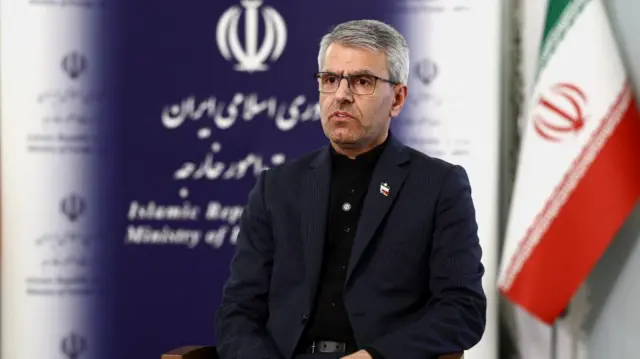
    Iran's Foreign Ministry spokesman Esmail Baghaei

    As the news conference with Marco Rubio is under way in India, here's a look back at what we've heard so far about a potential deal between Washington and Tehran.

    US President Donald Trump said on Saturday an agreement with Iran has been "largely negotiated", which would include the reopening of the Strait of Hormuz.

    He doesn't provide more details, but says "final aspects and details of the deal are currently being discussed, and will be announced shortly".

    He has insisted any agreement would "absolutely" prevent Iran from obtaining a nuclear weapon.

    Iranian foreign ministry spokesman Esmail Baghaei has said that US and Iranian positions had been converging in the last week, but warned that did not mean agreements would be reached on key issues and accused the Americans of "contradictory statements".

    Iran's semi-official news agency Tasnim this morning reported that the Strait of Hormuz "will not return to its pre-war status" under an agreement.

    Pakistan's Foreign Minister Ishaq Dar says a "positive and durable outcome is within reach" in the Iran war following the latest negotiations.

  14. US Secretary of State Rubio speaking now - watch and follow livepublished at 08:14 BST
    Breaking

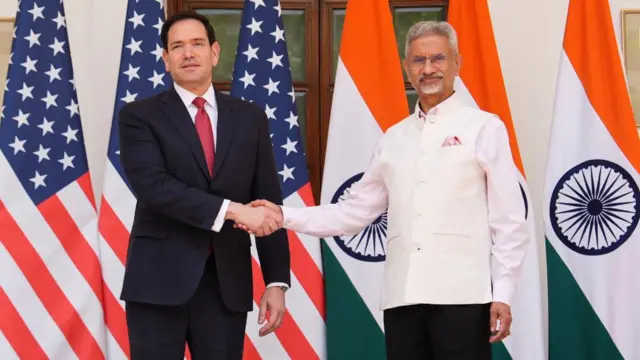
    U.S. Secretary of State Marco Rubio and India’s Minister of External Affairs S. Jaishankar shake hands after their talks in New Delh.Image source, Reuters
    Image caption,

    The news conference comes after Rubio's meeting with India’s Minister of External Affairs S. Jaishankar

    US Secretary of State Marco Rubio is now speaking at a news conference in New Delhi during an official visit to India.

    His comments are largely expected to be on his trip to India, but we're listening out for any key developments on the Iran war after Trump said a deal had been "largely negotiated".

    No official agreement has yet been reached.

    You can watch the news conference live above, stick with us for the latest updates.

  15. Positive outcome 'within reach', says mediator Pakistan on US-Iran negotiationspublished at 08:12 BST

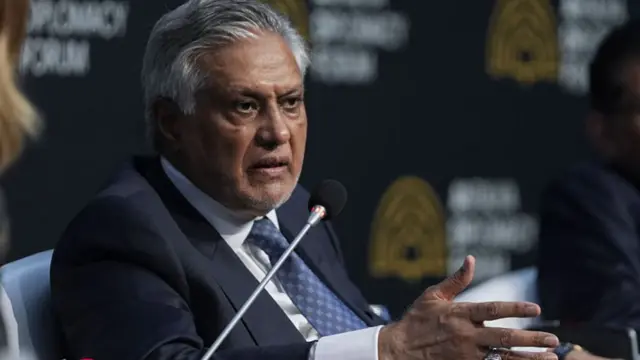
    Deputy Prime Minister and Minister of Foreign Affairs of Pakistan, Mohammad Ishaq Dar, pictured on April 17, 2026Image source, Getty Images

    Pakistan's foreign minister says a "positive and durable outcome is within reach" in the Iran war following the latest negotiations.

    It follows US President Donald Trump announcing that a deal with Iran had been "largely negotiated".

    Ishaq Dar, who is also Pakistan's deputy prime minister, says a phone call between Trump and representatives from Pakistan, Saudi Arabia, Türkiye, Qatar, Egypt, the UAE, and Jordan "marks a significant step" towards "regional peace".

    "Pakistan remains firmly committed to supporting all sincere efforts aimed at lasting peace, mutual respect, and regional stability," he says

    "The achievements of these negotiations offer grounds for optimism that a positive and durable outcome is within reach."

  16. Strait of Hormuz 'will not return' to pre-war status - Iranian mediapublished at 08:10 BST

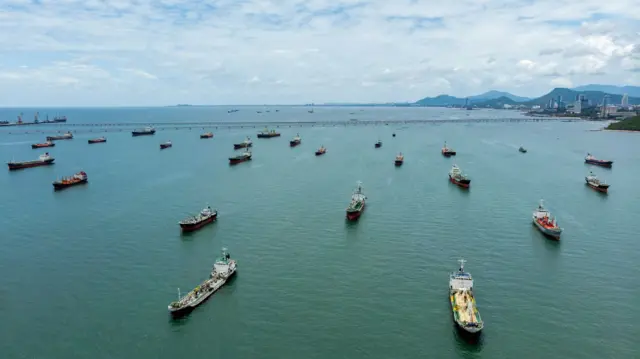
    Oil tankers and gas tankers were affected by the closure of the Strait of Hormuz, leading to a global energy crisis stemming from the war in the Middle EasImage source, Getty Images

    Under an agreement between the US and Iran, the Strait of Hormuz "will not return to its pre-war status" reports Iran's semi-official Tasnim news agency.

    The Islamic Revolutionary Guard Corps (IRGC)-affiliated news outlet has been reporting details of the deal with the US throughout the morning, however there has been no confirmation from the US on the details of any agreement.

    Tasnim reports that the strait will not return to the status quo immediately, but that the number of ships passing through the strait will be restored to pre-war levels within 30 days.

    However, it adds that Iran "emphasises exercising its sovereignty over the strait".

    It adds that the US' naval blockade on ships entering and exiting Iranian ports must be "completely lifted" within 30 days.

  17. Trump says agreement to bring end to Iran war 'largely negotiated'published at 08:05 BST

    US President Donald Trump in a suit, looking at camera.Image source, Getty Images

    US President Donald Trump says an agreement with Iran has been "largely negotiated" and details will be announced soon.

    In a Truth Social post on Saturday, Trump said the deal would include reopening the Strait of Hormuz.

    This morning, Iran's semi-official Tasnim news agency says the Strait would return to pre-war levels within 30 days, and adds that a potential deal would see the cessation of attacks on all fronts.

    We're shortly expecting to hear from US Secretary of State Marco Rubio following his meeting with India's foreign minister in New Delhi - you can watch live above once it gets under way.

    Iranian foreign ministry spokesman Esmail Baghaei told state television yesterday that US and Iranian positions had been converging in the last week.

    But he warned that did not mean agreements would be reached on key issues and accused the Americans of "contradictory statements".

    Trump also said he had a "very good call" with the leaders of Saudi Arabia, the United Arab Emirates, Qatar, and others about a "Memorandum of Understanding pertaining to PEACE".

    "An agreement has been largely negotiated, subject to finalization between the United States of America, the Islamic Republic of Iran, and the various other Countries, as listed," Trump said.

    We'll bring you the latest developments on this story throughout the day, stay with us.