Summary

  1. 'I don't switch the oven on' because of money worriespublished at 08:33 BST

    Eleanor Lawrie
    Social affairs reporter
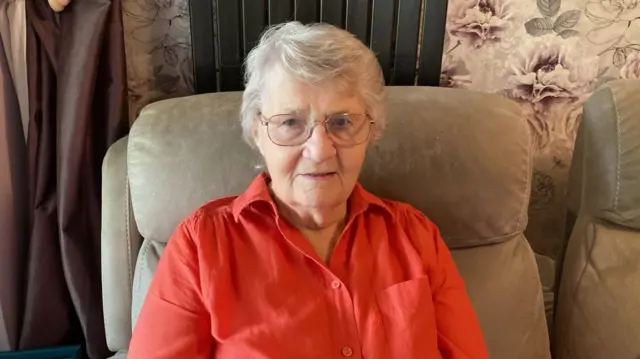
    Elaine Yates sits in an armchair

    The inflation rate falling does not mean prices are dropping, it just means they are rising less quickly

    Elaine Yates, 77, says money worries mean she "can't remember" the last time she used her oven to cook a hot meal.

    "I don't look after myself. I can't remember the last time I put the oven on. I have got an air fryer that I probably used about three weeks ago," she says.

    The Northamptonshire pensioner spent 20 years as a full-time carer for her husband. Her finances are now "extremely tight", so she has felt particularly vulnerable to price rises since he passed away.

    Four years into the cost of living crisis, almost two-thirds of low-income families say they struggle to buy essentials such as clothes, heating and food, according to anti-poverty charity the Joseph Rowntree Foundation.

    A record 62% of low-income families were unable to afford an essential item in the past six months, the charity found - the equivalent of 7.4m households, up from 7.1m a year ago.

  2. One thing to remember about inflationpublished at 08:21 BST

    When we talk about the inflation rate falling, it doesn't actually mean that the price you might be paying for food, for example, is dropping.

    It just means prices are rising less quickly. A slowdown in the pace of inflation is to be welcomed, however.

    If it stays close to the Bank of England's 2% target, it means the Bank is less likely to raise interest rates.

    Read more about inflation here.

  3. Where next for food prices?published at 08:06 BST

    Overall, food price inflation eased to 1.7% in the year to June.

    That's down from 2.2% in the 12 months to May and the slowest pace since August 2024.

    While there is a lot of focus on what impact the war in the Middle East in having on the rest of the global economy, food manufacturers have also had to contend with the conflict between Ukraine and Russia.

    Often referred to as "the breadbasket of Europe", Ukraine has been a major supplier of key cereals and grains.

    Food and Drink Federation chief economist Liliana Danila says businesses have been able to diversify their supply chains to guard against major shocks.

    She says: "We continue to anticipate rising food price inflation as the year goes on, however this is likely to be lower, come later and plateau for longer than the previous inflationary cycle."

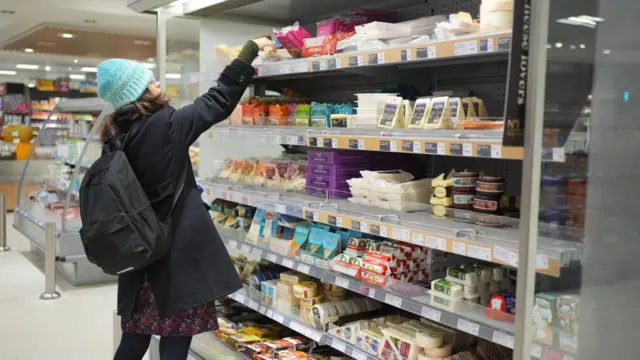
    A woman in a supermarket fridge aisleImage source, PA Media
  4. Analysis

    Falling inflation is unlikely to lastpublished at 07:43 BST

    Kevin Peachey
    Cost of living correspondent

    The new PM, and particularly the new chancellor, will welcome an inflation rate close to the 2% target.

    But the boost is unlikely to last long.

    A 13% rise in energy bills felt by millions of households in England, Wales and Scotland this month will be seen in the next set of inflation data.

    Andy Burnham and John Healey will hope that events fall in their favour and not create too much inflationary pressure.

    But in just a couple of days, they’ve already shown they are willing to intervene with policies aimed at supporting consumers and bringing the inflation rate down too - if only a little.

    Whether they will continue to have levers to pull as time goes on will be a key question.

  5. Shadow chancellor accuses Labour of stoking inflationpublished at 07:42 BST

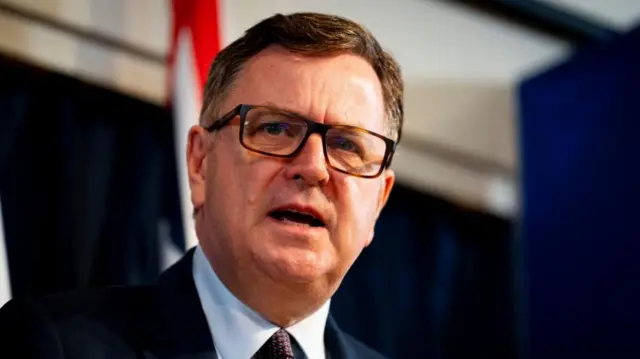
    A headshot of Mel StrideImage source, PA Media

    Shadow Chancellor Mel Stride says the 2.6% figure released today is "deeply concerning for families" - outlining that it remains above the Bank of England's 2% target.

    "Labour's tax hikes and reckless borrowing stoked inflation, and Andy Burnham has already made billions of pounds of spending commitments without any plan to pay for them," he says.

    Stride adds his party has set out a "credible plan to cut spending, cut taxes and get Britain working again".

  6. Petrol prices fall for first times since Iran war beganpublished at 07:24 BST

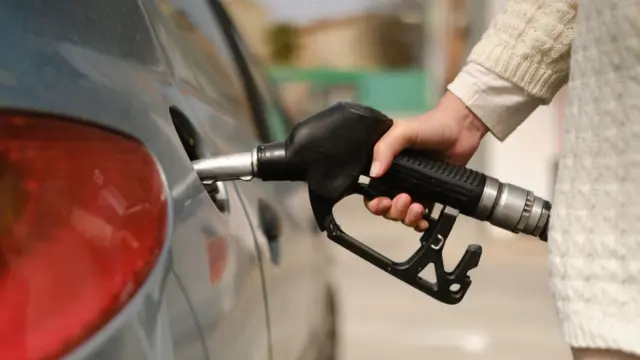
    Woman with petrol pumpImage source, Getty Images

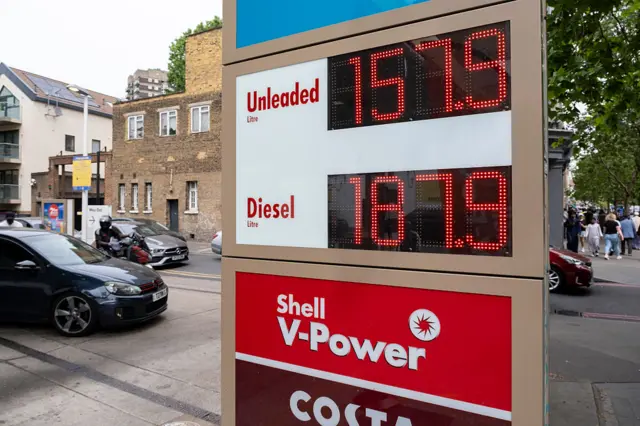
    Delving into the official statistics a little more, the ONS says that the cost of a litre of petrol dropped by 2.1p per litre, taking it to an average price of 155.3p.

    This is the first time petrol prices have eased since the start of the US-Israel war with Iran which began on 28 February.

    Meanwhile, the fall in diesel prices last month was far sharper than petrol. The ONS says that the average price of diesel fell by 10.7p per litre between May and June, to 176.4p.

  7. Healey: 'We have chosen to focus on the cost of living in our first week'published at 07:23 BST

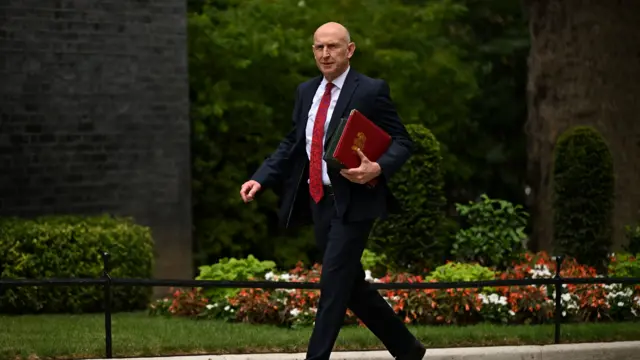
    Chancellor John HealeyImage source, Reuters

    Newly appointed Chancellor John Healey says today's drop in inflation is "news families want to hear".

    However, he stresses there is "much more to do to give people the breathing space they need".

    He points to the two recent policy announcements from the government on cutting VAT from domestic electricity bills and the new bus fare cap on most journeys in England.

    "We have chosen to focus on the cost of living in our first week, signalling that concern for working people will be at the heart of everything we do.

    "Both these changes are a win-win. They help keep inflation down while helping people afford the essentials."

  8. Chocolate, margarine and beef prices easepublished at 07:09 BST

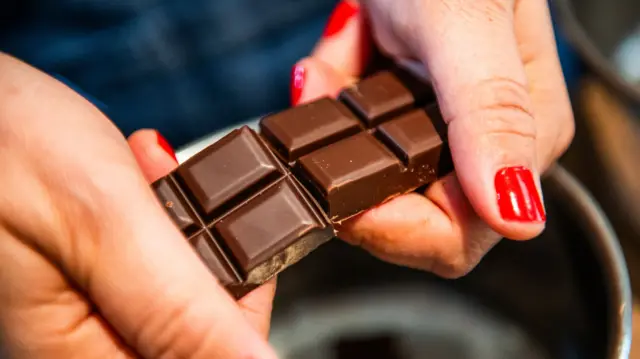
    A heady mix of chocolate, margarine and beef helped ease inflation last month, according to the ONS.

    It also says that clothing was cheaper as retailers cut prices more sharply in this year's summer sales compared to June last year.

    Woman breaking chocolateImage source, Getty Images
  9. Diesel prices pull inflation lowerpublished at 07:03 BST

    The pace of inflation fell due to motor fuel prices, according to the Office for National Statistics, in particular diesel.

  10. UK inflation slows to 2.6%published at 07:00 BST
    Breaking

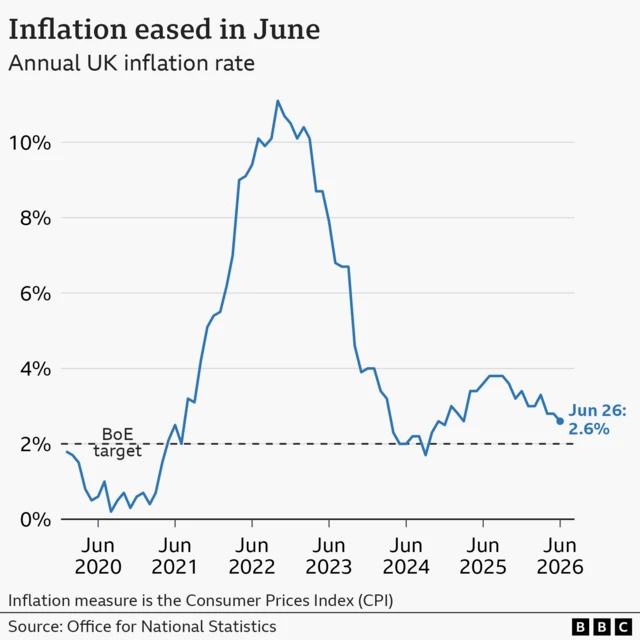
    The UK rate of inflation has slowed to 2.6% in the 12 months to June, official figures show.

    That compares to 2.8% for the year to May.

    A line graph showing the annual UK inflation rate against the Bank of England target of 2%. June 2026 reads at 2.6%. Inflation measure is the Consumer Prices Index
  11. Analysis

    Inflation likely to fall - but not for longpublished at 06:55 BST

    Ben King
    Business reporter, BBC News

    As we just reported, inflation numbers could see a temporary dip as a result of lower petrol and diesel prices.

    June saw a period of relative calm in the US-Iran war, when Washington and Tehran agreed to halt military operations and reopen the Strait of Hormuz - a key route for global oil supplies.

    This led to cheaper prices at the pumps.

    Lower inflation is, however, expected to be short-lived. The price cap on gas and electricity rose in July, lifting the typical household energy bill by 13%.

    Meanwhile, the resumption of military strikes in the Middle East has sent oil prices back over $90 a barrel. If it stays elevated, that risks inflaming inflation.

    For now, much depends on how long the war continues, and how high energy prices remain.

    A petrol forecourt on London on 29 MayImage source, Getty Images
    Image caption,

    A petrol forecourt on London on 29 May

  12. Inflation was 2.8% in Maypublished at 06:53 BST

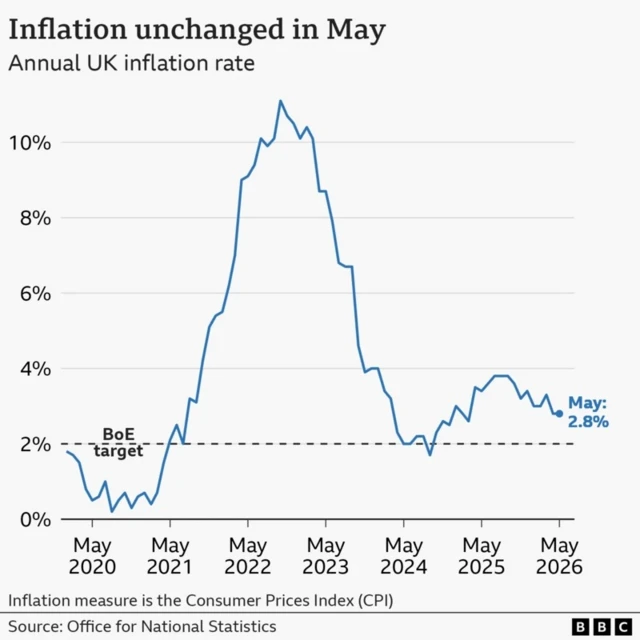
    Last month, it was announced that the UK's inflation rate remained at 2.8% in the year to May, slightly lower than the 3% that had been predicted.

    This means the prices of good and services in the UK, on average, were 2.8% more expensive in May compared to May of 2025.

    That figure is above the Bank of England's target of 2%. It is, however, well below the 11.1% figure of October 2022, which was a 40-year high.

    Following last month's announcement, former chancellor Rachel Reeves said the government had "the right economic plan to build a stronger more secure Britain".

    Today's figure is expected to drop slightly - driven by lower petrol prices.

    Graph showing the inflation rate for the UK from 2020 to May 2026, which was at 2.6%
  13. Latest UK inflation figure about to be releasedpublished at 06:48 BST

    We're about to find out the latest UK inflation rate, when the Office for National Statistics releases the figures at 07:00 BST.

    Inflation measures the increase in the price of goods over the last 12 months. The figure covers hundreds of everyday items.

    Experts expect the figure to fall to around 2.6% - this means prices are still rising, just at a slower pace. In May, inflation was 2.8% for the second month in a row.

    We'll bring you the figure as soon as we get it, along with analysis and reaction.