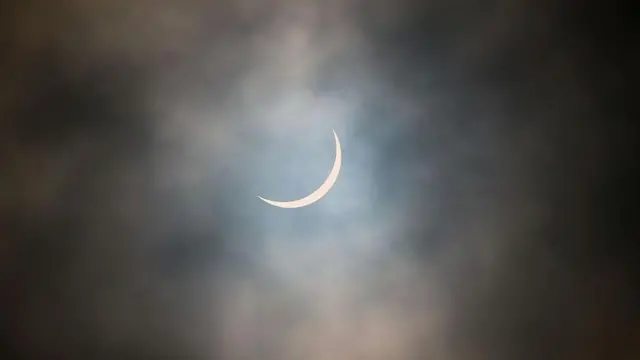
Summary

  • The UK and parts of Europe are getting ready for the most significant solar eclipse since 1999

  • More than 90% of the Sun will be covered by the Moon for most of the UK, while parts of Iceland and Spain will witness a rare total eclipse

  • In the UK some will be able to view the eclipse from shortly after 18:00 BST before it peaks an hour or so later - where and when you could see it

  • With excitement building, one shopkeeper reports selling thousands of special eclipse glasses as people try to get a pair before this evening

  • Experts say watchers should not look directly at the Sun without protection or you risk seriously damaging your eyes - how to watch the eclipse safely

  • The eclipse's path will start in Siberia in Russia, travelling to Alaska in the US around 07:30 local time (16:30 BST) - it will then sweep round to Greenland and through Europe

Will you be watching the eclipse?

  1. Dark skies and silent birds - what happens during a solar eclipse?published at 12:22 BST

    Pallab Ghosh
    Science correspondent, reporting from Burgos, northern Spain

    The light changes first: flatter, cooler, as if the colour has drained from the day.

    Through eclipse glasses, you can see the Moon keeps taking bites from the Sun.

    Then, in the last seconds, tiny sparks of sunlight flare through lunar valleys — the diamond ring effect — and abruptly, the magic moment of totality.

    The moon completely blocks the Sun’s bright disc – and a new object hangs in the heavens in their place - like a gigantic shimmering black pearl - for a few moments turning day into night.

    Around the Moon appears the corona: the Sun’s extraordinary outer atmosphere, normally drowned out by daylight, now visible as a pale, pearly-white crown. Its delicate streamers stretch into the darkening sky, shaped by magnetic forces reaching far out from the Sun.
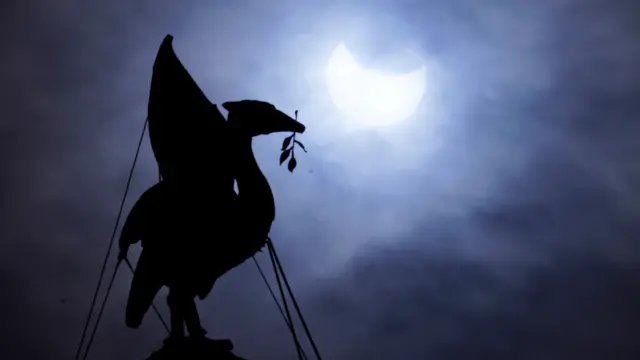
    Liverpool, during an eclipse in 2015Image source, Getty Images
    Image caption,

    Liverpool, during an eclipse in 2015

    On Earth the horizon can glow with the colours of sunset in every direction. Bright planets or stars may appear.

    For many people, the stillness is what stays with them: the hush, the change in temperature, the awareness that this familiar sky has become something utterly unfamiliar.

    It is a moment that moves those who are lucky enough to witness it – reminding us the wonder of the universe and out place in it.

  2. ...and they're like gold dust in Glasgowpublished at 11:58 BST

    Claire Thomson
    Reporting from Glasgow

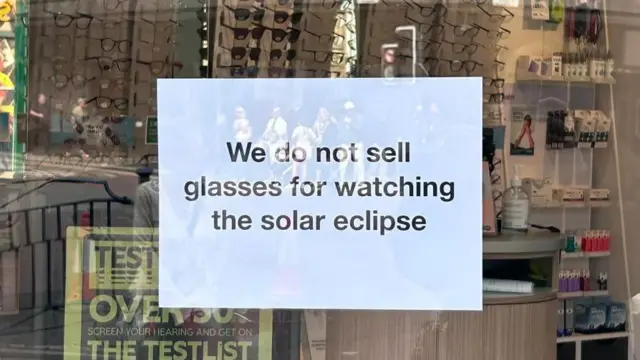
    A sign which reads "we do not sell glasses for watching the solar eclipse".

    I went on the hunt for the right kind of protective eyewear in Glasgow on Tuesday, where specialist eclipse glasses seem to be like gold dust.

    In the store window of Specsavers on Argyle Street – one of the main shopping streets in the city centre – a sign read: “We do not sell glasses for watching the solar eclipse.”

    Opticians said they had taken a lot of calls, with people desperately asking whether they had any eclipse glasses.

    But customers have had no luck as many shops made the decision not to stock the protective eyewear.

    Giles Edmonds, clinical services director at Specsavers, said: "With the type of glasses required for viewing the eclipse, being a single-use item and designed for a relatively rare event, we've decided not to produce or supply them this time as it's not the most sustainable choice for us."

    He added people should only buy genuine products from reputable sellers and not use an old pair of eclipse glasses until they have been checked for damage.

    There are also multiple signs dotted on the shop window of another retailer: “Sorry, we are SOLD OUT of solar eclipse glasses,” the notice read.

  3. Eclipse glasses rocketing off the shelves in their thousands in London...published at 11:43 BST

    Jake Lapham
    Live reporter

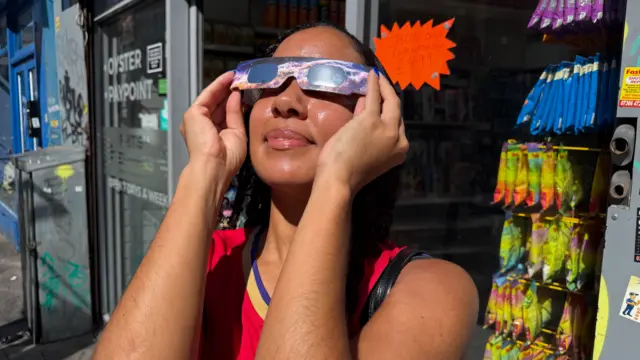
    A woman holds up cardboard glasses to her eyes while looking at the sun in front of a store.
    Image caption,

    Louisa was lucky enough to get a pair of eclipse glasses

    I’m at a convenience store in Shoreditch in central London where eclipse glasses are flying off the shelves.

    People are literally arriving out of breath from running here, fearful they will miss out.

    Taimur, the shopkeeper, tells me they have sold 26,000 pairs in three days across a handful of stores.

    Louisa Scott just snapped some up, and tells me she saw someone on the street with a pair and asked where they got them.

    “I’m really excited, I only found out very last minute that it was a thing and everywhere doesn’t have them,” she says.

    But many people are scoffing at the £10 price tag. “Extortionate”, one buyer remarks.

    A man smiles at the camera while holding a bunch of cardboard glasses in front of row of crisp packets in a store.
    Image caption,

    Taimur, the shopkeeper in Shoreditch

  4. Don't point your phone camera at the sunpublished at 11:33 BST

    Tom Gerken
    Tech reporter

    Pointing your phone at the eclipse can be terrible news for your device's camera.

    "Point an unfiltered lens at the sun, and you risk burning out the sensor, just as looking with the naked eye risks your vision," says Uswitch's Jez Samuel.

    "A phone camera lens focuses sunlight into an intense point on the sensor behind it, and enough unfiltered exposure will kill pixels permanently."

    And it's not just him. Even Nasa says don't do it, external.

    Funnily enough, the solution is the same for your camera as it is for your eye. Hold your eclipse glasses in front of the camera lens if you really must take a photo of it.

    And if the temptation comes over you to ignore this advice, just remember: the bill to repair a damaged phone camera could end up being hundreds of pounds.

    A group of people holding mobile phonesImage source, Getty Images
  5. A partial eclipse? Or totality? What's the difference?published at 11:09 BST

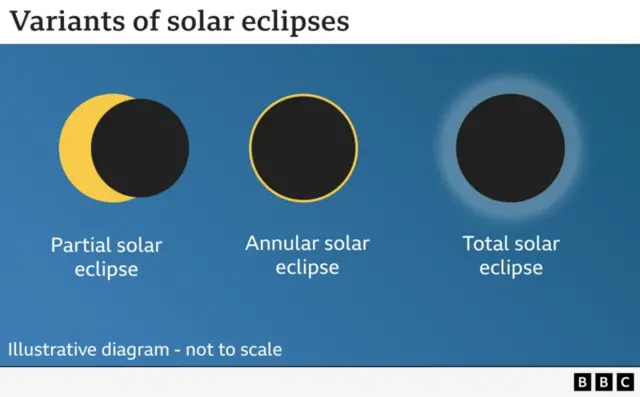
    A BBC graphic shows three diagrams for the different types of eclipses. For the 'partial solar eclipse' a black circle is in front of a yellow circle creating a crescent shape. For the 'annual solar eclipse' there is a black circle with a yellow ring around it. For the 'total solar eclipse' there is a black circle with a white glow behind it

    The UK is gearing up for a partial solar eclipse, while other parts of Europe are due to experience totality.

    But what are the different types of eclipse?

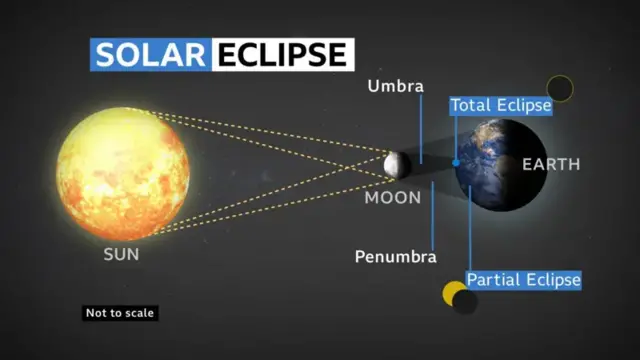
    Depending on how the Sun, Moon and Earth line up, different types of eclipses that are visible.

    • A partial eclipse is when the Moon only covers part of the Sun.
    • A total eclipse is when the Sun is completely blocked by the Moon, causing the sky to go dark.
    • There's also an annular eclipse, where the Moon is in front of the Sun, but is too far away from Earth to completely block it.

    During an annular eclipse, it looks like there's a dramatic ring of fire around the Moon - but this is just the part of the Sun that hasn't been covered up.

    A solar eclipse graphic shows the Sun, the Moon and the Earth lined up. A shaded section behind the Moon shows where it would obscure the light on Earth.
  6. Horse racing and cricket matches make alterations for today's eclipsepublished at 11:01 BST

    Charlotte Coates
    BBC Sport journalist

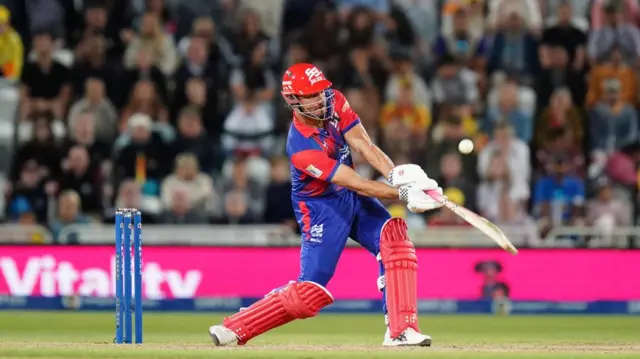
    A Hundred cricket match played earlier this weekImage source, PA Media
    Image caption,

    A Hundred cricket match played earlier this week

    The horse racing meeting at Ffos Las in South Wales will begin about two hours earlier today because of the solar eclipse.

    At other sporting events, including four Hundred cricket matches, floodlights will be turned on throughout the games.

    At Ffos Las, the first race was scheduled for 17:40 BST but that has now been rescheduled by the British Horseracing Authority to 15:35.

    Officials at Kempton racecourse, which has races scheduled for 19:00 and 19:30, said there will be no disruption as all races were set to be under floodlights.

    During the solar eclipse in August 1999, a League Cup football match between Torquay United and Portsmouth at Plainmoor stadium was postponed.

  7. Astronomers in Cornwall are ready for the eclipsepublished at 10:46 BST

    Kernow Astronomers, a club for stargazers in Cornwall, are hosting a special public viewing event of the eclipse tonight on the coast.

    Frank Johns, a member of Kernow Astronomers, told BBC Radio 5 Live the eclipse "will take place very slowly".

    "The description I would use is that it progresses about the same speed as the minute hand goes around, so it's not something that is instantaneous, especially here," he said.

    Johns explained that the actual darkening of the moon won't occur "until it gets more than 50% covered, because the sun is very very bright".

    After that there will be "a very slow eating away of the sun until it's more like a thin crisp moon", he added.

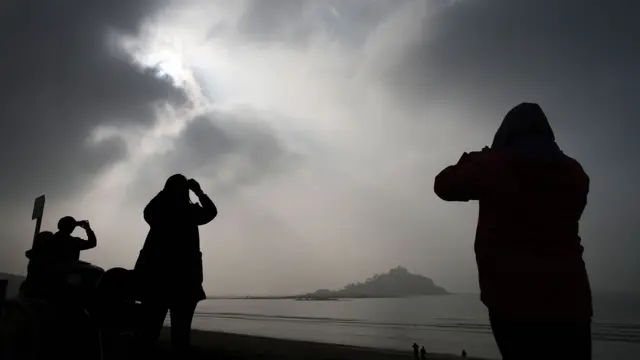
    People watching the 2015 eclipse in CornwallImage source, Getty Images
    Image caption,

    People watching the 2015 eclipse in Cornwall

  8. Experiencing totality a real physical experience, says eclipse chaserpublished at 10:27 BST

    Ben Hatton
    Live reporter

    Ryan Milligan poses for a selfieImage source, Ryan Milligan

    Ryan Milligan is travelling from Northern Ireland, where about 93% of the Sun will be blocked out, to northern Spain, where the Sun will be completely hidden behind the Moon, so he can experience the moment of totality.

    I ask him if those few extra percentage points of eclipse cover worth the trip - but he doesn’t even let me get to the end of the question.

    "Yes, 100%" he says.

    An eclipse chaser, Milligan has travelled the world to experience that fleeting moment - including trips to Chile, China, Indonesia and Australia.

    "Getting into the path of totality is always the challenge," he says.

    "That path, which is essentially the Moon's shadow being cast onto the Earth, is usually about 100 miles wide. So you need to get to wherever that is on the Earth. It will only be there for a matter of moments usually."

    He describes the moment of totality as "a real physical experience because the temperature drops, the light becomes all weird, and your brain is trying to process all this new information".

    Milligan adds: "It does become highly addictive because it is such a unique experience that cannot be replicated by any other event in nature in my experience."

  9. Clear skies forecast for total eclipse in Spain and Portugalpublished at 10:19 BST

    Darren Bett
    BBC weather presenter

    The total eclipse will track from western Iceland across the Atlantic to Spain, and a little bit of Portugal.

    Iceland is likely to stay cloudy with the best of any breaks in the northwest of the country.

    For Spain and Portugal the picture is very different.

    Here there will be little or no cloud and viewing should be excellent.

    So ideally find somewhere with a clear, unobstructed view to the west – somewhere high up and away from trees and buildings.

  10. Clear skies should give many in the UK a good viewpublished at 10:05 BST

    Matt Taylor
    BBC Weather

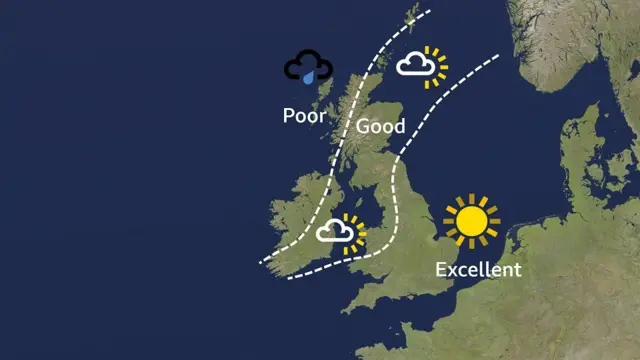
    The UK is stuck in the middle of two different weather systems.

    High pressure lies across much of continental Europe with low pressure and weather fronts out towards the north of the Atlantic.This means contrasting fortunes.

    High pressure is expected to bring generally dry and settled conditions across much of the UK, with a hot and sunny day forecast for most.

    That means clear skies should give many a good view of the eclipse.

    However, across some parts of north Wales, northern England and especially Scotland and Northern Ireland, areas of cloud could push their way through between 18:00 and 19:00 BST.

    Across some parts of western Scotland and in towards the north and west of Northern Ireland, we see cloud bring some outbreaks of rain.

    A map of the UK with graphics showing weather patterns including white lines, clouds with sun, rain and the sun.
    Image caption,

    The viewing conditions of the eclipse from the UK.

  11. Eclipse chasers scramble for glasses as stocks run lowpublished at 09:53 BST

    Maia Davies
    Live reporter

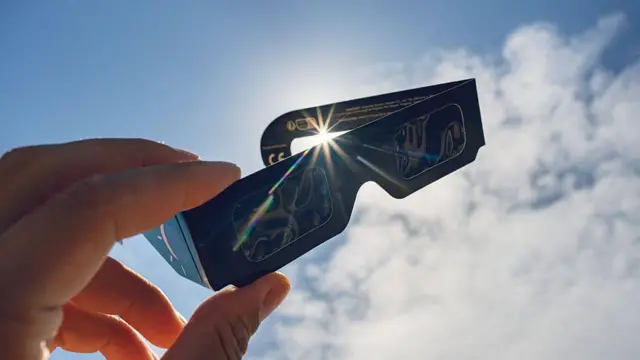
    A pair of eclipse glasses held up in front of the sunImage source, Getty Images

    While eclipse glasses are one of the best ways to view an eclipse safely, many here in the UK have been struggling to get hold of a pair at the last minute.

    Experts have urged eclipse enthusiasts not to look directly at the Sun or use their everyday sunglasses - with even brief exposure causing lasting damage - and seek out specialist spectacles instead.

    But with online supplies all but sold out, they have been turning up for sale in unexpected places as retailers try to cash in on demand.

    "I've sold, like, 100 this morning," a staff member at a central London bakery told the BBC on Monday.

    "People have been struggling to find them all over," said a customer waiting in line for her supplies.

    The scramble has prompted eclipse chasers to trawl social media for tips, turning to WhatsApp groups, Reddit and Facebook threads dedicated to tracking down the glasses.

    But experts have advised real caution when using supplies found online, warning that major eclipses can attract ineffective knock-offs - the use of which could lead to serious injury.

  12. Eclipse glasses, pinhole projectors, or a colander - how to view the eclipsepublished at 09:39 BST

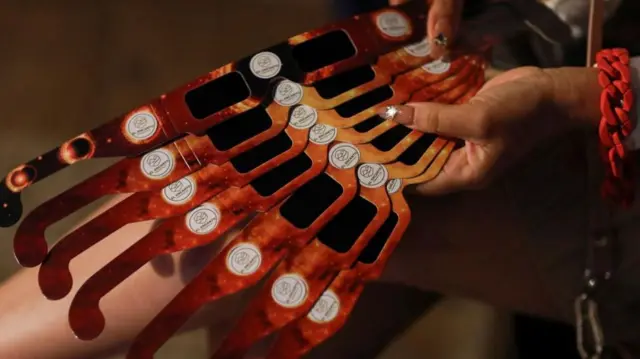
    Protective glasses to observe the solar eclipse safely, being handed out ahead of a total solar eclipse in Mazatlan, Mexico, on 6 April 2024Image source, Reuters

    Looking directly at the Sun can severely damage your eyes - even during an eclipse.

    Even using standard sunglasses could leave you with permanently damaged eyes, so you should only look with special eclipse glasses.

    The only time you can look without special glasses is for the brief period when the Sun is totally eclipsed by the Moon - which won't happen in the UK.

    And you cannot use binoculars or telescopes or the viewfinder of a camera even while wearing eclipse glasses - the magnifying effect can nullify the protection of the glasses and damage your sight.

    No solar glasses or handheld solar viewers? You can use an indirect viewing method, such as a pinhole camera, which doesn't involve looking straight at the Sun.

    You can make a simple one with a single sheet of card or something more ambitious using a cardboard box - or you can use a colander to project multiple images on to a surface all at once.

    This Flourish post cannot be displayed in your browser. Please enable Javascript or try a different browser.

  13. Here in the UK, just after 7pm will be the peakpublished at 09:27 BST

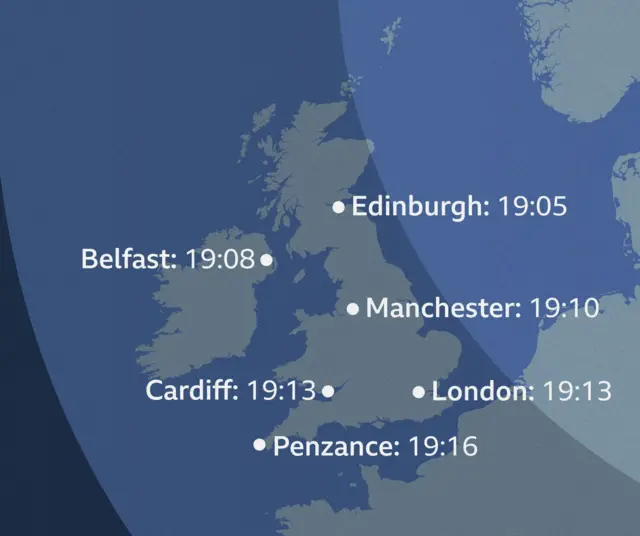
    Depending on where you are in the UK, the eclipse will be at its maximum between 19:02 BST and 19:16 BST.

    What time the peak occurs for you will depend mostly on how far north you are. In general, the further north, the earlier you will see the maximum eclipse.

    And, in general, the further west you are, more of the Sun will be covered.

    The best places to view the eclipse are from higher ground, or areas with a clear view towards the western horizon.

    A blue-grey map of the United Kingdom, Ireland and surrounding parts of northern Europe. White labels identify the times of maximum eclipse in several UK cities: Edinburgh at 19:05, Belfast at 19:08, Manchester at 19:10, Cardiff at 19:13 and London at 19:13. Semi-transparent blue bands curve across the map, indicating the general path of the eclipse shadow. The geographical spread of the time labels shows that the peak of the eclipse occurs slightly earlier in the north than in the south.
  14. Where and when could I see the eclipse?published at 09:24 BST

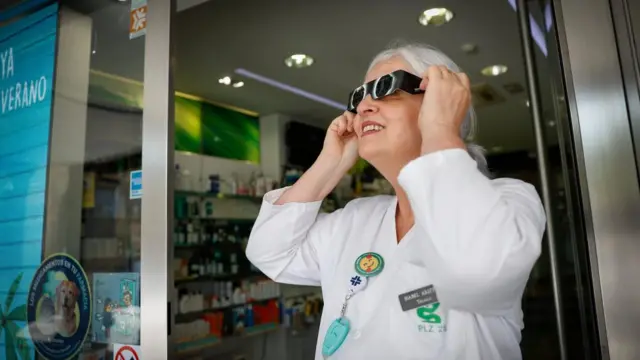
    A pharmacist tries on glasses for the solar eclipse at her pharmacy in Pamplona, SpainImage source, EPA

    The solar eclipse will first be visible in the far north of Russia, before its path slowly moves across the globe - stretching as far as northern Africa.

    A total eclipse will only be visible in a few places, including:

    • Reykjavik, Iceland - 17:48 local time (18:48 BST)
    • León, Spain - 20:28 local time (19:28 BST)
    • Zaragoza, Spain - 20:29 local time (19:29 BST)
    • Valencia, Spain - 20:32 local time (19:32 BST)

    Nasa has forecast that viewers in the US and southern Canada will only see a "small bite" taken out of the sun as it appears to only be clipped by the Moon - but those watching closer to its path across Europe will see most of the Sun covered up.

    Here in the UK, large parts of the country will be able to see almost 90% coverage - peaking between 19:02 BST to 19:16 BST, depending on your location. More on that in our next post.

    This Flourish post cannot be displayed in your browser. Please enable Javascript or try a different browser.

  15. Will you be watching the eclipse? Get in touchpublished at 09:17 BST

    We want to hear from you!

    Do you plan on watching the eclipse? How are you watching?

    You can share comments, pictures and videos by pressing the get in touch button at the top of the page - or in the following ways:

    Please read our terms & conditions and privacy policy.

    In some cases a selection of your comments and questions will be published, displaying your name and location as you provide it unless you state otherwise. Your contact details will never be published.

    A purple banner displays the words 'your voice'
  16. Hours until Europe's most significant eclipse in decadespublished at 09:06 BST

    Alex Smith
    Live editor

    The sun is pictured during a partial solar eclipse. The sky is dark and cloudy. The sun is a thin arc in the sky.Image source, Getty Images

    Later today, people across the northern hemisphere will crane their necks towards the sky to view a celestial phenomenon.

    A total solar eclipse will be visible in parts of Iceland, Spain and the far north of Russia. It is the first time such a sight will be visible from continental Europe since 1999.

    A partial solar eclipse will be visible in other areas, with the UK set to experience its most dramatic event of this kind in 27 years, set to begin shortly after 18:00 BST.

    Large parts of the country will be able to see the Moon cover more than 90% of the Sun - that's weather permitting, of course.

    The eclipse's path will start in Siberia in Russia, travelling to Alaska in the US around 07:30 local time (16:30 BST). It will sweep round to Greenland, past Iceland and through western Europe.

    We'll be hearing from people across the northern hemisphere throughout the day as they settle in to witness the phenomenon.

    Get in touch to share your experiences and pictures of this rare event.