Summary

  • The UK inflation rate remains steady 2.8% in the year to May, ONS figures show

  • Economists had expected an increase to the rate, but the rising pace of costs in areas like transport were offset by an ease in food prices

  • Today's figure raises the hope that the cost of living squeeze won't be as bad as feared, says the BBC's Dharshini David

  • Chancellor Rachel Reeves welcomes the news, saying the government has "got the right economic plan". Mel Stride, her Tory shadow, says that "prices are still rising too fast"

  • Inflation is the increase in prices over time, it affects how much money people can spend and borrowing costs - here's a quick guide

  1. Analysis

    Upward pressure on inflation yet to manifest in fuel prices for consumerspublished at 07:53 BST

    Faisal Islam
    Economics editor

    The best measure of inflation in the pipeline, what are known as Input Producer Prices, were up 8.7% in May on the year, after a 71.8% increase in crude oil prices in the year to May. It’s the highest rate since February 2023.

    This suggests there is still some upward pressure on inflation working its way through the system, yet to be passed on to consumers in fuel and other prices.

    The slightly better news here is that in the month of May that crude oil factor had already fallen back 5.9%. This month it had fallen yet further, to within range of pre-Iran war levels.

    Food price pressures are also calming for now, but there are many concerns about the price of fertiliser, which is globally reliant on chemicals manufactured from the Gulf petrochemical industry.

    All of this will be greatly helped if the Strait of Hormuz reopens properly.
  2. 'Prices are still rising too fast,' says shadow chancellorpublished at 07:34 BST

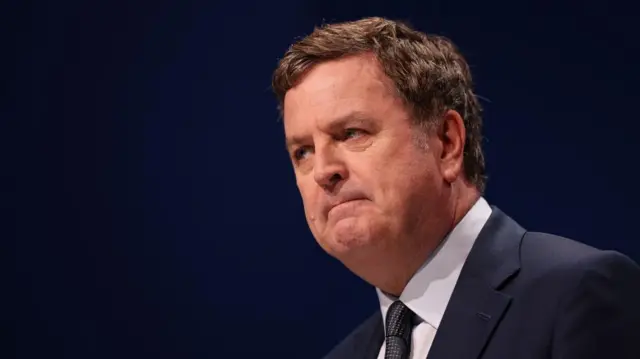
    Mel Stride looks stern as he delivers a speech in October 2025. He is wearing a dark suit and is against a dark blue backgroundImage source, EPA/Shutterstock

    Mel Stride insists that "prices are still rising too fast" following the release of the latest inflation figures.

    "Thanks to Labour’s choices the UK went into the latest energy crisis with the highest inflation in the G7," the shadow chancellor says in a post on X.

    He adds: "Rachel Reeves has increased the deficit by 75% and those lining up to replace Keir Starmer want to borrow even more."

    Stride says that only the Conservatives "have a leader with the backbone and strong team needed to build a stronger economy and get Britain working again".

  3. UK government has got the right economic plan, Chancellor sayspublished at 07:31 BST
    Breaking

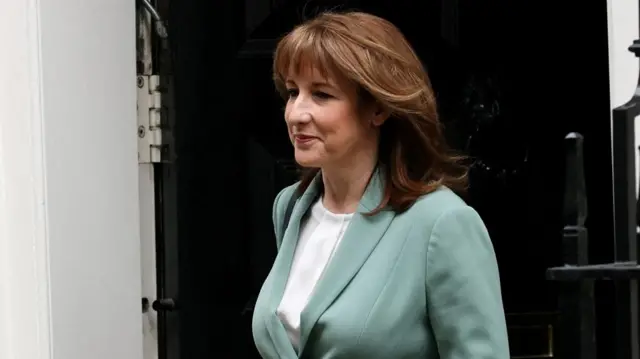
    Rachel Reeves steps out of 11 Downing Street wearing a teal suit and a white shirtImage source, Reuters

    Chancellor Rachel Reeves says that while conflict in the Middle East pushes prices up globally, the UK government has "got the right economic plan and inflation has held steady".

    As a reminder, prices in the UK rose by 2.8% in the year to May, the same rate as the previous month, according to new figures.

    She adds: "We’re protecting families and businesses from rising costs, with cuts in energy bills and freezes in fuel duty and rail fares.

    "This is the right economic plan to build a stronger more secure Britain."

    Quote Message

    We’re protecting families and businesses from rising costs"

    Chancellor Rachel Reeves

  4. Motor fuel and air fare prices risepublished at 07:26 BST

    Dearbail Jordan
    Business reporter

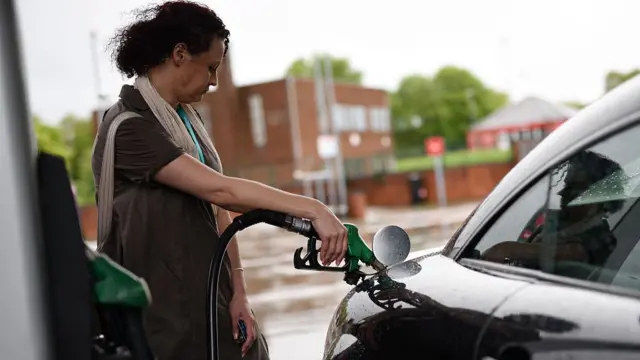
    A woman puts fuel in her car at a filling station.Image source, Getty Images

    The biggest contribution to inflation was transport prices, in particular air fares and motor fuel.

    The price of petrol and diesel soared by 24.6% in the 12 months to May 2026 - the highest since September 2022.

    No surprise there - this was fuelled by the US-Israel war with Iran and the closure of key Strait of Hormuz oil route.

    Plane tickets were also more expensive than a year ago.

    Overall, prices in transport rose by 6.8%, ahead of a 4.5% increase in the year to April.

  5. Analysis

    Today's figure raises hope the cost of living squeeze won't be as bad as fearedpublished at 07:15 BST

    Dharshini David
    Deputy economics editor

    Genuine relief.

    The failure of inflation to rebound as expected last month raises hope the cost of living squeeze won’t be as bad as feared this year.

    But at one point, there were hopes that inflation would have returned to its 2% target this spring; these figures are a reminder of the price pressures a war thousands of miles away have exerted at home.

    With higher energy costs, however, taking several months to feed through to other areas such as food it is likely that inflation will rise a bit further this year.

    But most economists expect it to remain below 4% as the deal to bring about an end to the Iran war allows vessels through the Strait of Hormuz and energy production to rebound fully in the Middle East.

  6. Inflation remains steady as transport price rises offset by ease in food pricespublished at 07:10 BST

    We're now hearing from ONS Chief Economist Grant Fitzner, who says the inflation rate held steady as rises in the prices of air fares, vehicle taxes and petrol was offset by an ease in food prices.

    Fitzner adds decreases in inflation were "seen across a range of meat, dairy and vegetable items compared to last month, as well as the cost of domestic heating oil, which fell back after climbing in recent months".

    He says the annual cost of raw materials continued to increase, led by rises in the cost of chemicals.

    The increase in the cost of goods leaving factories also slowed, partially due to a drop in the cost of domestically produced cars, he adds.

  7. May inflation rate comes a surprisepublished at 07:05 BST

    Dearbail Jordan
    Business reporter

    The inflation rate remaining at 2.8% in the year to May is a surprise.

    Economists had been expected the pace of price rises to increase to 3%.

    We'll bring you details of the data shortly.

  8. UK inflation rate remains at 2.8%, ONS figures showpublished at 07:01 BST
    Breaking

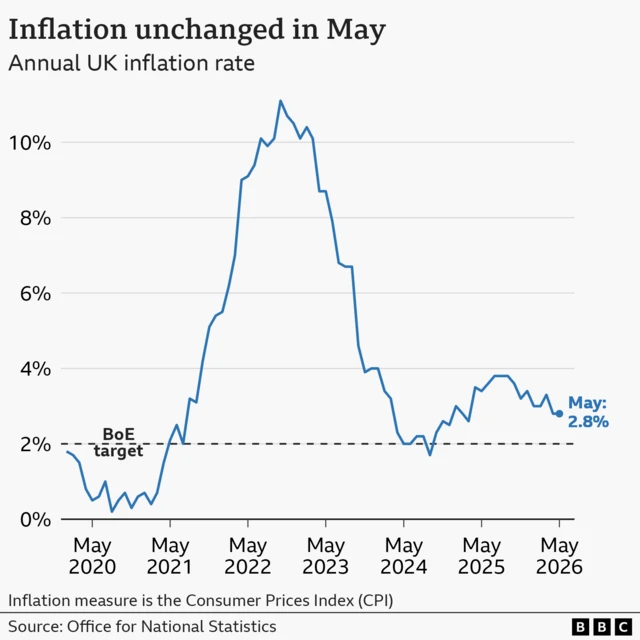
    The UK's inflation rate remains at 2.8% in the year to May, the latest figures from the Office for National Statistics (ONS) show.

    Line chart of the UK's Consumer Price Index annual inflation rate, from January 2020 onwards In the year to January 2020, inflation was 1.8%. It then fell close to 0% in late-2020 before rising sharply, hitting a high of 11.1% in October 2022. It then fell to a low of 1.7% in September 2024 before rising again. In the year to May 2026, prices rose by 2.8%, unchanged compared with the 12 months to April 2026.
  9. How does the inflation rate affect you?published at 06:55 BST

    The inflation rate measures the pace of price increases of goods or services over a period of time.

    So, if the pace of inflation rises it means everyday essentials such as food, energy and transport are more expensive.

    The rising cost of goods and services has an impact on the money you save or earn - as you are having to pay more.

    It erodes your spending power unless your pay is rising faster than inflation. This causes many households to feel squeezed.

  10. 'We are on a knife edge': Farmers weigh up whether to plantpublished at 06:45 BST

    Priya Patel
    Economics producer

    Al Booth a farmer

    Some farmers say increases in food prices later this year now look unavoidable because of disruption in the Strait of Hormuz since the start of the Iran war in February.

    Hampshire farmer Al Brooks tells BBC News fertiliser costs have risen by "45% or more", warning prices are unlikely to return to previous levels even if global tensions ease.

    He says recent volatility has been "so sharp" that any savings "don’t carry through", as many farmers have already paid high prices to secure supplies for next season.

    "We have committed...we’ve had to budget, look at our cash flow, and decide whether it is worth planting. I’ve already bought my fertiliser ready for next year," he says. "We are on a knife edge with what we’re doing."

    Booth adds that some farmers are now questioning whether to plant at all. "There are a lot of farm businesses...asking whether it’s even worth it,” he says.“This is affecting people’s mental health quite, quite badly."

  11. Which of these products are in the 'basket of goods' used to track inflation?published at 06:38 BST

    This Riddle post cannot be displayed in your browser. Please enable Javascript or try a different browser.

  12. A quick guide to inflationpublished at 06:26 BST

    A woman selecting bananas from a supermarket produce aisle with a shopping cart.Image source, Getty Images

    Inflation measures the pace of price increases of goods or services over a period of time and it is one of the figures that give us an idea of how well the UK economy is doing.

    A classic example is that if a bottle of milk costs £1 but is £1.05 a year later, then annual inflation is 5%.

    The Office for National Statistics tracks the prices of hundreds of items - from regular supermarket goods, to fuel, to travel costs and home furnishings - to work out the overall rate of inflation.

    That "basket of goods" is regularly updated to reflect shopping trends, as consumer preferences change, and this year items including alcohol-free beer, dashboard cameras and pet grooming were added.

    The main measure of inflation is the Consumer Prices Index, which is updated each month.

    Benefits, pensions and interest rate decisions by the Bank of England are all affected by inflation. The Bank has a target of 2% for the CPI.

  13. Analysis

    High energy and food costs expected to push up inflationpublished at 06:18 BST

    Marc Ashdown
    Business correspondent

    The pace of price rises might have surprisingly eased in April, but the impact of the Iran war is now starting to properly filter through to our food, energy and fuel costs.

    The consensus among economists is for 3% inflation in the year to May, up from 2.8% the previous month - but some see prices possibly rising by as much as 3.2%, driven by the high cost of energy and food.

    While the markets have been cheered by the outline agreement between the US and Iran to end the war - which means vital supplies can (in theory) soon start transiting the crucial Strait of Hormuz once more - the lag effect of war will weigh on the inflation picture for months to come.

    An acceleration in costs in the services sector, coupled with higher air fares and car duty have been the main factors so far, but there may be more pain to come across the economy over the coming months.

    Investors are hoping a relatively swift return to normality will amount to a bump rather than a spike in inflation, and much will ride on the Bank of England.

    Policymakers were expected to raise interest rates up to three times this year due to the conflict. They meet again on Thursday, with the city now betting that rates will be held, at least for now.

  14. Fall in energy bills drove drop in UK inflation rate to 2.8% in year to Aprilpublished at 06:12 BST

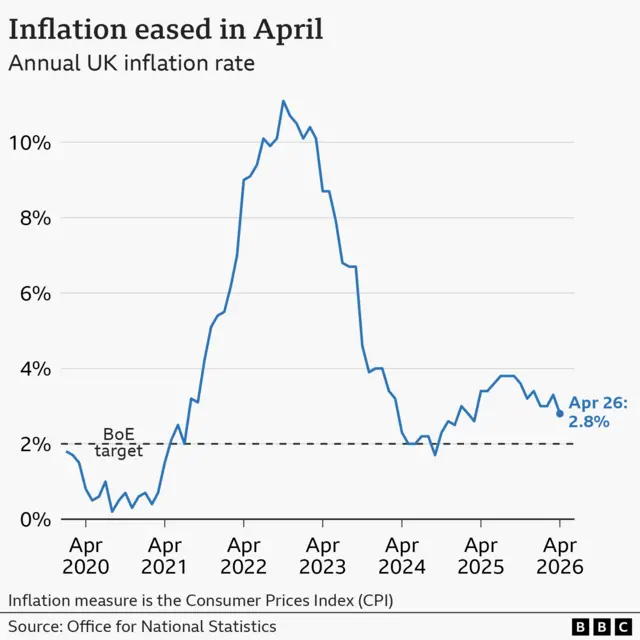
    The previous set of figures published on 20 May saw the UK rate of inflation fall to 2.8% in the year to April.

    That was lower than the 3.3% figure recorded in the 12 months to March.

    The fall was driven by lower electricity and gas prices, after the government's energy bill support package came into force, the Office for National Statistics said.

    A chart showing the change in the inflation rate between the beginning of 2020 and now.
  15. UK inflation rate expected to rise, economists saypublished at 06:05 BST

    The latest UK inflation rate is expected to rise when new figures are released this morning, according to economists.

    The official figure for April was 2.8%, a fall from the 3.3% figure recorded in the 12 months to March.

    Inflation is the increase in prices over time, it affects how much money people can spend and borrowing costs.

    We're expecting the Office for National Statistics (ONS) to publish the latest data at 07:00 BST.

    We'll bring you the latest updates and analysis right here on this page.