Summary

  1. What is the current state of peace talks between the US and Iran?published at 11:03 BST

    A hotel building seen behind several palm trees at the end of a road. A worker can be seen dusting the street beside signs that say: "Islamabad talks"Image source, Reuters
    Image caption,

    Talks between the US and Iran were held in Islamabad on 11 April

    As we've just heard, Axios is reporting that the White House believes it could be closing in on a memorandum of understanding with Iran.

    Here's a reminder of how talks between the US and Iran have played out in recent weeks:

    • A two-week ceasefire was due to end on 22 April, and led to high-level negotiations being held in Pakistan - which later collapsed over key issues such as Iran's nuclear programme and passage through the Strait of Hormuz
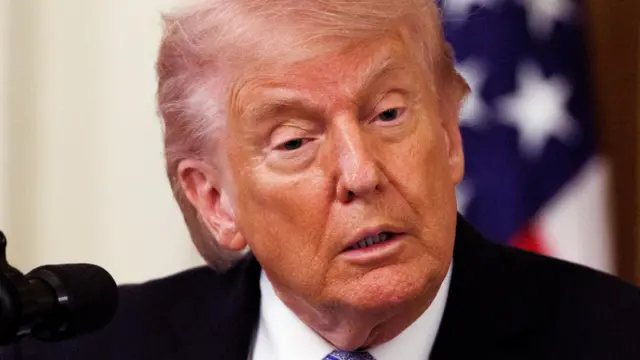
    • US President Donald Trump extended the ceasefire anyway, and maintains that his representatives are having "very positive discussions with the country of Iran"
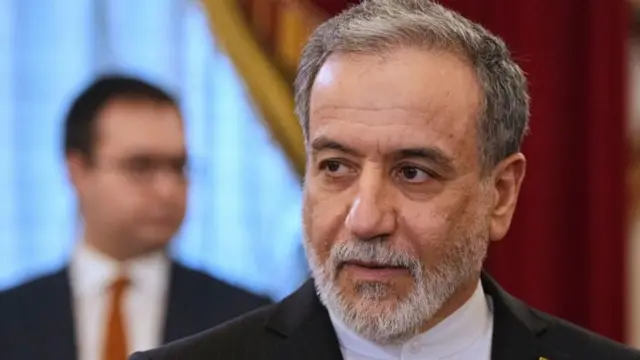
    • Tehran put forward a 14-point plan for peace, Iranian media reported, and on Sunday Iranian Foreign Minister Abbas Araghchi said "talks are making progress", while warning the US against "being dragged back into quagmire"
    • A representative of Pakistan, which has acted as a mediator, told the BBC on Tuesday that his country was continuing to exchange messages between the US and Iran - with Trump later saying "great progress" had been made toward a "final agreement"

    The report from Axios describes the White House proposal as a one-page 14-point memorandum of understanding; it's not yet clear how closely this memo aligns with Iran's earlier proposal.

  2. White House believes it's close to agreeing memorandum of understanding with Iran - US reportpublished at 10:34 BST

    Axios is reporting that the White House believes it is close to a memorandum of understanding with Iran on ending the war.

    The news outlet cites two US officials and two other sources it describes as briefed on the issue, who are all unnamed in the report.

    It describes the memorandum as a one-page memo which could set a framework for more detailed nuclear negotiations. Among the provisions it lists are a suspension on Iranian nuclear enrichment, the lifting of sanctions, and restoring free transit through the Strait of Hormuz.

    Ending nuclear enrichment and reopening the strait have been key sticking points in the negotiations so far.

    Axios cites sources as saying that many of the terms laid out in the memo would be contingent on a final agreement being reached.

    The US expects a response in the next 48 hours, and nothing has been agreed yet, it reports, citing sources.

    The BBC has approached the White House for comment - Iran has not yet commented.

  3. Situation 'largely unchanged' for stranded seafarers, says shipping representativepublished at 10:12 BST

    Another industry expert who's spoken to the BBC says the number of ships and seafarers still stuck at sea is a huge concern.

    Jakob Larsen, chief safety and security officer for the BIMCO (Baltic and International Maritime Council) shipping association, tells the Newshour programme there are about 1,000 stranded ships with some 20,000 seafarers on board.

    He says: "We didn't see a whole lot of ships move out during 'Project Freedom' so as far as we are concerned the situation is largely unchanged."

    Seafarers are very worried as they are trapped in the Gulf "with no prospects really for getting out safely", he says.

    They have provisions and can generate fresh water, but want the situation resolved sooner rather than later, he adds.

    • There are different estimates for how many ships are stranded; a Pentagon briefing on Tuesday said there were 22,500 mariners stuck on 1,550 vessels.
  4. 'Project Freedom' was not delivering results - expertpublished at 09:48 BST

    A large cargo vessel loaded with containers is shown in the Strait of Hormuz.Image source, Reuters

    The US and Iran apparently getting closer to agreeing a deal is "one of the reasons" the US suspended its "Project Freedom" operation to guide ships through the Strait of Hormuz, says one expert.

    Ali Vaez, Iran project director for the International Crisis Group think tank, says Trump's choice was between continuing an operation that was "clearly not delivering the results" or suspending that operation and seeing if there was a "diplomatic way out".

    He tells BBC Radio 4's Today programme that the Iranian response to Project Freedom – including shooting at ships and attacks on the UAE – likely persuaded Trump that this operation was "not going to solve the problem" and could "drag him back into a war".

    On the seemingly rapid American U-turn, Vaez says in his view "there is no real policy process in this administration".

    "The president makes decisions based on impulse more than process, therefore there are inconsistencies that happen all the time," he says.

  5. Analysis

    Hormuz transit remains dangerous despite 'project pause'published at 09:27 BST

    Frank Gardner
    Security correspondent

    The US "Project Freedom" - announced with great fanfare and now halted after less than 48 hours - was unlikely to ever be the panacea that unblocked the Strait of Hormuz.

    It was framed by President Donald Trump as "a humanitarian gesture" to help release the estimated 20,000 seafarers trapped inside the Gulf as a result of the double blockade by the US and Iran.

    But Iran viewed it as a violation of the 8 April ceasefire agreement and it attacked the first escorted transit by the US Navy of two US merchant vessels. The US military says its helicopters destroyed six Iranian fast boats in response; Iran denied this.

    Getting two ships through the strait is – forgive the pun – just a drop in the ocean.

    In normal times, before this war began, around 140 vessels a day were passing through the strait.

    Not even the huge and powerful US Navy has the capacity to escort that number so this would have been primarily a coordination and overwatch operation.

    But there is no getting round the fact that the IRGC Navy retains enough drones, missiles, mines and fast boats to threaten any vessel passing its coastline.

    So without a deal with Tehran, the Strait of Hormuz will remain a dangerous place to transit.

  6. Attacks on 26 vessels since outbreak of war - UKMTOpublished at 09:02 BST

    There have been 26 attacks on vessels in the Middle East since the start of the Iran war, according to marine authority UKMTO (UK Maritime Trade Operations).

    It says since 28 February, it has received reports of 46 incidents "in and around" the Gulf, the Gulf of Oman and Strait of Hormuz.

    Of these, 26 were attacks, and 18 were reports of "suspicious activity", in addition to two reported hijackings.

    Smoke rises above a cargo ship with 'Mayuree Naree Bangkok' written on it. Rafts are floating in the sea around it.Image source, Royal Thai Navy
    Image caption,

    The Thai-flagged bulk carrier Mayuree Naree became one of these 26 attacks when it was struck by two projectiles when attempting to navigate the strait on 11 March

  7. French shipping group says vessel was attacked in Strait of Hormuzpublished at 08:49 BST

    Paul Pradier
    Reporting from Paris

    French shipping group CMA CGM says this morning that one of its vessels, the San Antonio, was the target of an attack on Tuesday while transiting the Strait of Hormuz, resulting in injuries among crew members and damage to the vessel.

    The injured crew members from the attack have been evacuated and are being provided with medical care, the company says in a statement.

    "CMA CGM is closely monitoring the situation and remains fully mobilized alongside the crew."

    • While the company did not specify who attacked the vessel, Iran has said it will target any ships that attempt to transit the Strait of Hormuz without its permission.
  8. Israeli military continues to hit targets in southern Lebanonpublished at 08:39 BST

    While a lot of attention is on the Strait of Hormuz today, there's still active conflict in Lebanon.

    The Israeli military has hit 25 Hezbollah targets in southern Lebanon over the past 24 hours, the Israeli Defense Forces (IDF) says in an update.

    IDF spokesperson Avichay Adraee has also issued a new evacuation warning to residents of several towns across southern Lebanon, adding anyone near Hezbollah facilities or combat "exposes their life to danger".

    Lebanon's National News Agency has reported multiple airstrikes across the south of the country over the past 24 hours.

    • A ceasefire remains in place between Israel and Lebanon, but Israel says it retains its "right to take all necessary measures in self-defence, at any time, against planned, imminent, or ongoing attacks".
    An Israeli helicopter is shown in the air, firing its cannon - smoke trails behind.Image source, Reuters
    Image caption,

    An Israeli helicopter fires its cannon near the Israel-Lebanon border on Tuesday

  9. Tracking data shows little movement near the straitpublished at 08:16 BST

    A red circle is shown on a diagram of the Strait of Hormuz, positioned on the strait. Land is shown in dark grey and water white, with red, green, blue and purple colours being used to indicateImage source, MarineTraffic

    There is little movement around the Strait of Hormuz again today according to ship-tracking website MarineTraffic.

    The precise movements of ships in the area has been difficult to verify throughout the conflict, with some ships turning off their transponders, and with GPS interference thought to be producing unreliable information.

    Under normal circumstances, roughly one-fifth of the world's oil and liquefied natural gas (LNG) passes through the waterway.

    It also sees about one-third of the world's fertiliser trade, as well as vital imports to the Middle East, including food, medicines and technological supplies, pass through.

    But Iran has severely limited traffic through the vital shipping route since the war began in February, while the US has launched its own blockade on Iranian ports.

    The Pentagon said on Tuesday that around around 22,500 mariners on 1,550 vessels are stuck in the Gulf. There has been growing concern over dwindling supplies and the effects on sailors' physical and mental health.

    This Flourish post cannot be displayed in your browser. Please enable Javascript or try a different browser.

  10. A closer look at the paused US plan to guide ships through the straitpublished at 07:48 BST

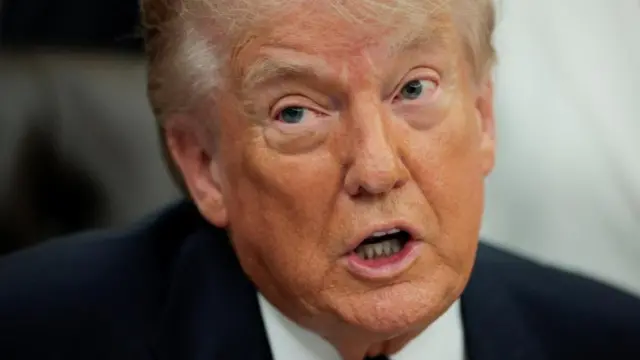
    Donald Trump speaks while sitting in the Oval Office. He is wearing a dark suit and navy tie with red and white dots.Image source, Reuters

    As we've been reporting, Trump said the US operation to guide commercial ships through the Strait of Hormuz would be paused on Tuesday evening.

    "Project Freedom" was announced by the US president on Sunday, with Trump saying it was a "humanitarian gesture" to help the seafarers stuck in the Gulf.

    US Central Command (Centcom) said it was "essential" to regional security and the global economy.

    Iran responded by saying it would attack US forces if they entered the strait, with Iranian media later reporting a US warship had been hit by two missiles.

    This claim was denied by Centcom, which said two US-flagged merchant vessels had successfully passed the strait with the US Navy.

    Trump also said US forces had struck seven Iranian "small boats" he said had tried to attack commercial ships - disputed by Iran - with the US president later telling Fox News that Iran would be "blown off the face of the Earth" if it attacks US vessels.

    On Tuesday, Iran's chief negotiator and parliamentary speaker Mohammad Ghalibaf accused the US of breaching the ceasefire.

    Later in the day, the US president announced the operation would be paused for a "short period", saying it followed "great progress" made towards an agreement with Iran, and after a request from Pakistan, which has been acting as a mediator between the US and Iran.

    The US military says around 22,500 mariners on 1,550 commercial vessels are stuck in the Gulf.

  11. US still enforcing separate blockade of Iranian portspublished at 07:28 BST

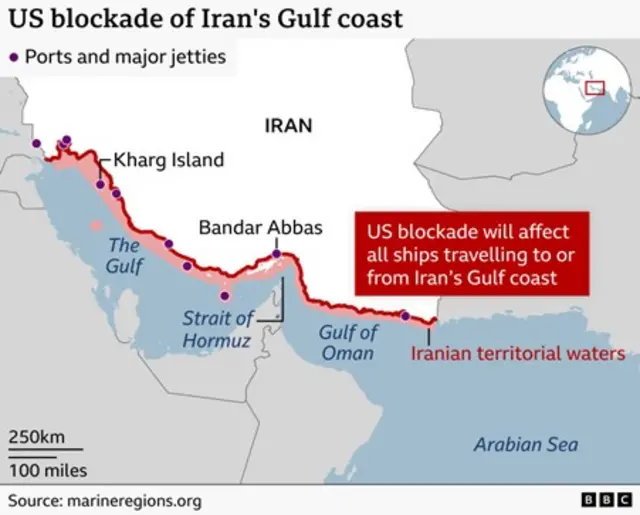
    Separately to Donald Trump's newly-paused operation to guide boats out of the Strait of Hormuz, the US military has been enforcing a blockade of Iranian ports - and the US president says this will "remain in full force".

    It was announced in mid-April, when US forces said they would intercept or turn back vessels travelling to or from Iran's coast.

    Speaking after the blockade was announced, Chairman of the Joint Chiefs of Staff Dan Caine said it would target "any vessel attempting to provide material support to Iran", including "dark fleet vessels carrying Iranian oil".

    On Tuesday, US Central Command gave an update on this blockade, saying that it had redirected 51 vessels to date.

    US Chairman of the Joint Chiefs of Staff General Dan Caine shows a map of the blockade area on 16 April - with US forces marked in blue and Iranian ships in redImage source, AFP via Getty Images
    Image caption,

    US Chairman of the Joint Chiefs of Staff General Dan Caine shows a map of the blockade area on 16 April - with US forces marked in blue and Iranian ships in red

  12. How Iranian media is framing the US's announcementpublished at 07:14 BST

    We've not yet had an official response from senior figures in the Iranian regime to Trump's "pausing" of the US operation to guide ships through the Strait of Hormuz.

    But several Iranian media outlets have framed the US announcement as a victory for Iran.

    The hardline Tasnim news agency, which is affiliated with the Islamic Revolutionary Guard Corps (IRGC), writes that "Trump has retreated" and that the US president had tried "to cover up the failure" of the operation.

    While Iran's state-run IRNA news agency calls it "America's defeat" and says that Trump has used his "last card".

  13. 'Project Freedom will be paused for a short period' - Trump's statement in fullpublished at 06:49 BST

    A file photo of President Trump sitting at his deskImage source, Reuters

    As we've been reporting, Trump posted on Tuesday announcing that he was pausing the military operation, first announced on Sunday, to guide commercial ships through the Strait of Hormuz.

    Here's his post in full:

    Based on the request of Pakistan and other Countries, the tremendous Military Success that we have had during the Campaign against the Country of Iran and, additionally, the fact that Great Progress has been made toward a Complete and Final Agreement with Representatives of Iran, we have mutually agreed that, while the Blockade will remain in full force and effect, Project Freedom (The Movement of Ships through the Strait of Hormuz) will be paused for a short period of time to see whether or not the Agreement can be finalized and signed. President DONALD J. TRUMP

    The Strait of Hormuz, a narrow shipping route in the Gulf region, is one of the world's most important shipping routes. Bounded to the north by Iran and to the south by Oman and the United Arab Emirates (UAE), the Strait of Hormuz connects the Gulf with the Arabian Sea. The strait is deep enough for the world's biggest crude oil tankers, and is used by the major oil and gas producers in the Middle East - and their customers.
  14. Australia to spend A$10bn on securing energy suppliespublished at 06:09 BST

    A crude oil and product tanker, sits at Viva Energy Australia's Gore Bay fuel terminal overlooking the city skyline in Sydney.Image source, Reuters

    Australian Prime Minister Anthony Albanese has announced his government will spend A$10bn ($7.2bn; £5.3bn) on securing energy supplies, prompted by the ongoing crisis in the Middle East.

    Under the package, Australia will establish a government-owned fuel reserve of around a billion litres, boosting the country's critical reserves of diesel and jet fuel to 50 days.

    Earlier on Wednesday, Albanese told reporters: "This is aimed at making sure that Australians can have more confidence in protecting our energy sovereignty, not just during this crisis, but going forward as well, protecting our nation's energy interests."

    Australia has faced some of its biggest ever spikes in petrol and diesel prices since the start of hostilities in Iran.

  15. Chinese and Iranian foreign ministers meet in Beijingpublished at 05:50 BST

    China's foreign minister Wang Yi met his Iranian counterpart Abbas Araghchi for talks in Beijing on Wednesday, Chinese state news agency Xinhua reported, without giving further details.

    Araghchi was set to "discuss bilateral relations and regional and international developments" with Wang, Iran's Fars news agency reported earlier.

    Araghchi's trip comes before a scheduled visit to China next week by Donald Trump, who is due to meet Chinese President Xi Jinping.

    Trump delayed his trip after his administration and Israel launched strikes on Iran.

  16. Analysis

    Iran likely to characterise pause of Project Freedom as a victorypublished at 05:33 BST

    Bernd Debusmann Jr
    White House reporter

    Donald Trump's post announcing a "pause" in Project Freedom will come as a surprise to many.

    It undercuts a day's worth of messaging from Secretary of State Marco Rubio, defence secretary Pete Hegseth and Joint Chiefs Chairman General Dan Caine - all of whom vowed that the operation will ensure freedom of navigation and commerce in the Strait of Hormuz and Gulf.

    What happens next is unclear.

    Earlier, it was made clear that Project Freedom is a "separate and distinct" campaign from the blockade, which is meant to pressure Iran economically.

    Project Freedom was meant to help restore the flow of oil from the region and the eventual return to normality of the global economy.

    If during the "pause" global shipping firms and the insurance companies that work with them feel as though they are unable to move because of Iranian interference, that objective will be very difficult for Trump to claim has been achieved.

    On the other hand, the administration will hope that the freeze in Project Freedom - which the Iranians strongly objected to - is seen as a gesture that helps bring them to the negotiating table again.

    In the meantime, Iran will very likely characterise the pause as a victory.

  17. Rubio says 'Operation Epic Fury' is overpublished at 05:33 BST

    Before President Donald Trump's announcement that the US would pause "Project Freedom", Secretary of State Marco Rubio gave a briefing at the White House confirming that "Operation Epic Fury" - the name given to the initial US-Israeli offensive against Iran - had finished.

    "Operation Epic Fury is concluded. We achieved the objectives of that operation," Rubio said, adding the offensive stage of the war with Iran was "over".

    Rubio said Trump would now prefer to reach a deal with Iran including a memorandum of understanding on how the Strait of Hormuz can be fully reopened.

    "That's the route he prefers. That is so far not the route that Iran has chosen," Rubio said.

  18. US pauses operation to guide vessels through Strait of Hormuzpublished at 05:31 BST

    hips and boats in the Strait of Hormuz, Musandam, Oman.Image source, Reuters

    US President Donald Trump has halted the US military operation to escort ships through the Strait of Hormuz after less than 48 hours. However, a US blockade of Iranian ports will remain in place, he said.

    Trump said he made the decision following a request by Pakistan - which has acted as a mediator between the US and Iran - because "Great Progress has been made toward a Complete and Final Agreement" with Tehran.

    Iranian state media described the move as a "retreat" after Trump's "continued failures" to reopen the vital waterway for global shipping.

    Shortly before Trump's announcement, US Secretary of State Marco Rubio had said the initial US-Israeli offensive in Iran - Operation Epic Fury - was "over" after its objectives had been achieved.

    Stay with us as we bring you more updates.