Half Man's Richard Gadd and Jamie Bell talk masculinity and complex relationships - "You never really know which of them is bad and which of them is good"
Niall and Ruben. Brought into each other’s lives through death and circumstance, all they have is each other…
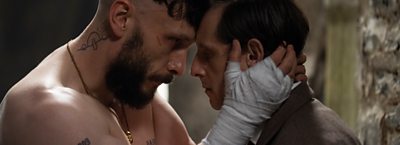
Niall and Ruben are brothers. Not related in blood but the closest you can get. One, fierce and loyal. The other, meek and mild-mannered. Inseparable youth. Brought into each other’s lives through death and circumstance, all they have is each other…
But when Ruben turns up at Niall’s wedding three decades later, everything seems different. He is on edge. Shifty. Not acting like himself. And soon, an explosion of violence takes place which catapults us back through their lives, from the eighties to the present day. Capturing 30 years in the lives of these broken men, Half Man explores brotherhood, violence, and the intense fragility of male relationships. After all, when things fall apart… it is sometimes the closest relationships which break the hardest.
HC2
Interviews
Richard Gadd (Ruben)
Series Creator, Writer and Executive Producer
Where did the idea for Half Man come from?
With my past projects I've touched on masculinity in the context of my own struggles with being a man. All of my stories explore human feelings, but this time, I wanted to come up with an idea that explores what it means to be a man in this ever-changing world through these two characters. To me, it feels like the debate about men has reached quite a high pitch and, at the same time, become somewhat simplified.
“Toxic masculinity” is a phrase we hear a lot, and while it can risk feeling overused, it’s also being discussed so widely for a reason. What’s interesting is that, despite that visibility, there are still aspects of it that haven’t yet been fully explored in the mainstream. I think that much of how society has been structured can lead to men having an inability to express themselves and express love and vulnerability, so it felt interesting to posit that conversation through Niall and Ruben.
What does a normal day look like for you when you’re writing a new project?
When I’m writing I usually go for a run whilst listening to my playlist, and those songs always provide a backdrop to my inspiration for a project and often end up being included in the project itself. For Half Man, I was bulking up to play Ruben, so I missed my running, but I still had a playlist. I usually begin my writing day at 5am because I think it’s my most productive time, so I usually get up at 4:30am and get a coffee and I’ll then write from 5am to 9pm - aside from Christmas Day and Soccer Aid, when I give myself a day off! I work hard and I’m constantly reworking and questioning things until it feels right. It is a constant, evolving process.
How do we first meet Niall and Ruben in the series?
We meet Ruben and Niall as two teenagers thrown together in their youth, and we then follow them over three decades. When the series starts, they’re forced to coexist in a lot of ways within a working-class household. Ruben is violent and volatile, whilst Niall is very sensible and self-conscious. They’re polar opposites but in a strange way they form an alliance – for better or worse – which catapults them through the ages. They both have something that the other does not and they crave what each other has.
What made you want to set the story over multiple decades of Niall and Ruben’s lives?
It felt that in order to have a conversation around masculinity and how we got to where we are now, we needed to go back to their adolescence, which is when Mitchell Robertson and Stuart Campbell play young Niall and Ruben in the 1980s. I thought the 1980s was an interesting time to set it as it is often the decade which is cited as being one of the most problematic in our history due to certain ignorances or subtle prejudices. It felt like a good way to start the characters’ journeys and explore what they learn and inhabit from our less than accepting times. I also think seeing the characters in their youth establishes their relationship early on. The connections we make when we are young can be hugely formative and emboldening and I wanted to give meaning to their shared camaraderie and connection.
The friends we make growing up are sometimes the most powerful relationship we have, and I needed to show the good and the bad all at once and show how intertwined our early relationships can become. I never want to beat audiences over the head with moral trajectories either. There are two men struggling to live and coexist in a way. In seeing Niall and Ruben over an extended period, you never really know which of them is bad and which of them is good either.
I wouldn’t want my work to present the idea that men should be a certain way or are a certain way, because then I’m adding to a bigger problem and so I hope that within Half Man, there’s a very human explanation of what it is to be a man, which is knotty and complicated, and hopefully the conversation around the show will feel like that too.
How would you say those adolescent moments shape the men Niall and Ruben become when you and Jamie take over those roles?
Niall and Ruben both stay in the same place whilst the world develops around them, and I don’t think either of them ever truly manages to shake off the damage of their youth. I think that feels familiar in this day and age where we have experienced cultural shifts - some people are on board whilst others aren’t and feel left behind or alienated For some people, change can be really difficult and the more you repress certain parts of yourself the harder life becomes as the years go by.
In a way, the only conversation Niall and Ruben ever have that is fully honest comes at the end of the series. It takes them six episodes and decades of their lives to get to a point where they are emotionally mature enough for that and meanwhile the world around them has changed and progressed so much. I think that, in a way, is the quintessential male struggle.
We do see dark moments for Niall and Ruben at various points throughout the series. Why did those moments feel important to you given the story you were trying to tell?
I think in order to explore the topic of male repression and violence you need to show violence, or at least the extremities of it - so that we can understand the context and depths of where repression can lead. I think a show exploring male existence in all its forms needs to show the worst – and indeed best – sides of masculinity because you are never fully exploring anything if you stray from the edges or fail to paint a full picture. Ultimately, whether we like to admit it or not, we live in a violent culture and world, but I don’t see that on television very often. At least not in a way which is realistic or “brutal.” I think exploring and showing these things not only leads to powerful drama but echoes a very real part of society where these things do happen and are seen on a daily basis.
What it’s been like working with Jamie Bell?
Jamie is such a lovely guy. I remember when we were casting for Baby Reindeer, lots of famous faces really wanted to play Martha, but I wanted everyone to audition and naturally a lot of global stars did not. However, there was something about this show as I was writing it – I couldn’t get Jamie out of my head. He’d probably roll his eyes if he heard me talking about Billy Elliot, but I can’t believe that he managed to do that at the age of 13 and I just think he’s instinctively an incredible actor.
I never thought Jamie would actually be in Half Man, but when I heard he was interested, I flew out to LA, and we had a long chat. Jamie said he’d love to do it if I played Ruben. Before that moment, I had never thought about it and didn’t see myself being in the series. We shot our final scene together at 3am in the morning, and it was a really emotional one. In that moment I knew how much I would miss acting alongside him and I feel really grateful to have had that opportunity.
How did you go about finding your young Niall and Ruben?
I love Mitchell Robertson and Stuart Campbell, and I want it on record that they were my favourites for Niall and Ruben from when I first saw their self-tapes. It was the same with Jess Gunning where I just knew from her first audition that I was experiencing exceptional talent. I cannot describe it, but it is like I see the character in my head, and I just need an actor to come in and echo it back at me – and these boys did that – and then some! They are true professionals through and through and I never doubted them for a second. It is also a joy to give young, Scottish talent their moment to shine. They would be a gift to any production they work on.
And what has it been like for you to transform into Ruben for Half Man?
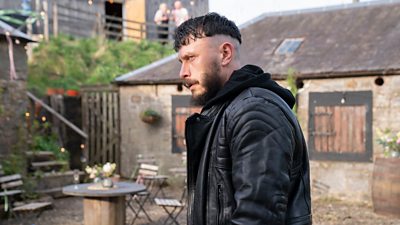
Ruben is so far from any role I’ve taken on before and also from me as a person. I’ve done a lot of work to take on the role in terms of changing my diet and putting on a lot of muscle mass to inhabit that role and it has been a huge commitment alongside writing and producing. But I always think fear is never a reason to not do something and it makes it worth giving something a shot. We have two different looks for Ruben to reflect where he is in his life. One I would describe as meaty and beefy – he looks intimidating and overbearing - and that involved a lot of weight-lifting. Those are the present-day scenes.
Then in flashback, we have a slightly leaner look which meant stripping a lot of weight off in a matter of weeks. My order every day with the catering team was a salad and protein and that was sometimes the only thing I ate all day, which is a serious calorie deficit. It was brutal!
The show is filmed and set in and around the surrounding areas of Glasgow, what made you choose to base this story there?
Not only do I have fond memories of my time at university in Glasgow for four years, but I think it’s an amazing cultural city with a huge personality. It’s the biggest city in Scotland and Glasgow has also undertaken a huge shift of its own over the decades to become one of the UK’s most formidable cultural hubs. It almost marries the change that you want to see in the characters across the show - Glasgow evolves and changes around these guys as they struggle to change themselves.
I grew up in a town in Scotland outside of Dundee, about a mile over the water. The town had one shop – a corner shop – and it was an incredibly small one. I wouldn’t change it for the world now, but I felt like I needed to get out and escape when I was younger. That feeling is reflected in some of the earlier episodes where we see Niall and Ruben growing up in a smaller town outside the city. I think that adds a teenage hotbed of emotion and intensity to what the characters go through. I’ve loved working with an amazing cast and crew here and it has been such a brilliant backdrop for the show.
Jamie Bell (Niall)
How would you describe Half Man?
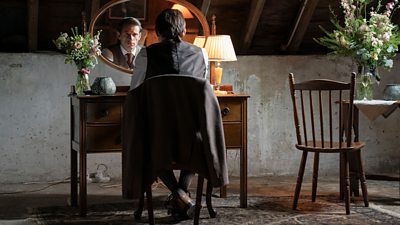
Half Man chronicles the relationship between two men – Niall and Ruben - over three decades. The series starts with the two of them as young men in their teenage years and it follows them both as life drifts them apart and pulls them back together. The series looks at how their time together has shaped them as adults and at the same time, how the culture around them growing up has done that too. More specifically, the series explores what their personal relationship with their own sense of masculinity is and what being a man means to them both, and how complex that is.
What did you think of the scripts when you first read them?
I heard that Richard had written this with me in mind and was incredibly flattered. Upon meeting him I could see how unique Half Man would be. Richard actually sent through episode six for me to start with and whilst that might seem like a strange place to begin, I was so taken by the spiral throughout episode six that it was actually a great place to start; I knew where Niall ended up and I wanted to know how he got to that point. Richard is a brilliantly unique and singular writer, and I often find his writing activates the senses quite specifically and takes you to emotional places very easily. As his previous work goes to show, he has such a strong grasp of things that feel challenging and complex and emotional. I was also astounded by some of the length of some of the scenes too – there are scenes between myself and Richard that are up to 16 pages long. As an actor I knew that was incredibly ambitious, but you also never really get gifted that kind of material where essentially these two characters are talking - about their lives, their problems, their failures - much like a piece of theatre.
How would you describe Niall and his relationship with his Ruben?
Niall is an incredibly complicated person. He’s a product of a certain place and time – he was born in the seventies and is becoming a man in the 80s - and he has big identity struggles. He’s not comfortable in his own skin and he’s certainly not comfortable with looking inwards in any meaningful way. When we first meet Niall, he’s genuinely someone who has a good heart, but systemically with everything going on around him he becomes flattened into someone he thinks the world wants him to be. A lot of Niall’s social discomfort stems from an unwillingness to be honest and truthful to who he is and this leads to a lot of the problems he experiences within his life, such as this toxic relationship with Ruben who isn’t his brother by blood, but is his brother in many other complicated ways. Niall has identified Ruben as this aspirational person and I believe that’s because Ruben is unapologetically who he is and although Ruben’s problematic, at least he's honest. Meanwhile Niall is always fraught with this sense that he can’t be honest about who he really is and that’s the essence of their whole relationship.
How do you think the women in Niall’s life contribute to who he is?
I think if Ruben is the male role model for Niall’s lack of a father figure, then the women in Niall’s life instantly feel really important, but his unwillingness to admit who he is hampers his relationships with everyone in his life. I think the closest he comes to a sensitive and understanding relationship with any woman throughout his life is Ava, who I won’t say too much about as everyone will meet her later in the series.
I think Niall and Ava see each other as equals and there’s a shared respect that I think is absent from a lot of Niall’s other relationships – he's someone who is often manipulative and selfish. I think those kinds of people aren’t necessarily interested in listening to people or sharing with people unless it benefits them in some way, and I think a lot of Niall’s relationships are based around what he can get from people and what they can shoulder for him.
Tell us about Niall’s relationship with his mum, Lori
Niall’s relationship with Lori is one that I think will constantly confound people throughout the series. I think Lori is always trying to do what she sees as the right thing, whilst at the same time always saying the wrong thing to Niall and perhaps doing wrong by him too... You’ll see that there's a lot of love within that relationship between mother and son, and also none whatsoever at the same time. I think that the absence of Niall’s father from his childhood ultimately informs a lot about how Lori raises him and who he becomes.
We see from the start of the series that Lori really puts her own happiness first; she’s comfortable with putting Niall in situations that really aren’t good for him and her expectation is that he will survive - and that’s been how life has been for Niall since his father’s death. As Niall gets older, the strain put upon that relationship by those decisions really comes out. In the scenes I’ve had with Neve McIntosh we’ve really had the opportunity to explore the turbulence of that relationship over many years with all its complexities.
You and Richard share so many intense scenes, what has it been like working alongside each other?
Working with Richard has been extraordinary. He's a phenomenal scene partner who has been immersed in taking on that role of Ruben – he’s changed his physical look – and he really pushed me in the best way. The scenes are of such an intense variety between us and we started the shooting schedule with the beginning and ending of the series, which were physically and emotionally demanding scenes. I hope that on screen we've formed a relationship with Niall and Ruben that people will feel invested in and want to go on a journey with.
Amidst the intensity of the scenes, we have a hard time keeping straight faces the whole time; Richard is an actor that I corpse with a lot, which I didn’t anticipate! His writing is intensely uncomfortable, intensely human, intensely tragic and intensely funny and so naturally at times when we are performing the scenes we find it amusing. And sometimes when I am performing in a scene without Richard, I can hear him laughing off set, which is like music to me, as I find myself abhorrently unfunny, so to hear him laugh is a relief.
What do you think the series says about masculinity?
I think Niall’s pre-conceived ideas of what the culture around him expects him to be as a man has informed every single decision he has made. Working on this series has actually made me reflect on how I perceive myself as a man and what I can be doing more of or be better at. I’m raising a son and a daughter in real life, and I didn’t have a father growing up. I’ve been raised by women and of course was a dancer as a child, so have been really heavily influenced by predominantly female environments and feeling the absence of my father quite strongly has really informed who I think I should be as a man in my adult life. I don’t think this is unique to me as many people have grown up with a single parent, but I think it’s interesting to look at Niall because he is so driven by who he thinks people need or expect him to be.
What’s it been like filming on location in Glasgow and do you have a newfound love for Scotland now?
There isn’t a newfound love for Scotland - I have always loved Scotland! I’ve worked here multiple times before and so I came here knowing that the people are amazing, the crews are super talented and dedicated and Glasgow can provide so much for a production, so I was well-versed in just how great the spirit of Scotland is and it’s always great to return. I find that spirit incredibly unique and palpable, and you really feel it in Glasgow, so I think people will find the west of Scotland is a secondary character within Half Man.
Stuart Campbell (Young Ruben)
What was your impression of Half Man when you first read the scripts?
I was immediately drawn to the contrast and contradictions in Ruben and Niall. There was so much light and dark, and Ruben can be such a brutal character, but that’s mixed in amongst this sort of boyish charisma. He brings such violence with him and is so macho, but that’s contrasted by the tenderness that you see in one or two glimpses with Niall – there is something more subtle underneath that exterior. I felt that I instantly recognised them both as well – I could see things in those characters that I felt were familiar and that really speaks to the kind of real human relationships Richard is exploring.
What was it about Ruben specifically that you were drawn to when auditioning?
I felt that taking on the role would challenge me in the best way possible. It instantly felt like there was so much to unpack for Ruben as a character. There was always a complexity and contradiction around every corner with him and I wanted to delve deeper and explore what was behind those contrasts and his unpredictability. Each episode - and each scene - almost feels like a short story or chapter in Niall and Ruben’s lives and piecing it all together was great fun for me and Mitchell.
Where do we find Ruben at the start of the series in your scenes?
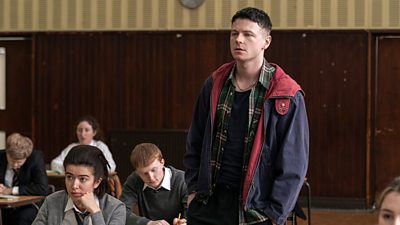
Ruben’s 17 years old – two years older than Niall – and he’s fresh out of a Young Offenders Institute. He’s moving into Niall’s mum’s home, alongside his own mum, and he’s re-entering back into society after probably having had a very fierce two years of trying to survive inside. It’s a turbulent time where Ruben’s experiencing a lot of change and facing a new reality.
How would you describe Ruben and Niall’s bond?
Ruben quite quickly feels a sense of duty to protect and provide for Niall in his own skewed and messed up way. However, that protectiveness can move into a more sinister possessiveness, and I think that ultimately comes from a place of envy; there are things that Niall has that Ruben lacks, and vice versa. It’s in those moments that Ruben becomes violent as he’s not got the tools to understand his own feelings and so he’s never too far away from aggression towards Niall and others. To Ruben, that aggressiveness is part of what it means to be a man in 1987.
What do Ruben’s relationships with the women in his life tell us about who he is?
I think it's really interesting that you only see Maura and Ruben in a couple of shots together. There’s an abundance of Niall and Lori in their beautifully funny and tragic relationship, but we don’t see that for Maura and Ruben, and they don’t interact much with each other. So, I think there’s a lack of closeness with his mum that informs who he is and how he treats women. We see in the other interactions he has with the female characters in the series that he oversexualises them and I think that perhaps stems from his overall perception of what it means to be masculine.
What has it been like working alongside Mitchell Robertson?
When we had our chemistry read together, I was really hoping the two of us would both get the roles and was buzzing when we did. I instantly felt like I could be very open and vulnerable with Mitchell. I think we both felt relaxed in each other’s company and that really helps when you want to find spontaneity in the moment in a scene and you’re discovering all the emotions the characters might be feeling. It was an awesome experience being able to live in Glasgow together, having a pizza crunch (pizza dipped in batter and deep fried!) on a Friday night after filming. We have remained really close.
Richard Gadd plays Ruben in his adult years – did you both have conversations about how you wanted to approach the role?
We spoke about Ruben’s physicality together and visually wanted it to look like I was a teenage version of Richard’s Ruben. We both individually decided that we wanted to bulk up for the role before we even had that conversation together. I wanted to feel like Ruben had a real presence and was commanding in a room and that physical approach was important to the both of us. Beyond that physicality, we didn’t discuss the details too much as we’re both playing that character when he’s at very different points in his life. Of course, as an executive producer, Richard was on set a lot, so he could see the Ruben I was before, but he made it clear he didn’t want to inhibit any ideas or spontaneity I could find when filming.
You live in England but you’re from Scotland. What was it like returning to film Half Man?
I love Scotland. I moved to England with my grandparents when I was younger and they would get the Scottish Newspapers sent down...I grew up reading the Motherwell Times! If I started speaking with an English accent, my Gran was very quick to pull me up on it and remind me of the Scottish way to say things! There was a comfortability to being back filming in Scotland, it felt like a safe place to push and challenge myself and to take risks when exploring the character.
Mitchell Robertson (Young Niall)
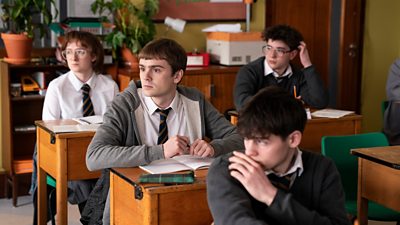
What was it about Niall that you were drawn to when you first read the scripts for Half Man?
Both the character of Niall and the relationship he has with Ruben was so nuanced and it had so much depth to it. Richard writes such complex characters that experience some big things, and as an actor that’s a really exciting place to potentially get to dig your teeth into and explore. On top of that, I could really relate to Niall in some ways. Not that I have experienced the things that he goes through, but more in terms of how he feels, and I really wanted to be a part of bringing him to life. I totally understood what it feels like to grow up in the West of Scotland as a softer, gentler male, especially in a working-class area. We don’t get a lot of protagonists in Scottish story telling like that, so it felt very unique.
I’m also hugely interested in masculinity as a theme in general and I’m particularly curious about how my West of Scottishness shapes me. I have this book by a writer called Carol Craig called The Scots’ Crisis of Confidence and there’s a chapter called Sceptical Scots that talks about our scepticism, and how its benefited us at points as a nation. The Scottish Enlightenment period is a great example of a time where the curiosity of Scots really helped shaped the world, but I don’t think as Scottish men we are encouraged in the same way to be curious about ourselves. Niall is a very real reflection of that and what happens when you internalise what the world around you is telling you, and also just how hard the walls we can create inside our heads can be to break down.
How would you describe the Niall we find at the start of Half Man?
Niall is so young at the start of the series, and he experiences defining moments that really shape him, whilst at the same time, he's at an age where he’s trying to work out how he fits into the world. He is very introverted and does a lot of watching and listening, scanning for danger. Right from the off, when we first meet Niall, his life takes a big turn when he gets the news that Ruben is coming back. There is nothing he can really do about it, and we watch as he navigates this relationship with Ruben and both the positives and negatives it has for him.
Tell us more about Niall's relationship with his mum, Lori?
Lori is in some ways the only place where Niall has a bit of safety and even sometimes that can be compromised. When we’re growing up, we're shaped by the people that surround us and then when we become adults, we try to unpick some of that. Lori’s a really strong women, partly because that's who she is, but also because she has to be and although you can see that Lori loves Niall a lot, I think you can also see where she's failing him as well. Lori gives Niall a lot of tough love because in her mind she's trying to prepare him for the world, but I sometimes don't think that's what he needs.
You can see in moments that Lori is maybe pulled and pushed between giving that tough love and another type of softer love. But I suppose that’s families, and Lori and Niall are the same as any, full of love but also full of complications.
Lori aside, how do the women in Niall's life shape him in his teenage years?
The female relationships Niall has very early on in the series are with Lori, Maura and Mona and I feel like what has been reinforced to him within all those relationships is that he has a lack of autonomy: his mum and Maura bring Ruben into his life and then Ruben brings Mona into his life in quite an extreme way. Both Ruben and Mona come into Niall’s home, his physical space, and there's nothing he can do about it. Niall doesn’t have autonomy over his own space, and at times his own body too. These relationships and these interactions are shaping who he is. You can see Niall shrink inwards and start to take up less space because it’s what he’s being told through the world around him. I think what we see a lot with Niall in his early years is that he is just trying to survive.
Did you and Jamie Bell have conversations together about how you both wanted to approach Niall?
Jamie and I did a get a chance to talk before the shoot started, we spoke about Niall, his inner workings, and the relationship he has with both himself and Ruben. We didn’t talk too much about approach, I was still working out a lot of how I was going to do the physicality and how Niall would change from episode to episode and a lot of that feels like a mix of kind conscious and subconscious work and seeing what happens on the day.
And of course, things like costume, make up, location and dialogue all influence and help carry that. So, for me it really felt like I was constantly working out and developing the character, and Jamie then had access to view what I'd filmed. Of course, the character changes, and the Niall that Jamie portrays years on is different from mine, but the core thread stays the same. Throughout the shoot I sent Jamie some audio clips so that he could hear my accent, but Stuart and I were deliberately in the dark during about what happens in the later episodes. I’m excited to watch it all as an audience member.
How do you think that the series, and Niall and Ruben’s bond, speaks to current conversations that we're having around masculinity?
In Half Man we have these two young men who, in different ways, are both quite vulnerable and who really need support. They are hurting and have both had to find ways to protect themselves, and where for Ruben that means using his fists, for Niall it means hiding parts of himself. I think with men, and people in general, the world can really teach us that we are all in competition with each other, and in order to get ahead you have to stamp on the guy behind you. Speaking also from experience, being a young man right now feels tricky and confusing, because culturally we’re a bit on fire.
In the show Niall and Ruben have real moments of connection and we see how good they could potentially be for each other. I hope Half Man can keep adding to that conversation around masculinity, and how maybe we can be a little more gentle with our young men. We're not really told in this country how to deal with shame, and I think Half Man really dives into that theme, because both Niall and Ruben are carrying shame on their shoulders, even though it might be manifesting differently within them both. I think a lot of men are struggling with that feeling right now, for different reasons, and I think Half Man really looks at that.
What was it like returning to Scotland to film Half Man?
It was absolutely magic, truly, and the crew were just as passionate as the cast – it felt everyone on set was connected to Half Man. We actually filmed part of it in Cumbernauld, which is where I'm from. There's a place in Cumbernauld called Abronhill and the first ever flat that I lived in as a wee baby was there. So, it felt like a full circle moment. All my family are still there, and there was one day when we were filming on the streets and my cousin's wife's mum - I don't know what that makes her to me! - she lives there with my cousin's wife's brother and I heard someone shout my name. I looked up and they were at the window like giving me the thumbs up. So, it was funny filming this show that felt like a really big thing in my life, whilst at the same time being back, where it all started for me, in Cumbernauld.
It was really, special to be in Glasgow making Half Man. It’s a city that takes up a lot of my heart, and to be getting to tell such a rich Scottish story on a bit of a global stage really fills me with a lot of pride.
Follow for more
Latest from the Media Centre
All newsSearch by Tag:
- Tagged with Media PackMedia Pack
- Tagged with Latest NewsLatest News
- Tagged with DramaDrama
