Dear England cast and creator discuss "state of the nation" Gareth Southgate drama that deals with serious subjects "all wrapped up in the beautiful game"
The four-part series is based on the multi award-winning play of the same name, about Southgate and the England men’s football team

With the worst team track record for penalties in the world when he takes over as manager, Gareth Southgate knows he needs to open his mind and face up to the years of hurt to take England back to the promised land.
The country that gave the world football has delivered a painful pattern of loss. Why can’t the England team win at their own game?
Dear England comes to iPlayer and BBC One from Sunday 24 May with episodes three and four arriving on Sunday 31 May. You can watch the drama on BBC One on Sunday and Monday nights.
EJ
Meet Dear England's Creator and Cast
James Graham (Writer, Creator and Executive Producer)

What made you want to adapt your play Dear England into a drama on the BBC?
I always hoped there might be a screen life to Dear England, which would allow us to get inside the heads of the characters with a more intimate quality compared to the epic theatricality of the stage play. It's been incredibly exciting to translate the story and the backstage world of the England men's football team into television.
There’s a huge reach to TV dramas too – this is a national side, it was shown at the National Theatre and it’s now going to be on our national broadcaster, the BBC, where the whole nation can access it.
I’m a big believer that stories like this should be for everybody and while theatre is great for packing people into a space, there are barriers to that, so the opportunity to put Dear England on TV made me feel excited to talk about these themes on a popular level.
Rupert Goold, Joseph Fiennes and a number of other actors from the stage show are involved in the TV version. What has it been like to have that continuity from stage to screen?
It was really delightful to continue the creative relationships that we built during the stage play. I basically built this show from the ground up with the director, Rupert Goold.
We found this story together and so for him to build this show with me for screen, with all the learning that we’ve done - and welcome new people and talent, such as our director for episodes two to four, Paul Whittington, whose work I’ve long admired - has been great.
We tried to maintain the scale, the themes, the euphoria, the theatricality and the poetry of the stage play, while making this work as four hours of television, with the realism that naturally happens on-screen.
In terms of your research, did anything change when you moved over to writing scripts for TV?
What’s great about adapting Dear England from stage is that a lot of people came to see the stage play who are involved in that world – we had a lot of legacy football players, people from the FA, and journalists. What’s great is that, when you continue the life of a story in a different medium, the people who have seen it want to talk to you about it, to share their experiences and new information.
It’s so useful from a research point of view. We had a fantastic six-month period where we were researching and I was meeting players and commentators and people at the top of their game who could help expand on our knowledge, which helped to create new scenes, ideas and perspectives for the TV version.
And of course, the 'story' kept going after the play. The original play ended at the 2022 Qatar World Cup, which was Gareth's third tournament as manager. He had a fourth tournament left in him, which becomes our fourth episode in the TV series. I got to travel to Germany and be amongst the 2024 Euros with the Football Association, who let me be in that world a little.
I had never been to an international tournament before, so to be in a stadium watching those games with the best players in the world and to feel the atmosphere, both when it goes right and when it goes wrong, and to make sense of it on the ground was really useful. I was watching my fourth episode happen around me - it was quite bizarre!
Were there any specific ideas that came about through adapting this story for the screen?
There’s one moment that I wrote quite early on that doesn’t exist on stage, because with television you have more permission to move around compared to the linear journey of a stage play. It’s where we get to go back in time to 1996 with the young Gareth Southgate, which we never quite found a way to put on stage.
After the young Gareth missed his famous penalty in 1996, he goes backstage of Wembley stadium and sits on his own briefly and happens to bump into the Prime Minister, John Major, who was on his way out – both out of the stadium and out of public life. Here were two men unlikely to ever have been at the top of their game who found themselves there.
Gareth found himself as a defender taking one of the most important penalties in English footballing history and failing. On the other hand, there was a Prime Minister who followed Margaret Thatcher and was called ‘The Grey Man’ who no-one ever expected anything of.
That moment lets us imagine two unlikely people talking softly, quietly and painfully against the backdrop of something huge and epic. It's private, intimate and surprising.
How did you approach writing characters like Gareth Southgate and Harry Kane who are not just real people, but incredibly well-known?
In Dear England, we’re dealing with well-known public figures, and it feels like we do know their stories, their behaviours, their mannerisms, their biographies, their family life. You feel a bit presumptuous putting the England captain, Harry Kane, on screen or legacy figures like Gary Lineker and Paul Gascoigne.
We all share an understanding or perception of these people. My rule when I’m writing real life people is that you have a responsibility to try and represent them fairly, and I take that really seriously. I try to get to know them as much as possible – I got to spend time with Gareth during this process, which was a real privilege.
At some point, they also have to perform the function of a character in a drama. Whether it’s Harry Kane or Othello, they have a role in terms of what they want, their obstacles, their objectives - what do they learn, how do they change, what are their strengths and weaknesses?
It’s great to have this existing biography, you’re not making them up from scratch, but eventually you have to liberate yourself a little bit and I think an audience understands that and recognises that I wasn’t there in the dressing room at half time when we were losing to Slovakia in Germany 2024. Once they leave the pitch, the characters become mine and I’m doing my best to present what I think may have happened and what conversations may have occurred in these private moments.
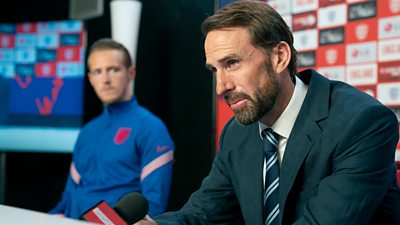
The title ‘Dear England’ is from Gareth Southgate’s letter to the nation. What message did you want to bring from that letter into this series?
The title of Dear England is taken from the letter that Gareth wrote to the nation in 2021, during the Euros that we were hosting. At the time, the pandemic was spreading across the world, and it was a big moment in all our lives. To me, that letter was such an impressive way to talk about why sport, in particular football, means so much to people in this country and across the world.
To me, it felt very philosophical in terms of why these sporting moments play such a significant part in our identity, our sense of belonging and our national story. Gareth used collective consciousness, almost like an academic, and it confirmed in my mind that his project went way beyond football.
It spoke to this extraordinary chapter in our national life, England and the wider UK, which has been an interesting one – chaotic, difficult, a time of division and instability. I got really excited about the idea of trying to make sense of that national moment but through the adjacent prism of the England men’s football team and the work they were doing to try to make sense of themselves and their nation.
How do you think football can change a nation?
Football is about creating collective memories. I’ve always wondered why, especially in the modern age, someone can sit at home with a massive screen television and a surround sound system and have a quality experience watching a quarter final of a World Cup on their own, but feel compelled to go and watch the game in a noisy pub where you have to queue for the toilet.I think it’s because you want to be with people and share that moment, both with people you know and people you don’t know. What is a nation if not the story we tell ourselves about ourselves?
I think people want to really feel that. I feel lucky to come from a playwrighting background, so I know the power of theatre and being in proximity to people watching something very moving, hopeful or inspiring. I think sport does that, as does drama. When a nation tunes in, either together or apart, to watch a TV drama that speaks to a moment and we can’t stop talking about it - that’s what makes us a country and community.
What are the other themes of Dear England?
It does feel, particularly in England but across other countries too, that there’s a real existential anxiety about belonging and identity. England is a very old country and we’re pretty much the longest continually functioning democracy on earth that is still in existence.
But I think we’ve slightly lost the ability to imagine our future, and it feels like we’re stuck and stagnant, and have been for a long time. Into that comes an insecurity about identity and cohesion; and some of that comes out very negatively. There is a toxic element to sport with hooliganism, violence and the ugly side of competitiveness where people think they’re better than other people.
Masculinity is also a theme in the series, with it being about the England men’s football team. There are a lot of men in this story, young and old. We explore questions like how do you play without fear, how do you play with joy, how do you play with freedom? I find that what Gareth Southgate represented and tried to do so positively was to inject some compassion and decency into the sport rather than being tough, punishing and hard.
That to me is wrongly thought of as being soft and easy. It’s actually incredibly challenging, muscular and robust to get a bunch of lads to share what they’re struggling with and to accept that we all get scared, we all lose, we all get humiliated and it’s hard to come back from that. To me, that’s the message here.
It’s about how to instill resilience in anybody, but particularly young men. Yes, you might lose, you might fail and it will hurt at the time - and you can either be the best version of yourself after that, or the worst version.
Joseph Fiennes (Gareth Southgate)

You starred in Dear England on stage, what made you want to return for the BBC series?
I was very fortunate to be part of the stage production. It’s a wonderful piece and I think to work with James Graham and Rupert Goold, and to be in their company again to translate what is essentially a state-of-our-nation drama beyond the stage and to an even wider audience, was an opportunity I really couldn’t miss.
What can you tell us about the journey Gareth goes on across the series?
Many people will have heard of Gareth Southgate, especially if they’re football fans and even more so if they’re England fans. The journey that Gareth has gone on since a young boy breaking into football and then finally making it into the England squad in itself is an amazing trajectory. He had an unfortunate moment, as many players do, in a penalty shootout in 1996 when a lot was riding on that.
There’s the personal journey for Gareth in this series from that, to when he was employed by the FA and England to run the under 21s. The seniors were then going through a terrible series of losses that culminated in a loss against Iceland, who were ranked much below England at the time. As many of us know, Gareth was brought in as a caretaker manager.
In Dear England we get these two wonderful journeys – Gareth’s personal demons connected to the loss of a cup, and then the bigger epic picture of what we might call a gentle reformation within England.That second part essentially boils down to quite a few important factors, one of which was bringing on board a team of psychologists into the England team.
A lot of other sports and teams had psychologists on board, such as golf and tennis, but it seemed like England and the Football Association were late to bring in that dynamic. That was one of Gareth’s drives – to understand the mental side of why they were losing; I think England and Gareth got a better understanding of the fragility that elite athletes are up against. So, these are the two journeys that we go on – the personal and the epic. It’s a brilliant ride.
I also think that Hollywood has used the concept of the underdog to great success and our story is right up there with that notion. The players and Gareth himself weren’t taken seriously and that makes for a great drama, because as they start to become successful, the needle starts to move, consistently so. Those underdogs become far more recognised and, as an audience, that’s a lovely journey to go on and to root for those people.
How did you approach playing Gareth?
It was always on my mind, both when I was doing the play and doing this series, that I was portraying someone that was present in everyone’s mind. The fortunate thing with James Graham’s vision is that this is a fictionalised version of someone that we think we know.
A lot of our story explores what might happen behind the closed doors of the dressing room and the conversations we think are going on - we get to see them but in a slightly heightened, fantastical, dramatised version of people and these events. As an actor, you’re then slightly off the hook, because we’re not doing an exact replica.
Of course, you lean into certain mannerisms, voice pitches and looks, but that only gets you so far because what is really important is the content and themes beneath that - mental health, racism, toxic masculinity, pressures for these elite athletes. Rather like football, the character itself is a vehicle for much bigger questions.
In terms of preparation for the play and the TV series, I pretty much used the same material – so looking at lots of interviews to get the right intonation and a sense of Gareth, but again the play and the television series has its own fictionalisation of him as well, so there was a slight departure. On the outside, there’s getting his wardrobe absolutely accurate.
We have an absolutely amazing hair and make-up department, so I think there were a total of several components that I would put on from nose, cheek, teeth, hair and what have you, all to slightly and delicately nudge that image into place so at least the audience can see the man they know, and then we get into a much more interesting narrative that goes beyond what Gareth looks like.

Tell us about your fellow cast members, what was it like working with them?
Not unlike Gareth and the England team, it’s all about how a unit can come together and how individuals can melt together as one company. As an actor, I’ve been very fortunate that most of my life is spent in the company of others and there’s been nothing quite as wonderful as this experience with this company of extraordinary talent – Jodie Whittaker who plays Pippa Grange brings all of her brilliance, authenticity and truth to a really important and integral role. To have her voice and presence and scope of mind, the brilliance of her psychology and the way that Jodie tapped into her, really balances the piece out.
Steve Holland is a real person who was the right-hand coach of Gareth, he’s played by the wonderful Daniel Ryan who I’ve bonded with immensely. We have another team member in the coaching club, the fictional coach Mike Webster, played by Sam Spruell. This group really are the backbone, as well as the players, of the piece.
I have to really shout out to all of the actors starring as the players as they are just extraordinary. They look the part, they act the part and they play football like professionals. The casting is quite brilliant and they themselves are pretty unique. It’s a hard one to cast but all of the young players went to a bootcamp and that bootcamp was good at getting them technically switched on to the game but it was a good way of bonding them together as a team because they came back onto set afterwards as this one unit which was great to see.
What would you say you’ve learnt from being in this production and how do you think viewers will respond to a story like this about the English football team?
One of the things I’ve learnt from being part of this production is that the British film and television industry when it comes together is world class and I really felt it on this and with the BBC. What they’ve delivered here is a real testament to extraordinary talent right across the board, so that’s one thing I’ve learnt and have been reminded of.
In terms of how I hope an audience will respond, I think Dear England is a nuanced piece, it’s political – football is political, there’s no way for it not to be – in its very minute delineations. This is a political piece in the best way, in not dividing people but actually bringing people together and ruminating on really important themes. I feel the psyche of our nation is part of that discussion, through football, which should bring people together and I really hope Dear England does that.
Dear England is ultimately a state of the nation piece and it deals with some serious subjects all wrapped up in the beautiful game.
Jodie Whittaker (Pippa Grange)
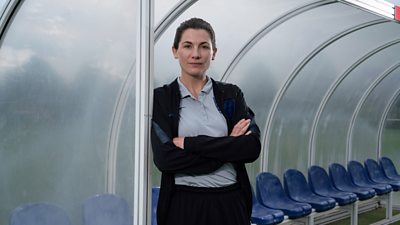
Were you familiar with the Dear England play before coming onboard for the series?
I was familiar because when I was offered the role, the play was in the last week of being in the National Theatre. I didn’t get to see Joseph play Gareth Southgate, but I saw Gwilym Lee, who was phenomenal. Liz White was also absolutely phenomenal as Pippa Grange - I was completely blown away. I thought the play was amazing and it made me feel so excited, inspired and also massively curious as to how the scripts were going to translate to television.
Who is Pippa, your character?
The drama is a fictionalised account, but these people do exist and they did have these roles within English football history. Pippa is fascinating because she’s at the top of her field, but within sports psychology, so it’s not like she’s recognisable in the way that some of the footballers are.
What was great about the role was the freedom to interpret James’ writing and I knew from the cast of the play that everyone had approached Pippa’s character in different ways, as they all had different interpretations of the part. I felt excited by the fact that this could be my version and not feel like I needed to do an impression of the real person.
It was helpful that she’s written an incredible book, about the psychology around fear and our approach to it. Pippa narrated the audio version, so I would listen to her accent and the way she spoke. She’s from the North but she spent a long time in Melbourne and that absolutely comes through in her accent – I hear an Aussie twang over a Northern twang so that really helped to give me a way in.
How do we first meet Pippa at the start of Dear England?
We first meet Pippa in episode one, when she is giving a talk to a room of people about how to get the best out of people within your workplace. If you run a tyrannical space, nobody performs at their best. When people feel nurtured and supported, you’ll bring the best out of them.
We’ve got into this habit of focusing purely on achieving and not failing, where actually the focus alone on achieving essentially creates failure. Whereas nurturing and giving a space for people to ask questions and make mistakes can provide a better mentality for someone to approach their work. In the series, Gareth comes to this talk and that’s how he initially meets Pippa. He’s aware of her because he attended the talk, but he approaches her after listening to the talk to invite her to become part of the England coaching staff.
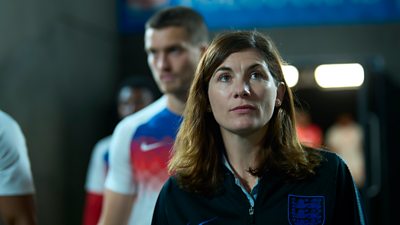
You share a lot of scenes with Joseph. What was that like?
It is like being in a scene with Gareth Southgate! I’m really into football and I was brought up with it all my life, my dad is a massive Huddersfield Town fan, and my husband is a huge Arsenal fan, as are my kids. People within football are very familiar to me, so even though I knew it was Joseph Fiennes opposite me, there were so many times where I’d glance over and couldn’t believe I wasn’t looking at or talking to Gareth Southgate. As an actor, Joseph is phenomenal. As a person, he’s an absolute gentleman and wonderful to be around. He’s a true leader.
What do you think people will find inspiring about watching this adaptation of Gareth Southgate and the England men’s team’s story?
I think what’s so brilliant and exciting about Dear England is that this piece isn’t Hollywood. They don’t win in the last two seconds of the game and everyone runs onto the pitch crying and they’re carried off as heroes.
This is the most English story, it’s an absolute celebration of someone’s dedication and craft to achieve, but also to achieve as a team and not just as an individual. I feel this celebrates Gareth Southgate and how, through his experience, he wants the team to get better at their own pace, ensure nobody is left behind and that their mental health doesn’t suffer. It’s an absolute celebration of marrying achievement with support, wellbeing and care, and it shows.
The series shows how far they came as a team and also sums up, unfortunately, the problem where we only see the loss and never the success. If someone asks about the England team, people are more likely to talk about the losses before the wins. I think Dear England really highlights how much there really is to celebrate.
Did you have a kick about on set in between takes with your castmates, or did you steer well clear of the footballs?!
Not massively! I had a Moonball that I took to set, which is a bit heavier than a tennis ball, so I played a lot of throwing and catching with the lads because they would have a kick about, but essentially, they were doing that to warm up or to practise. It didn’t massively interest me to get really sweaty, but I absolutely love throwing and catching, I’m like a dog! Throw a ball to me and I’ll catch it and bring it back.
I was the on-set puppy so anyone that would play catch with me, I’d play with them. Being around a load of people that would play was great, then we’d adapt so that we can play the game inside with my ball. We had this amazing game where we tried to bounce the ball into the box in the middle of the corridor, it was so satisfying because when I won, I never felt a greater achievement than beating a lot of 20-something lads at a game like that!
Will Antenbring (Harry Kane)
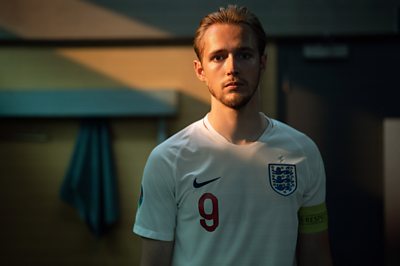
Can you tell us about Harry in the series?
Harry Kane is the captain of the England team, and I think his journey through the series is about maturing as an individual, but also learning how to become a leader. This is something that comes naturally to him, but also something he is wrestling with throughout the series.
What do you think the stakes of losing a match are when you play for a national team? What impact does that have on a person?
There is immense pressure and that’s one of the things I’ve learnt throughout this project. We did a scene from the Hungary match where England lost 4-0. When we were filming, there was a section of the crowd there as extras, a small proportion of the huge crowd that would be in an actual stadium, but just hearing them shouting abuse at you and then trying to imagine that on the scale the England team experience – it’s incredible what these players have to put to the back of their minds when they go out on the pitch.
The pressure for the players is a big part of the show. Was there anything else you drew upon from your character’s perspective?
You look at interviews and articles about the players, but I think you also need to try and understand – as much as you can - who they are as people and their life outside of football. What we’re exploring in Dear England are the highs and lows of the sport – as a player, when you’re on a high, it’s euphoric, but the lows are tough.
At your lowest, when you know you haven’t performed, the entire world is lampooning you; the mental fortitude the players must have to come back from that and get out there and play again is crazy.
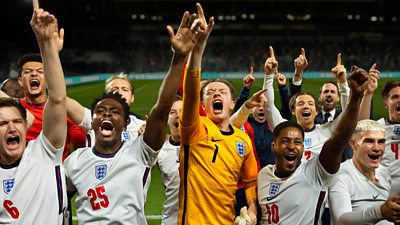
You did a football training bootcamp at the start of this process with the other cast members. What was that like?
One of the big aims of the bootcamp was making us more comfortable around each other. It was through that experience that I realised how much the players would get to know about each other as you’re spending so much time together, especially in quite a physical space.
You hear every single part of that person’s life, whether they’re joking or being more serious. There’s no way we could recreate that bond in such a short space of time, but working with the group of actors playing the other England players has been amazing. We also filmed a military training scene in episode one and I think, as a whole, using that as a microcosm for the players’ mental fortitude was interesting.
Some people think that we need to break people down to make them into performers working at the highest level. But I think Dear England tries to say that you don’t need to do that to get the best out of people, it can be done by appreciating and loving each other and that’s when people can do their best.
What was the football training itself like? How did you approach it with your skills beforehand and how much training did you do yourself?
I didn’t have many skills to be honest! I played a lot when I was younger, but I definitely don’t kick a ball around like Harry Kane! There’s no way I can do that – I was practising penalties constantly and trying to do it exactly how he does, but you have to remember that he’s trained for his entire life and for such a specific purpose; he’s incredible at what he does.
I wasn’t totally up to scratch at the beginning, so the boot camp was definitely necessary for me, but I think we’ve all come a long way since the start of the process! Tyson White, our coach, was instrumental in what ended up on screen. I think that experience working with him is part of the reason we became such a tight-knit group.
What was it like working with the other cast members as a unit and portraying the team?
Joseph is incredible. The way that he understands Gareth, especially after doing the play too so exceptionally, meant that being round him on a day-to-day basis was amazing. I recently saw him without any of the prosthetics and I didn’t recognise him, because I was so used to seeing him as Gareth.
I think that’s a testament to his skills as an actor (and the hair and make-up department!). Jodie is wonderful and such an open person, she’s like that on screen too – her way of being just lets you in and as she’s playing a psychologist, it’s perfect.
So many of the cast playing the players are just starting out, as am I, and having this as our first introduction to TV has been really special, especially as we’re all kicking a football around and having a great time in between! We’ve had so many footballs taken off of us on set because we’re constantly playing keepy-uppies, it’s been so much fun.
Follow for more
Latest from the Media Centre
All newsSearch by Tag:
- Tagged with DramaDrama
- Tagged with Media PackMedia Pack
- Tagged with Latest NewsLatest News
