Inspiring future women leaders in Fiji
Our Women in Focus Fiji is advancing women’s leadership and strengthening women’s voice, visibility, and political participation

“We portray women because of their feminine side rather than the things they’ve been able to achieve…‘Mother of five secures whatever’…Would you say ‘father of five’? No, of course not.”
Women’s equal representation in political and economic leadership is central to democratic governance and inclusive development. Yet women are underrepresented in positions of formal authority across the world. Fiji mirrors these global and regional disparities, despite strong formal commitments to gender equality.
The country has ratified the Convention on the Elimination of All forms of Discrimination against Women and set ambitious National Development Plan targets to reach 30% women in Parliament and 50% representation on boards by 2030. But they are far behind these targets: women hold only 9% of parliamentary seats, roughly 20% of board positions, and 33% of senior civil service posts.
Media plays a critical role in this ecosystem.
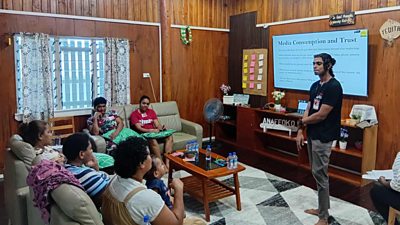
BBC Media Action’s Women in Focus Fiji (WFF) project aims to advance women’s leadership and strengthen women’s voice, visibility, and political participation. We are partnering with local media in Fiji to amplify the voices and stories of women leaders, inspire emerging talent, and promote gender-sensitive reporting.
To inform the project’s media training and production, and ensure it remains sensitive to the roles, needs, interests and portrayals of women and men, we carried out research to identify key trends, gaps, and insights within current social, political, media and institutional dynamics, and conducted 10 in‑depth interviews with women leaders across politics, media, civil society and business. These interviews reveal that women are underrepresented as leaders and experts in media, frequently framed through their appearance, personal lives and scandals, and rarely afforded the same substantive, issue‑based coverage as men. Even within newsrooms, women don’t have equal access to senior editorial positions and hard‑news beats.
Our report examines why gender gaps endure, what supports women to lead, and how media and public discourse shape both constraints and opportunities – and identifies key areas where media organisations can take immediate, practical steps.
A gendered media landscape
Fiji’s media landscape is one of the most developed and diverse in the Pacific, comprising several prominent newspapers, extensive radio coverage and multiple television stations, and a rapidly expanding online news environment. It plays a pivotal role in shaping public perceptions of leadership – in effect, through its portrayals, it decides who looks like a leader.
Our research finds that much of the coverage defaults to a woman’s appearance, family, and private life – with stories often spotlighting women’s maternal roles instead of their professional achievements and contributions.
“The focus should not be on what we are wearing … But somehow, they are distracted - using some odd photo and inviting negative comments on that rather than on the content."
Gender stereotypes create a “double bind” for women leaders: they are penalised if they conform to stereotypically “feminine” behaviours, and criticised if they adopt assertive leadership styles that are socially coded as “masculine”. Sensationalism and unequal treatment in scandals add another layer of harm.
“Sometimes, the way stories were portrayed suggested that someone is already guilty before anything is proven... Experiences like that make me feel the media has to tread cautiously and do its role with dignity and honesty.”
There is also persistent absence of women as experts and commentators. Media framing of authority still defaults to male voices.
“When it comes to the talking heads - the experts and commentators quoted in news stories - most are still men. That is a gap that needs to close.”
Women journalists, as well as politicians and advocates, also experience widespread, gendered online and offline abuse, leading to self‑censorship and contributing to burnout and “battle weariness” among women leaders.
“With the nature of media today, online harassment is a real issue. Female journalists can face more personal or gender-based criticism, especially when covering sensitive topics."
The same imbalance exists inside newsrooms, where women face unequal pay and limited leadership opportunities, and are disproportionately assigned to lifestyle and community reporting, while men dominate political and investigative beats, roles more closely linked to editorial authority. While representation has improved in recent years, underrepresentation in senior editorial positions further shapes newsroom culture and story framing, limiting opportunities for gender-responsive coverage.
“Today I don’t blame the journalists. I blame the system. That’s why there has to be more training, to get our people to become impartial sharers of the news.”
Where change begins
Media has significant power to either reinforce or disrupt gender inequality in leadership. Our research points to five main areas where media organisations can act: newsroom leadership and staffing; editorial policies and practices; sourcing and expert representation; safety and wellbeing; and monitoring and accountability.
Media organisations need deliberate reforms backed by clear standards, monitoring, and safer digital environments. Increasing women’s representation in editorial leadership and on boards is equally important: fairer appointments and gender‑balanced decision‑making teams can shift newsroom culture and the kinds of stories that are commissioned.
“[Journalists should ask themselves] Am I perpetuating discrimination here…am I making it about this person being a woman?... If you wouldn’t ask a man that question, then you should not ask a woman that question.”
Balanced, gender‑sensitive reporting can normalise women’s authority, diversify public images of leadership and inspire younger women to see political and corporate leadership as attainable. By amplifying women’s voices and holding institutions to account for gender gaps, media has the potential to be a transformative force to support more equitable leadership in politics and business. A coordinated approach – where institutions and media work together to move beyond token visibility towards genuinely shared power – is essential to advancing women’s leadership in Fiji.
Read the full report
Read more about our work in the Pacific
Search by Tag:
- Tagged with ResearchResearch
- Tagged with Pacific IslandsPacific Islands
