BBC HomeExplore the BBC
This page has been archived and is no longer updated. Find out more about page archiving.

28 October 2014
Inside Out: Surprising Stories, Familiar Places

BBC Homepage
England
Inside Out
East
East Midlands
London
North East
North West
South
South East
South West
West
West Midlands
Yorks & Lincs
Go to BBC1 programmes page (image: BBC1 logo)

Contact Us

Inside Out - Yorkshire & Lincolnshire: Monday February 13, 2006
Murder mystery

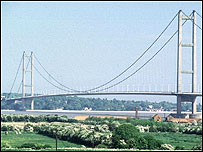
Humber Bridge
Humberside - land of opportunity for many Poles

There is a city where work is seemingly everywhere, the taxes are low and there's a chance to earn three times your hourly rate.

No, this isn't Tokyo or Geneva but Hull, and for tens of thousands Polish workers it offers the chance of a lifetime.

A weekly Sunday meeting in the city centre sees an old church hall packed with Poles who've come to East Yorkshire in search of a better life.

The Polish people come to England because the wages in Poland are very low and they need more money for their families.

One man who did just that was 31-year-old Krystof Kruk who came to Humberside for the good life.

But this man would be dead within his first week of life in Hull - a death that would lead to an investigation into the conduct of Humberside Police.

Polish roots

The story of Krystof Kruk began in Szcezcin in North Eastern Poland, Hull's twin city.

It can be a troubled place with its fair share of poverty and crime.

But in 2005 there was hope for the people in Szcezcin when Poland became part of the EU, meaning every citizen could earn abroad.

That's what drew Krystof to Yorkshire. His father was a peasant farmer - money was tight, and it was a life from which Krystof wanted to escape:

"Krystof was a happy lad, he liked to have fun, he didn't pick on anyone or cause harm to anybody, and the reason he went to England wasn't to visit the country but to get work.

"And I didn't hold him back at all because he was a grown man and he needed a job." Father, Unas Polska.

So in early September 2005 Krystof set out on his 1,000 mile journey.

It was a time of excitement, money and guaranteed graft.

Once in East Yorkshire Krystof easily found a job as a butcher.

His surroundings were modest at best but Krystof was believed to be enjoying his new life in Hull.

He was really looking forward to his first Friday night in the city.

Yet it was his first weekend night out in the city that would end his life.

Tragic night out

The details are unclear but it seems Krystof was out on the town.

He was known for liking a drink and having a good laugh.

But Inside Out doesn't know for sure where he went or how much he'd been drinking - if at all.

Sometime after eleven o'clock Krystof was on his way to Circus Circus.

He was still keen on continuing his night out, but the staff at the bar were thinking differently.

The Police are releasing little about what happened to Krystof that night - but Inside Out obtained a letter sent to Humberside Police.

"I was horrified when I read the paper the next day and saw he'd been killed on Beverley Road within minutes of being driven away from here."
Night club door man

It's from a staff member of Circus Circus. He didn't want to talk to us but this is what he said in the letter:

"It was the evening of Saturday the 17th of September and I was on duty. I'd say at around 20 past 11 to about half past….. me and the head doorman refused entry to a man I later found out was Krystof Kruk."

According to the letter, Krystof was asked to leave but the staff at Circus Circus believed he was drunk and he wasn't having any of it:

"He became agitated and started pushing and shoving at the doors. We radioed to the CCTV control room and we then asked for police assistance as we reckoned the man was a danger to others and himself. They came and I say it was about 11.30-11.40."

Krystof was taken away in a police van.

He was released on Beverley Road towards his home and some way from the Circus Circus pub.

What happened next is unclear, but some time later an ambulance was called just after midnight after Mr Kruk was hit by a taxi on Beverley Road and he died from his injuries.

A family's grief

Back in Poland Krystof Kruk's family are devastated:

"When you don't talk about it it doesn't hurt so much, you don't think about it all the time. But when you start talking about it, your heart starts to squeeze itself and crush itself.

"With time the pain may relent but when will that be?"
Father, Unas Polska.

The terrible news came on an ordinary autumn day:

"We didn't know anything - two weeks we waited which was very hard because we just needed him back to bury him... why does god always have to take the special children?" says his mother Kaleeshmee Kruk.

So why was Krystof Kruk released, and how drunk was he, if at all?

He was dropped off in a big city in which he was a stranger and where cars drove on the 'wrong' side of the road.

"They've been numerous cases in the past few years going into the police duty of care.

"And what they say is the police have a duty of care to anyone they detain.

"They don't have to be under arrest, they have to be in detention because once the police take somebody into custody in a police car, van or station and deprive them of them of their freedom of manoeuvre and they have to ensure that person's safety." Mike McColgan, Solicitor with Liberty.

Duty of care

There is no evidence that the officers in this case breached their duty of care.

Sources close to the investigation told Inside Out that Mr Kruk was not arrested for being drunk and he was able to walk unaided.

The case has now been handed over to the Independent Police Complaints Commission (IPPC) and Cleveland Police are now investigating their counterparts on East Yorkshire.

Humberside Police are limited as to what they can say but did provide us with a brief statement.

It confirms the IPCC is investigating the period of time Mr Kruk was in contact with their officers, while Humberside are investigating the road traffic accident.

The force acknowledges there is proper public interest in the incident but says it would be inappropriate to make comment at this time as such comment may be speculative and potentially damaging to the investigation.

Desperate for answers

Back in Poland Krystof's family is desperate for answers, and his father says:

"Here in Poland… we are far behind the UK but if we found a dog in the street, we would take it to shelter.

"The police stopped someone who didn't have any documents, couldn't speak the language. They should've kept him long enough till they worked out who he was."

The family still feel they are some way off from knowing the answers they want.

And perhaps the only person who knows the full story of what happened that night in Hull is Krystof Kruk

Links relating to this story:

The BBC is not responsible for the content of external websites

Inside Out Archive

Inside Out: Yorkshire & Lincolnshire
View our story archive to see articles from previous series.

BBC Where I Live

Find local news, entertainment, debate and more ...

Bradford
Humber
Leeds
Lincolnshire
North Yorkshire
South Yorkshire

Meet your
Inside Out
presenter
Jamie Coulson

Jamie Coulson
your local Inside Out presenter.

Contact us
Contact the Yorkshire & Lincolnshire team with the issues that affect you.

Free email updates

Keep in touch and receive your free and informative Inside Out updates.
Subscribe
Unsubscribe

Tower cranes

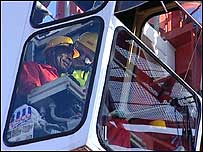
Johnny Nelson sitting in crane
Head for heights - Johnny Nelson climbs above the skyline

Inside Out joins Johnny Nelson as he takes to the skies to look at the chic urban developments rising up over Yorkshire's cities.

His mode of transport - a crane!

Tower cranes are littering our city skylines.

It's all down to the boom in city centre residential property building.

So what better place to get a bird's eye view of these new developments than from the seat of a crane?

Inside Out sent Johnny Nelson to become a crane driver for a day.

Sky high school

Johnny's first stop is the crane yard on the M1 near Meadowhall in Sheffield.

Johnny Nelson
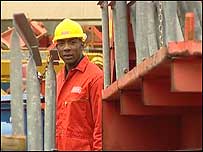
Johnny Nelson looks nervous about his high rise adventure

The cranes at the yard provide the muscle power on many new high rise sites.

The team at the site are going to put Johnny through his paces as a trainee tower crane driver.

It's a tall order but Johnny thinks that he's up to the task.

He's understandably nervous:

"Now before I can go up a crane, I've got to be kitted out properly and psychologically profiled in case I panic half way up and won't come back down.

"I can see the headline in the Star now - Sheffield boxer in TV crane horror."

Johnny passes the tests with flying colours with the guidance of an expert instructor, and it's time to test his nerves on a crane site in Leeds city centre.

Riding high

Climbing up into the cab with an experienced driver is just the start of the adventure, but Johnny pulls it off like a professional.

Normally it takes three months at a special crane driver training school to get to grips with these million pound beasts.

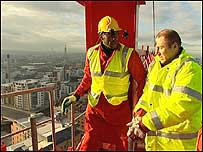
Johnny atop crane
Top of the world! A stunning view awaits

The drivers are highly skilled - an experienced crane operator like Tony can put a huge load down on a sixpence.

Top drivers can earn top dollar, and there are always plenty of people who want the job for those with a head for heights.

As Johnny heads for the skies, he's starting to feel queasy:

"I feel a bit sick now… that's the truth... Oh no… I cant do this."

But once he's up top, Johnny starts to marvel at the view and the sight of the homes of the future:

"These cranes are responsible for a group of new buildings that will dominate the Leeds skyline - a vast complex of offices and luxury apartments near Clarence Dock... and it all revolves around the skills of the city's tower crane drivers." Johnny Nelson.

Simon Wynne is Johnny's driver today - he's a former pro rugby league player and does this climb every day.

Johnny watches as Simon lifts some heavy construction materials.

The 75 metres high crane flexes in the wind, and tilts forward a metre when it picks up something heavy.

So what did Johnny Nelson make of his high rise experience:

"Put me in a boxing ring, give me your best shot - but don't ever get me to climb one of these things again - and just when you get to the top the whole thing starts to wobble and turn around."

Although the view was spectacular, it was a stomach churning experience which Johnny is not going to repeat quickly.

But it's hats off to the men who do this high rise job for a living - they certainly have a head for heights.

Links relating to this story:

The BBC is not responsible for the content of external websites

Whitby's slave legacy

Slaves in Africa
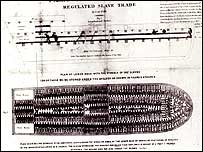
Barbaric trade - slaves were sent to the Americas

Inside Out investigates Yorkshire's links to the slave trade.

Whitby is one of our prettiest seaside towns but it also has an unsavoury past and links with the barbaric slave trade.

We investigate two men with Whitby connections who were involved in very different aspects of the slave trade - one who tried to stop it and the other who profited from it.

Inside Out travels in their footsteps to see who is remembered the most.

Slave labour

Two centuries ago sugar came at a price - it was produced by slave labour.

When Britain woke up to the inhumanity of packing slaves across the oceans, diplomats were sent to stop the slave trade at source.

John Beecroft was born in Whitby, and he was appointed as British Consul to try to stop the slave trade in West Africa.

It was his mission to persuade local chiefs to stop selling their fellow Africans into a life of slavery in the Americas.

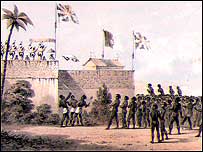
The Slave Coast's biggest trading post was Ouidah in the kingdom of Dahomey - the modern Benin.

Vestiges of the slave trade are not hard to find - the town's museum is a former slave holding post.

The King of Dahomey captured neighbouring tribes, sold them to the Europeans in exchange for goods and weapons.

It was a case of a black man selling fellow blacks to the whites.

More than 10 million Africans were taken from the continent.

Stopping the trade

We visit the library of The Lit and Phil in Newcastle to find more clues about Beecroft's mission.

Beecroft writes about the Dahomey Palace having walls lined with human skulls, a warning to all that King Ghezo was a ruthless warmonger.

Ghezo had an army of thousands of soldiers - half of them were female warriors who thought nothing of chopping off an enemy's head.

When Beecroft reached the palace, he had a fearsome mission - to persuade the king to give up slavery.

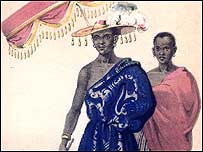
King Ghezo
King Ghezo - ruthless warmonger

But Ghezo wouldn't sign a treaty.

However, Beecroft must have made his mark as the king presented him with an ornate chair.

This is the only tangible reminder of our man of good intent.

Back in Ouidah the only link to those times are the descendants of the king's viceroy with whom Inside Out was granted an audience.

We found that whilst they are proud that the kingdom eventually replaced slavery with agriculture, no one could recall the British diplomat.

What we do know is that Beecroft convinced other chiefs to sign the treaty against slavery.

So we can be proud of the role he played, but we cannot honestly say that he managed to stamp out slavery.

Pillar of society

Someone who's wealth depended on that slave labour was
James Wilson.

Slave ship
Slave ship used to transport the Africans

Whilst Beecroft was trying to stop the slave trade, Wilson was busy making his fortune on the backs of those forced to work on his Caribbean sugar plantation.

He would eventually give up his sugar plantation in St Vincent, settle in Whitby and try and re-invent himself as a model citizen.

He spent his wealth on ostentation, turning a large house into a castle, commissioning his own coat of arms, providing a new school and rebuilding the local church at Sneaton.

Wilson wanted to be seen as a pillar of the community.

Making their mark

So what impact could our two Whitby citizens possibly have had on such a massive trade in human lives?

Although Beecroft did make some advances in stopping the slave trade, he is barely remembered today.

And Wilson's legacy is now seen more as a model citizen than a slave trader.

However, there is one delicious twist of fate - Wilson's Castle is now owned by an order of Nuns whose main charity work is in Africa.

Links relating to this story:

The BBC is not responsible for the content of external websites


About the BBC | Help | Terms of Use | Privacy & Cookies Policy