BBC HomeExplore the BBC
This page has been archived and is no longer updated. Find out more about page archiving.

28 October 2014
Inside Out: Surprising Stories, Familiar Places

BBC Homepage
England
Inside Out
East
East Midlands
London
North East
North West
South
South East
South West
West
West Midlands
Yorks & Lincs
Go to BBC1 programmes page (image: BBC1 logo)

Contact Us

Inside Out - Yorkshire & Lincolnshire: Monday February 6, 2006
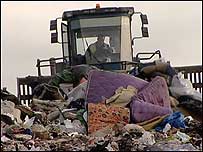
Landfill in Sheffield

Rubbish heap
What a load of rubbish - trouble at the tip

Inside Out investigates the controversial issue of landfill sites in Sheffield.

Neighbours are making a stink about what they consider to be the unacceptable amount of rubbish next to their homes.

Trash trouble

Most landfill sites are in old quarries miles away from anywhere - but Parkwood Springs is right in the middle of Sheffield.

The nearby houses are very close to this landfill site - in fact some are right up against its perimeter.

Neither the Environment Agency nor the site operators wanted the houses there - but Sheffield City Council, who sold the land, gave it permission.

The licence to fill the hole at Parkwood says it can be filled right to the edge with garbage, meaning that the rubbish is higher than surrounding houses.

These are pleasant four bedroomed houses with two bathrooms - so it's no surprise that they sold well.

But pretty soon after residents moved in some of them began to feel unwell as one householder pointed out to Inside Out:

"In the summer particularly it's dry and dusty - and despite this stuff - which is odour neutraliser - it can pong a bit.

"Up top the neighbours fear that what is in the air isn't doing them any good."

The site stood accused of not only just smelling bad and causing asthma, but of causing cancer and birth defects.

No evidence

For three years people living nearby were studied and surveyed, and the results have just been published

The report's main conclusion is that there no evidence to link health problems to this site.

The company that currently runs Parkwood is called Viridor, one of the UK's largest waste management companies.

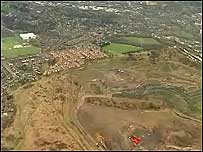
Parkwood landfill site
Parkwood landfill site from the air

They have sites up and down the country, but none are quite so close to the locals as the one in Sheffield's Parkwood.

Historically waste from homes in Sheffield was burnt.

But lots of chimneys meant smog - and poor health.

In the 1950's the law changed and the Clean Air Act came into force.

Councils had to get organised and collect our rubbish, and began putting it in landfill sites like Parkwood.

Concerns

Not all the landfill sites' neighbours live in new houses.

Some have been putting up with it for a lot longer - and they keep a very close eye on what goes on.

For 30 years Jean Armstrong and her committee have tirelessly worked to look after their precious hillside in Sheffield.

They've been to hundreds of meetings - and now feel that they are being listened to at last.

But some of the neighbours have long memories and grave concerns about what was buried in years gone by.

The problem is that this is our rubbish and it has got to go somewhere.

In Yorkshire alone we create 11 million tonnes of rubbish - that's 43 million wheely bins.

If we didn't bury it and it built up, it would obliterate Sheffield.

There's no easy solution to the problem, but one thing is clear - rubbish is now higher on many people's agendas from the disposal authorities to residents who live near the landfill sites.

Links relating to this story:

The BBC is not responsible for the content of external websites

Inside Out Archive

Inside Out: Yorkshire & Lincolnshire
View our story archive to see articles from previous series.

BBC Where I Live

Find local news, entertainment, debate and more ...

Bradford
Humber
Leeds
Lincolnshire
North Yorkshire
South Yorkshire

Meet your
Inside Out
presenter
Jamie Coulson

Jamie Coulson
your local Inside Out presenter.

Contact us
Contact the Yorkshire & Lincolnshire team with the issues that affect you.

Free email updates

Keep in touch and receive your free and informative Inside Out updates.
Subscribe
Unsubscribe

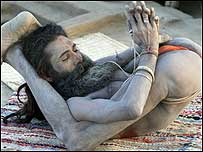
Yoga movement

Yoga man c/o Associated Press
Traditional yoga in India

When you go to yoga class, you expect to tweak a few muscles and work on that Madonna-like physique.

You don't expect to end up devoting the next seven years of your life to an obscure religious movement.

This is what happened to Lyn Dale, a hairdresser and mother-of-two from Hull.

It all started in the 1990s when Lyn was working as a fashion model in London.

She was living the dream, earning lots of money, but started to have panic attacks and so turned to meditation.

Lyn dabbled with several classes, but was most drawn to one advertised as Sahaja Yoga.

She loved the atmosphere and the meditation practice, and was so enamoured of her teacher she fell in love with him, and married him three weeks later.

"I felt like I'd known him from somewhere before, it was really strange.

"If I'd have felt like I'd only known him for three weeks, I wouldn't have married him so quickly but it just happened and it was part of the Sahaja Yoga thing really I think."

Mediation and spirituality

Sahaja Yoga classes are not exercise classes.

They're part of an enormous growth of new religious movements in 70s counter culture, when people discovered meditation and spirituality.

Sahaja Yoga hasn't westernised as much as some of the other ones.

It's interesting because the leader of the religion is a woman.

Shri Mataji Nirmala Devi, is the founder of Sahaja Yoga.

She's a wealthy and well connected Indian woman, the childhood protégé of Gandhi, and married to a respected Indian diplomat.

But to the Sahaja Yoga followers, as Lyn discovered, she's a divine being.

YOGA CHECKLIST


If you are looking for a yoga class, things to check are:

What type of yoga is it? There are many different styles of yoga. Most classes in this country will be in Hatha Yoga, which has elements of bending and stretching, with some breathing and meditation. Iyengar Yoga is similar to Hatha Yoga, but performed according to a method devised by a teacher called Mr BKS Iyengar. Power Yoga, or Astanga Yoga is the form made popular by celebrities such as Madonna and Geri Halliwell. This is a more dynamic and strenuous workout.

Is it the right class for you?

It is a good idea to have a short discussion with the teacher before you start to practise yoga. Some classes are suitable for beginners, whilst others might suit more advanced students. Also, you should talk to your teacher about your general health, and if there is any health or fitness issue the teacher should be aware of.

Always check the teacher's credentials. Most qualified yoga teachers will be certified by the British Wheel of Yoga, the governing body for yoga. Any qualified teacher would be happy to tell you their credentials.

Whatever form of yoga class you attend, you should make sure the teacher is fully trained and certified to teach. Most yoga teachers will be certified by the British Wheel of Yoga, by an organisation affiliated to the British Wheel. Any teacher would be happy to tell you their credentials.

Anti-material girl

Whatever Sahaja Yoga asked of Lyn, she went along with it.

She turned her back on the world of fashion, and severed ties with friends and family.

But she began to have misgivings when she witnessed Shri Mataji accepting lavish gifts, and at the same time encouraging her followers to reject material wealth.

Lyn couldn't just walk away.

By now she had two children, and feared that rejecting the Sahaja Yoga movement would threaten her marriage and break up her family.

"If you feel like Sahaja yoga is like a family to you and if you've got doubts, you will get thrown out of Sahaja yoga.

"So it would be a case of leaving Sahaja yoga and also splitting with my husband and my marriage would break down," says Lyn.

Not every form of yoga is like Sahaja Yoga, of course.

Laura Bissell of the Yorkshire Yoga Centre points out that, "if you go to a yoga class in the West it's 99% likely to be Hatha yoga.

"This is physical exercise with breathing techniques and relaxation.

"It's important to check out the qualifications of any yoga teacher, so you know that the teacher's training has covered the precautions necessary for individual problems."

No pressure

The Sahaja Yoga organisation know Lyn's history, and have made these comments:

"There are no rules forcing an individual to adopt any particular lifestyle.

"We function with unpaid volunteers. No money is ever taken from practitioners under any form of duress.

"Donations are only accepted to help fund communal activities such as the hiring of halls.

"No-one is under pressure to attend meetings, contribute funds or to do anything that they are unhappy with.

"Ms Dale's account of her experiences does not correspond with those of other people."

Regrets

After seven years, Lyn split from her husband and broke away from Sahaja Yoga, taking her children back home to Hull.

She regrets the time she spent in the Sahaja Yoga Movement:

"You wouldn't imagine anything like that could happen really to you, but it just shows that it can affect anybody.

"There's a lot of regret there and that's why I want as many people to know about it so that they don't make the same mistakes."

Links relating to this story:

The BBC is not responsible for the content of external websites

Bobsleigh champion

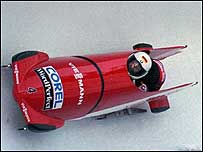
Bobsleigh
Competitive edge - competition at the Olympics will be tough

Inside Out meets Nicola Minichiello – bobsleigh World Silver medallist and Britain’s fastest woman on ice.

We follow her preparations as she bids to bring home gold at next weeks Winter Olympics.

We watch the British Bobsleigh Championships at the Igls Olympia near Innsbruck, Austria’s premier track.

Bobs here reach 90 miles an hour along 1,200 metres of steep ice and sheer banked bends.

For Nicola and brakewoman Jackie, this race is vital in the build up to the Olympics, they’ve got a new bob and testing time is running out.

Tough training task

When not competing, Nicola splits her time between training and working as a primary school PE teacher in Sheffield.

But only five years ago she was still a top heptathlete – second only to Denise Lewis and dreaming of a Summer Olympics.

Then one day she tried pushing a bobsleigh.

Two months later Nicola was competing in the Winter Olympics at Salt Lake City, finishing a respectable 10th but already proving she’s one of the most powerful women ever to take up the sport

It’s difficult to comprehend what 90 miles an hour and pulling five g’s on ice really feels like.

Bobsleigh is the fastest and most physically demanding winter Olympic sport and for one terrifying minute, Inside Out presenter Nicola Rees finds out just what Formula One on ice really feels like, and her reaction is not a predictable one.

With the Olympics fast approaching, Nicola’s preparations hit problems.

Her tight muscles hamper training and she’s still getting used to her new bob.

Will she become Yorkshire's next Olympic Heroine?

Find out when Nicola races on 21st February 2006, on BBC2.

Links relating to this story:

The BBC is not responsible for the content of external websites


About the BBC | Help | Terms of Use | Privacy & Cookies Policy