HEAD IN THE CLOUDS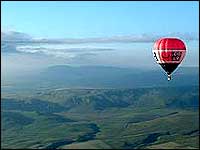 | | View the beauty of the Dales from the sky |
If you are up early enough or if you're out on an evening jaunt in the Yorkshire Dales you may just get a glimpse of a hot-air balloon. And the chances are - it's David McCutcheon and friends. Inside Out's Sophie Hull takes to the air. The grace and serenity of ballooning (apart from the intermittent blasts of burning for lift of course) is almost indescribable. So for those who get vertigo in thick socks - it maybe something to avoid. 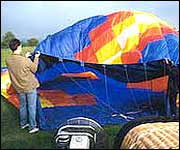 | | Getting the balloon ready is a team effort |
But if you are prepared to shake a leg at about 5-o'clock in the morning, and wrap up well, even in summer, you will be set to join the couple of dozen or so other balloons around the country in a real adventure. Flying is best either early morning or early evening. The wind is usually at its lowest at these times, and the temperatures are also cooler - two crucial factors to get right to achieve optimum flying conditions. Weather or notDavid McCutcheon and his Airborne Adventures crew took the Inside Out team to fly over the Dales and to get an understanding of his commercial operation. David says that weather conditions are crucial, and in the Yorkshire Dales there are particular weather factors to consider. 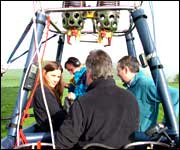 | | Passengers need to be well briefed before the flight |
He says, "In spring, morning fog is fairly common, and it can restrict the number of days you can fly, the day we went flying with Inside Out was difficult. "As you will appreciate, the undulating hills of the Dales is something that as a pilot you have to be very aware of, but with fog, as we had on that day, it can be difficult to judge where to land," he explained. Before any flight, the pilot will have vital information on weather and other aero-activity in the area, and will brief his crew and passengers. As a passenger, you'll need to know what's going to happen when you take off, what you will see and hear in the air, and what might happen when you land. 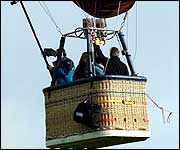 | | The polcam comes into its own for the tricky shots |
Pilots like David McCutcheon are very experienced - they go through very rigorous training to get their Private Pilot's Licence or PPL(B) - the same rigors as a plane pilot. But the landing can be just a little hairy sometimes - it's all part of the fun. Foot and mouthSetting aside the matter of money, and it does cost the price of a family car to get the full kit to fly; the devastating effect of foot-and-mouth in 2001 hit ballooning companies hard. There was a voluntary ban on balloon flying in the UK (fine to take off, but with no guarantee of 100% accuracy of landing, the disease could have been unwittingly transmitted). This put many commercial pilots on the rack - no flying - no exposure - no contracts. With good judgement and incorporating other outdoor adventures such as white water rafting, quad biking etc in the adventure mix, David has a thriving business. Today, there are signs that the recession in commercial ballooning is starting to bottom out, and companies are looking to include this form of marketing in their marketing-mix. The BBAC, British Balloon and Airship Club, have a liaison officer for every area of flying around the country. 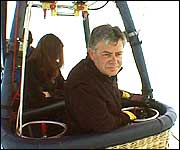 | | The pilot is always on the lookout for landing spots |
It is his or her role to keep a record of the way in which farmers and landowners interact with balloonists. However balloonists are treated, by landowners, they are keenly aware of the precious nature of both stock and crops on the land being flown over. Balloon burners are even equipped with "whisper-burners" that do what it says - burns at a quieter pitch so as not to scare livestock. Getting off the groundAfter laying out the balloon envelope, the fan blower is set to task to fill it with air. This cold inflation has no effect of lift for the balloon; so once the mouth of the balloon is supporting itself, the burners are ignited in order to give the envelope heat. It's then you get the lift. In the 21st Century, you may think that balloon baskets would be made of aluminium, carbon fibre or similar material. 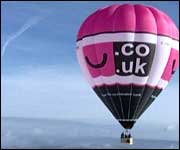 | | But where better to be - high over the Yorkshire Dales |
But no - baskets have always been made with wicker - a very forgiving and malleable natural material, and when landing you sometimes need a great deal of forgiving! FlyingWhen you fly at low levels, you could find yourself talking to families barbecuing - they always attract attention. You get a totally different perspective on the Yorkshire Dales and life in general when drifting 1000+ft up. And when you're less than 50ft from the ground, you can witness nature close up - maybe hares playing tag through the crops, or deer on the run too. | 



