BBC HomeExplore the BBC
This page has been archived and is no longer updated. Find out more about page archiving.

28 October 2014
Inside Out: Surprising Stories, Familiar Places

BBC Homepage
England
Inside Out
East
East Midlands
London
North East
North West
South
South East
South West
West
West Midlands
Yorks & Lincs
Go to BBC1 programmes page (image: BBC1 logo)

Contact Us

Inside Out - West: Monday October 24, 2005
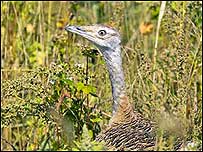
Bustards

Great Bustard
Rare sighting - the Great Bustard is making a comeback

Dave Waters is on a quest. In fact, you might say he’s a man obsessed.

He dreams of watching a rather special bird fly over Salisbury Plain – a bird that died out in this country over 170 years ago.

The Great Bustard is the heaviest flying bird in the world and became extinct in Britain in 1832.

Although changes in farming played a major part, ironically it was the bird watchers of the day who finished the UK population off,

If you were a “twitcher” then, you had to produce the carcass to prove you had actually seen the bird.

Sadly the last British Great Bustards were only viewed down the barrel of a gun.

But Dave, from Wiltshire, has made it his aim in life to bring the Bustard back.

He’s given up his job as a policeman, sold his beloved motorbike collection, forgone holidays - all in attempt to try to establish a self-sustaining Great Bustard population back on the plains.

Dave feels that they are a missing piece of our wildlife heritage. They’re especially important to Wiltshire, featuring on the county crest and local place names, so it’s fitting that they return here first.

Spectacular birds

In fact, it’s been Dave’s dream to see Bustards back here since he was a young lad.

GREAT BUSTARD

The Great Bustard is the largest flying bird in the world - some males weigh over 20 kilograms.

Males usually have to be five years of age before they are able to breed.

Males gather in groups called 'leks' to attract females.

The bird's diet is seasonal and quite opportunistic. They eat insects such as grasshoppers in the summer and cereal seeds in the winter.

Until the end of the 18th century, Great Bustards were widely distributed in England on open chalk downland, grassy heaths and agricultural land. The intensification of agriculture led to the bird's decline.

As a prized game bird, heavy persecution led to their extinction by around 1830.

At their height, the bird's stronghold was Wiltshire, especially on Salisbury Plain and the extensive chalk downs in the north of the county.

The last records of British Great Bustards are recorded in East Anglia.

Source: RSPB

In the 1970s, Dave saw a captive flock from Portugal being reared just up the road at Porton Down.

The birds appealed to Dave’s boyish sense of humour… there’s obviously something in a name!

They’re also known for their spectacular mating display - the adult males inflate special throat pouches and twist their feathers, turning from their normal brown colouring to almost totally white.

Thirty years on, Dave’s quest has taken him all the way to Russia, where the Great Bustard still survives on the plains of Saratov.

The Russian authorities have allowed Dave to collect eggs that are abandoned by the female birds and would otherwise perish.

This is the project’s second year and back in the summer, Dave hatched out 37 chicks.

Then came the tricky job of transporting the chicks back to Salisbury Plain. After a month in quarantine, the chicks were ready to be released.

The birds were released into an open topped pen to give them some initial protection until they were happy to fend for themselves.

Of course, it’s still early days – Dave expects that it will take up to ten years to establish the Great Bustard properly and for us to be rewarded with the wonderful breeding spectacle.

But so far so good, and the latest news from Dave is that there is now a big flock of Great Bustards happily flying over Salisbury Plain – so keep your eyes peeled!

Links relating to this story:

The BBC is not responsible for the content of external websites

Inside Out Archive

Inside Out: West
View our story archive to see articles from previous series.

BBC Where I Live

Find local news, entertainment, debate and more ...

Bristol
Gloucestershire
Somerset
Wiltshire

Meet your
Inside Out
presenter
Josephine d'Arby

Josie d'Arby
your local Inside Out presenter.

Contact us
Contact the West team with the issues that affect you.

Free email updates

Keep in touch and receive your free and informative Inside Out updates.
Subscribe
Unsubscribe

Amazon adventure

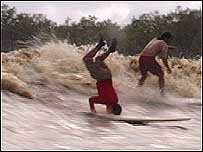
Surfers
Making waves - riders of the bore Brazilian style

The Severn Bore is one of Britain's most spectacular natural wonders and for the last 50 years it has also been a playground for surfers.

But what do you do if you've conquered the waves on the Severn and you're looking for a new challenge?

Inside Out West has been following a group of bore surfers from Gloucestershire on an adventure to Brazil.

They're taking on the mighty Pororoca - a vast wall of water which thunders across the Amazon basin with a destructive fury.

As they travel out to meet the giant wave they worry if their experiences on the Severn will be enough to help them survive.

They've been told the bore can reach up to five metres in height and the river is home to some deadly fish.

But their mission is a success and the Gloucestershire team become the first Europeans to surf the Pororoca.

Their adventure is even picked up by Brazil's biggest TV channel as a feature on the evening news.

Steve King says, "It was everything we thought it was going to be - the people, the place, the location. It was absolutely a special place".

Now the boys are setting their sights on new challenges with a possible trip to surf a river bore in Alaska.

Links relating to this story:

The BBC is not responsible for the content of external websites

Strike up the band

Brass section
Big band - striking a chord with modern audiences

Inside Out West meets the veteran musicians who are still going strong after more than 50 years in the business.

The New Parkway Show Band from Bristol are led by Tony Stone.

He says that big band music has never gone away.

His band still pull large crowds when they play for social dances at the Old Georgian social club in Whitehall, or the Hanham Folk Centre, or at Whitchurch British Legion.

Ballroom dancing is making a big revival now, through the success of TV series like ‘Strictly Come Dancing’.

Around the dancers there’s always a crowd of enthusiastic listeners, drawn by the seductive power of a good tune or a well-made song.

Band playing live
Strictly ballroom - it's a swing thing

In Bristol, 50 years ago there were dance halls all over town and you could dance to live big band music seven nights a week.

The BUPA hospital car park was once a Mecca for dancers on the Downs.

It was called 'The Glen' and admission cost just 1/9 pence.

Rather more upmarket was the Grand Spa Ballroom overlooking the Avon Gorge, now sadly derelict.

In the 1950s Cary Grant and Peter Sellers were seen on the dance floor.

Across town, in Bedminster, the council used to convert its swimming pool into a ballroom in the winter months.

Links relating to this story:

The BBC is not responsible for the content of external websites


About the BBC | Help | Terms of Use | Privacy & Cookies Policy