CLIMBING EVEREST AT 61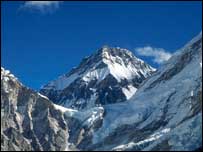 | | Can Sir Ranulph conquer the highest mountain on earth? |
Everest is one of the most inhospitable places on earth - almost 150 people have died trying to conquer it. Yet, aged 61 and only two years after a double bypass operation, veteran adventurer, Sir Ranulph Fiennes is taking to its slopes and it's all in the name of charity. For the past 35 years Sir Ranulph Twisleton-Wykeham Fiennes has tramped to every corner of the globe and has put his body through more rigour than most. His expeditions may have honed his body to its peak, but two years ago, a heart attack looked set to put a stop to Sir Ranulph's physically punishing expeditions for good. | Mount Everest | Everest was formed about 60 million years ago Everest is 8,850 metres high Everest rises a few millimetres each year due to geological forces Everest was named after Sir George Everest in 1865, the British surveyor-general of India Its summit ridge separates Nepal and Tibet Sir Edmund Hillary was the first to successfully reach the summit on May 29, 1953 Avalanches are responsible for the highest number of deaths on the mountain The most dangerous area on the mountain is Khumbu Ice Fall, where 19 people have died Source: Mt. Everest.net |
Pushing on On June 7 2003, Sir Ranulph collapsed just before boarding a plane due to take off from Bristol airport. Suffering a heart attack, Britain's biggest killer, Sir Ranulph was rushed to Bristol Royal Infirmary where he underwent the double heart bypass operation. "Altogether they had to try and start me up 14 times. "In normal circumstances I would have copped-it after six attempts, but they found that my heart was extremely strong," says Sir Ranulph. He continues; "the actual act of dying frightened me because of the unknown, but now I've to all intents and purposes spent four days dead - it doesn't frighten me anymore."
Despite being advised rest and relaxation by his doctors, a week after being discharged Sir Ranulph was completing 30 minute training runs in preparation for a marathon of epic proportions. Seven marathons, in seven continents, in seven days. In October 2003, four months after surgery, Sir Ranulph pushed his body and heart to the limit to complete the mammoth run. Crushing griefSir Ranulph's health may have gone from strength to strength post bypass, but in February 2004, the sudden death of his wife, left him devastated. After a short illness Ginny, age 56, died in hospital in Exeter with Sir Ranulph by her bedside. 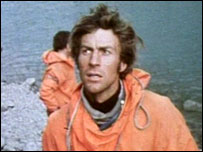 | | 'World's Greatest Living Explorer' says Guinness Book of Records |
As childhood sweethearts, the couple had been married for 30 years and Ginny had been involved in many of her husband's expeditions. During the transglobe expedition in 1982, Ginny organised and ran all the Antarctic and Arctic bases, travelling to the frozen wastes with her husband. In 1987, the Queen awarded Sir Ranulph and his wife the Polar Medal. Ginny was the first woman ever to receive the honour. Now in 2005, Sir Ranulph prepares to face one of his toughest expeditions without her. Practice makes perfectOn a wet cliff face outside Cardiff, Sir Ranulph gets a crash course in climbing from climber Hayden Griffiths. But two years after his bypass, will his heart cope with the stress of the altitude of Everest? "I'm fearful of all sorts of things but in particular altitude. The other thing is I don't like heights," admits Sir Ranulph. 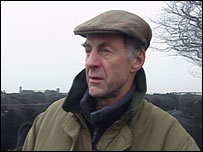 | | Sir Ranulph Fiennes is tackling Everest and his fear of heights |
At Everest Base Camp a climber breathes only half the oxygen that is available at sea level, whilst at the summit it is just one-third. Allowing the body time to adjust to low oxygen levels is the key to surviving at altitude. "A lot of people die of heart attacks over a certain altitude, but that could be because they didn't know they had bad hearts," says Sir Ranulph. "Whereas I had a bad heart but I've had it fixed, therefore I could be said to have a good heart." When asked if he is concerned about dying on the mountain, Sir Ranulph remains typically non-plussed "I'd prefer to meet my maker somewhere more cosy."
His expedition up Everest this March will not only be another achievement in his glittering career, but Sir Ranulph also aims to raise £2m for the British Heart Foundation. To find out how you can help, or to make a donation visit the British Heart Foundation website. | 



 Inside Out - West: Monday February 21, 2005