CONCORDE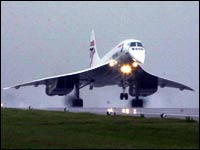 | | Was Concorde a dream or a nightmare for Bristol? |
As the curtain comes down on a landmark of aviation history, Inside Out asks whether it would have been better for Bristol if Concorde had never been built. It was a proud moment when Bristol's Filton Airbase was chosen as home for Britain's Concorde supersonic project. But perhaps alarm bells should have rung in the birthplace of the 'Bristol Brabazon'. The Brabazon was a technological marvel, and touted as the future of transatlantic travel, but in the end no-one would buy it and only one was ever built. HIGHS AND LOWS
OF CONCORDE
IN BRISTOL | HIGH - 1969 - She flies!
LOW - 1970 - PanAm launch the Jumbo, which offers cheap transatlantic flight and proves to be Concorde's nemesis
HIGH - 1972 - Over a dozen airlines place orders for Concorde
LOW - 1976 - Of 16 Concorde's built only 9 have been sold. In the end planes are sold for £1 each HIGH - 1976 - Concorde's first true commercial flight is a success LOW - 2000 - All Concordes grounded after one crashes outside Paris, killing everyone aboard
HIGH - 2002 - Concordes are back in service after bulletproof fuel tanks are fitted
LOW - 2003 - Last Concorde flights to take place after a 'rescue bid' by Richard Branson's Virgin fails |
It was an expensive white elephant. A byword for progress?The infrastructure left behind by the Brabazon created an ideal space to build the mighty Concorde. And arguably the supersonic jetliner followed the same model as the Brabazon. Jobs were created - then squeezed - as the plane was developed, built, and quickly discontinued when airlines failed to place orders. But, like the Brabazon, Concorde pushed the limits of technology and made Bristol a byword for progress and innovation. So many Bristolians have mixed feelings about the Concorde project - as do the citizens of their French counterpart Toulouse, home of the Air France Concorde. As the Mairie de Toulouse states in its online history: "In Toulouse people will not forget either [the] commercial failure or the technological progress made - the key for the future success of Airbus Industrie." The legacy for Toulouse and Bristol is the massive Airbus aviation building consortium. Filton remains the company's UK headquarters, and the Giotto spacecraft, blasted into space aboard an Arianne rocket, was built there. 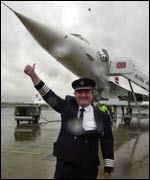 | | Pilot Mike Bannister celebrates the aircraft's post-Paris rehabilitation |
Plans to open Filton to commercial airline traffic in the early 1990s were shelved after local protests. And Aviation Services - formed to overhaul and maintain the Airbus family - closed in 2002. However, new orders for Airbuses by budget airline Easyjet are now creating jobs in the area. Airbus boss Iain Gray told Inside Out: "I think there's no doubt that in the 1970s and 1980s the US grabbed the lead in terms of commercial aviation. The 747 was a milestone in doing that. "What we have achieved in Airbus wouldn't have happened if we hadn't had that spirit of Concorde... "In terms of setting technology standards and setting a spirit of how we work together, I think Concorde was very much the predecessor of what we see today in terms of Airbus' organisation."
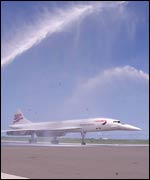 | | Concorde gets a water cannon salute on her final trip to Barbados |
At the end of the dayBut what do ordinary Bristolians not employed in the aircraft industry have to show for their town's 35-year association with Concorde?
Hopes remain that one of the fleet will find its final resting place in a local museum - boosting the city's tourist trade. As one airfield worker told us: "I don't know whether it was right to build Concorde - but I do know she belongs to Bristol." Whatever the future may bring to Bristol, there will always be the honour of being associated with one of the key moments in aviation history - and a European institution. | 



