TWILIGHT WORLD OF THE BADGER
by Chris Packham 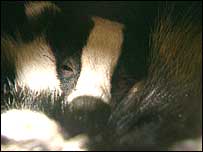 | | Cuddly yes, but badgers have a darker side too |
In this week's nature notes, Chris Packham roots out the setts of badgers. For many, a badger is a cuddly creature from the leaves of childrens' books but they can be a farmer's nightmare too. Chris tells us how we can see them in their native surroundings. For about five years of my life I was doggedly devoted to unravelling the ecology of two groups of badgers. Together with an accomplice, Clive Brown, I counted all of the animals in two large areas of the New Forest and some farmland north of Southampton. | Badgers - some facts | Because the badger is a nocturnal animal, very few people ever see them. The badger's small head, short neck, long wedge shaped body, and a very short tail make them excellent diggers. They have poor eyesight as they are nocturnal and most of their time is spent underground in their setts. They have acute hearing and excellent sense of smell. Badgers are very heavy and their weight frequently changes depending on the food available in their area. An average adult badger will weigh between 6.5k (14lb) and 13.9k (30lb). HABITAT
Badgers are most common in the south and south western counties of England and Wales. Setts are found in woods, copses, hedgerows, quarries, sea cliffs, moorland in mountainous areas, open fields, green belts in city boundaries, and housing estates. FOOD
Badgers are omnivores feeding mainly on earthworms. They can also take young rabbits, mice, rats, voles, moles, hedgehogs, frogs, slugs, and snails. The plant food they eat includes most fruits, acorns, bulbs, oats and wheat. BREEDING
Badgers give birth to between one and five cubs during January and March usually in underground chambers. Cubs remain there until they are about eight weeks old. BADGERS AND THE LAW
Badgers are often seen as pests; the main complaints being that they eat poultry, roll in the corn and eat the grain, sometimes kill lambs, and occasionally eat partridge and pheasant eggs. The Badgers Act was introduced in 1973, amended by the Wildlife and Countryside Act 1981, amended in 1985.
This now means that badgers are fully protected. Some provisions of the Act mean that it is an offence to;
1) Kill, injure or take any badger or attempt to do so
2) Cruelly ill treat a badger
3) Dig for a badger
4) To possess or have under control a dead badger. For full details - see the Wildlife and Countryside Act 1981 (amended 1985)
|
We monitored their setts, mapped their territories, and worse
analysed mountains of their dung! Every Sunday for five long years I collected 12 samples in polythene bags, froze them (to reduce the smell) and took them, on the following Thursday morning, to the University. Here, on the Thursday evenings (now defrosted and very smelly), I sat until gone midnight counting tiny fragments of earthworms in dozens of sub samples of "poo". Despite the fact that most "normal" teenagers were down the pub or going on dates, I was down at the sett getting attacked by midges, wet, or both. And I must be honest with you, it took me a few years to forgive the badgers. I am sure you understand! Badger love Those unscarred by such memories, love badgers. They appear as benevolent, bumbling, cuddly, gentle, nocturnal nice guys. The truth is somewhat different. But they have attained cult status amongst our fauna despite the fact that many people never see or only snatch fleeting glances of these secretive mammals. It is this aspect of their nature which makes them so enigmatic. Over much of the South they are not an uncommon animal, and successful badger watching is not rocket science, just common sense and a little knowledge of their ecology.
Here are a few of my tips to help you enjoy badger watching more...  Search out in daylight any well drained quiet woodland near you until you find a sett - but ensure you obtain landowners' permission if appropriate. Search out in daylight any well drained quiet woodland near you until you find a sett - but ensure you obtain landowners' permission if appropriate.
A sett is a collection of holes - not foxey singles or tiny rabbit tunnels. If it is active there will be spoil (loose earth) or bedding that has been recently dragged out. Decide which is the most active hole and walk about to find a good viewing spot. Climbing a low or small tree is best, but if none are appropriately positioned, choose a larger tree further away so you can sit or stand with your back to it. Make sure that it is not next to one of the badgers' well worn paths. Map a route to your chosen spot that you will be able to follow/find at dusk. Choose a still night for your visit and arrive early, normally before dark. Make sure you are dry, warm and comfortable. Remember that any noise will equal disaster and any scent of yours on the sett will equal disappointment. Strike a match, blow it out, see which way the smoke goes. If it is from you over the hole, go home straight away - or change your tree! 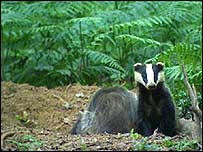 | | Observing from a 'downwind' position is vital |
A wary badger is not your friend. If all is well, stay still and silent with slow movements if any. Badger watching is not relaxing! Wait... wait longer
perhaps longer still. Oh yes, I have forgotten something important - your source of light! Get a powerful torch and cover the front with a piece of red gel to reduce and colour the beam. When you hear 1) sniffing, 2) scratching, or 3) rustling. Wait. Don't light up until you are certain that the badger is out, up and happy, that it has lowered its guard, then, turn on your torch facing the sky and slowly pan it down onto the source of sound. If it is a woodmouse or hedgehog you are allowed a quiet 'huff'. 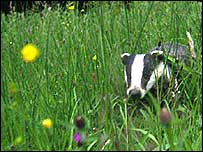 | | A sighting of the elusive badger is well worth waiting for |
If it is a badger, your lungs will empty and your heart stop. You will freeze and remain rigid until you ache with cramp. Don't move away until the badger(s) have because if you super-spook them now you'll blow it for next time. Avoid crowds and over enthusiastic children on the sett, it is best as a one or two person practice. May or June are the best months, the young will be active and the bracken yet to reach its peak, plus the nights are shorter so you'll get either a daylight emergence or have less time to wait. Good Luck. You'll need it!  And don't get hooked, badgers can seriously damage your sensibilities! And don't get hooked, badgers can seriously damage your sensibilities!
If you feel you need more help/advice contact the Mammals Trust UK, The Mammal Society or the National Federation of Badger Groups and never be put off by over protective badger folk. Enjoy your wildlife responsibly. | 



 Inside Out - South: Monday January 31, 2004