I MUST GO DOWN TO THE SEAS AGAIN...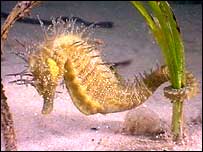 | | An exclusive wonder of nature in British waters |
For the very first time in British waters, marine naturalists have not only discovered but also filmed an almost mythical creature. The seahorse. Inside Out presents the exclusive film. Seahorses are what legends are made of. In almost every tale of the high seas, they feature along with mermaids and sea-dragons as creatures of a fertile imagination. But this is far from the truth. 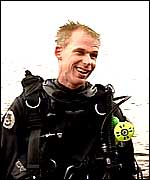 | | The find was a rare day of excitment for Colin Froud |
Inside Out's own naturalist presenter Chris Packham reveals some truly fascinating film of a discovery off the Dorset coast that has to remain a secret location. The footage was shot by specialist underwater diving cameraman Colin Froud. Hidden treasureEmerging from the shallows, he tells Chris of his sheer delight, "This is so exciting. It had its tail down marking a kind of trail in the sea. I recognised it straight away. But it was hard to follow in the eel-grass. "If it had been within the eel-grass I wouldn't have spotted it but it was in an open area on the edge, just sitting there trying to look inconspicuous," he says. The seahorse, around this stretch of the British coast, lives in a fragile habitat. The elegantly dense eel-grasses grow in shallow sandy waters. 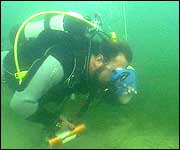 | | The search was a labour of love in such surroundings |
This is perfect to allow seahorses to do what seahorses do best - intertwining their tails with the eel-grass and "hangin' on in there" in the current. Colin Froud equates the filming of these bizarre creatures to that of filming Yeti in the Himalayas - it's something that he can hardly believe has happened. On the day that Colin shares his experiences with Chris, Neil Garrick Maidment a world seahorse expert from Devon, joins them. First on filmEven for him with all his expertise, this is a dream come true. Neil has been working with seahorses for 17 years and has never seen one in the wild in British waters. | Seahorse quirky facts | The seahorse belongs to the same family as the pipefish and sea dragon
There are 35 different species
Habitat is the warm shallow waters all over the world
It's body has an elongated tail covered by about 50 rectangular bony plates
'Hippocampus' (Gr: bent horse) is the scientific name for the seahorse
The male incubates the female's eggs for a month before giving birth to up to a thousand babies
They have one partner during their lifetime
They perform greeting dances every morning to confirm their bond
The seahorse's long tube-like snout acts like a vacuum cleaner for food
Its ability to hang on to sea grasses helps it to avoid being swept away by strong currents
Like chameleons, seahorses can change colour so they match their surroundings
With their bony armour, there are very few animals that can eat them anyway Source:
BBC Science and Nature |
He helped set up the Aquarium in Plymouth and runs the Seahorse Survey which, for 10 years, has recorded seahorse sightings around the British coastline. But this is the first time anyone has ever filmed one. The divers and cameras go out to sea, and trail out through the shallow eel-grass. Finding these creatures is like finding the proverbial needle in a haystack. Neil has had so many reports of sightings from around the country, some even from the shallow coasts of Scotland. He says, "We've known they're here
people have spotted them but this is proof that they're here in the South. "They're breeding and their environment needs protecting." There are two varieties of this delicate creature in British waters, the Spiney and the Short Snouted. But as yet, neither enjoy protected species status. "We applied in 2002 to have them as a named species," says Neil. "We're still waiting, partly because people doubted they really existed here." But this exclusive video is now substantial proof. Horse tradingSeahorses are under threat around the world, with about a million a year being collected and sold as seaside curios. According to Neil, many shopkeepers selling them still believe they've been washed up and dried - this is a fallacy. But the most significant threat is from the far eastern drugs market. 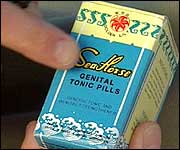 | | Chinese medicine has ancient origins |
It is estimated that 30m seahorses a year are killed and used in traditional Chinese medicine. It is because of this, that Inside Out are keeping the exact location of this British seahorse breeding-ground a total secret. Even with the quite innocent pleasures of watersports, the seahorse's habitat is also under threat. The more that shallow waters are disturbed through the use of anchors, water-skiing speedboats and the like, the more the eel-grass is agitated. Highly disturbing for such delicate creatures. New age dadAs well as being a secretive creature of the brine, the seahorse holds another surprising secret. The male of the species is the only one in the animal kingdom that goes through a true pregnancy. Underwater photographer and diver Steve Trevalli, shows Chris some equally unique pictures of a pregnant male. "In theory there's quite a few baby seahorses out there. This one's hard enough to spot - to see the babies would be even more difficult," Steve explains. A pregnant male in British wild waters is another "first" on record. 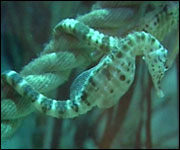 | | A pregnant male is a curious sight |
The female deposits her eggs into the male's pouch where he fertilises them. With the spiney variety, after 28 days, he goes through labour for anything up to 12 hours and gives birth to fully formed mini seahorses. And as ever a glutton for punishment, within 24 to 48 hours he's pregnant again. This film is of such a sensitive nature that Chris Packham and the Inside Out team would stress the importance of a "look but don't touch" approach to anyone who may be lucky enough to come across them when in southern waters. | 



