 | 28 October 2014 |

| |
| BBC Homepage | | |
| |||
| Contact Us | | |
People and PlacesYou are in: Humber > Features > People and Places > Eyes in the sky 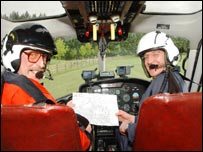 Eyes in the skyBy Clare Muckart BBC Reporter Clare Muckart gets a birds eye view of faults on the region’s power cables as they’re inspected by engineers. Taking off from Breighton Airfield in East Yorkshire you become aware of the task facing the engineers. 54,000 kilometres of overhead cables provide power to 3.7 million CE Electric customers from Northern Lincolnshire to the Scottish Border. Helicopters have revolutionised inspections which in the past were carried out on foot and still must be every decade. But between January and March, engineers are in the best place to look for faults, hovering just over the lines. “If you can imagine the North Yorkshire Moors. We have lines going over the North Yorkshire Moors, it's so difficult to get to but in a helicopter it makes it so much easier for us to do these patrols and spot if any damage has been done to the wires”, explains Ann Walker, the customer liaison co-ordinator for CE Electric The engineers and crew are manually looking for not just damage to the equipment but also any obstructions such as overgrowing trees which may in the future disrupt the power supply. “Ken can also see when he's flying whether anybody's building children's playgrounds under overhead power lines, whether people are building fishing ponds.... so things like fishing lines, kites, goal posts even. Just make sure long objects don't come anywhere near high voltage power lines because electricity can jump gaps.” says Ann. 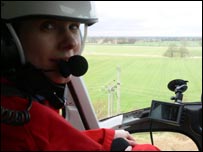 The twin engine helicopter is also equipped with a thermal imaging camera. In the Northern Lincolnshire and East Yorkshire area this scans more than 1000 kilometres of 33,000 and 66,000 volt lines. Lines should be the temperature of the air so any faults are immediately obvious on the monitor carried by the crew. The hotter the fault, the whiter the image glows. It’s for this reason inspections must be carried out at this time of year during cold and dry conditions. The crew is given special permission to fly very low and close to the cables. Working over predominantly rural land, it’s not just the cables the crew must concentrate on. They’re also looking out for cattle and horses which they must avoid upsetting. "Obviously our prime concern is that we don't cause any distress to any livestock animals or anybody. We are doing our utmost to try and make sure we do this job as safely as possible without actually causing any problems to the owners of the land." explains Ken Chisholm, Airborne Observer, CE Electric. last updated: 31/03/2008 at 15:55 SEE ALSOYou are in: Humber > Features > People and Places > Eyes in the sky  Pictures from around the region |
| | About the BBC | Help | Terms of Use | Privacy & Cookies Policy |
