

- Contributed by
- John Constant
- Location of story:
- Burma
- Background to story:
- Army
- Article ID:
- A7882095
- Contributed on:
- 19 December 2005
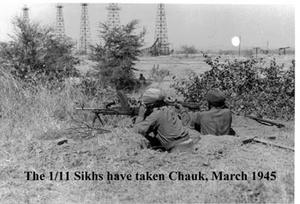
Sikhs capture Chauk
Chapter 8.
It was a particularly nasty custom, as it was in many cases one of our stretcher-bearers, or a first aid medic, who paid the price! For our Brigade, having reached the river ahead of all the other troops, it was galling to have to wait so long to be allowed to cross. However, this pause did give me time to remember the achievements of the previous seven weeks, including our move of nearly 600 miles through the twisty lanes which we had to use as "highways". Inevitably, I then gave thought to the battles looming ahead, particularly that of surmounting yet more big rivers, the Sittang, the Salween and what beyond; would we reach them before the summer floods? This operation at Nyaung U went on for days, as the forward troops raced ahead in open savannah to make sure the Japs could not bring any guns within range of the crossing; and the whole Corps with its armoured brigade debouched through the bridgehead, on their way to dash for the Meiktila airfields.
Our task then became one of slogging our way southwards down the east bank of the river, with an East African brigade on the west. With little resistance at first, the Japanese defences soon hardened, until one night they put in a two-company counterattack on the Sikhs, just in front of Brigade HQ. As it was beaten off, the rest of the Jap battalion went through exactly the same tactics and failed again; the noise of gun-fire and battle-cries was unbelievable. The Brigadier was furious when he found that the Sikhs had gone through the whole of their first line ammunition with little to show for it; they liked excitement, and whenever it was their turn to put on a formal attack, they had demanded tank and air support, which we were almost invariably able to arrange.
I might mention that the Gordon Highlanderss 10th Battalion had been raised as antitank gunners, and were with 2nd British Division, with whom we had become friendly during the training days near Kohima. Now we found that the 11th Battalion were in Sherman tanks, and in support of us. We prayed that the two units would not let their rivalry become lethal ! Of some 550 men in that unit, I believe that 286 all enjoyed the surname of Gordon, and so many were "Jamie" that they used to address one another by the last three figures of their army number. They were great soldiers.
Our air support was a model of efficiency, and all the more for personal reasons. At the appropriate seniority in each air formation HQ, the Operations staff officers allocating the air strikes had been students with me at the Indian Army Staff College, Quetta, and were always most helpful. Not only did they produce the strikes, but they also had one Hurricane adapted for spraying insecticide over the defeated Japanese positions, where their occupation had been so insect-ridden and lousy.
Having mentioned how the Sikhs always wanted their attacks to be so noisy, it was a complete contrast to find that our Gurkha battalion liked silence. Time and again, they would carry out a successful operation, by mounting vigorous reconnaissance patrols across their whole front, while one fighting patrol took a wide sweep well clear of the enemy. This was followed by the rest of that company, and, in turn, by others until the whole front had been taken over by the KOSB, while the Gurkhas had moved right round to the rear of the enemy, ready to carve them up, first by using their Kukris on any individual unlucky enough to pass their way, and then, the whole battalion together, with the bayonet. Each time this left a grim sight the next morning.
These Ghurkas had such a strong sense of personal honour that one of them, in the rank equivalent to sergeant, was so upset, when his valour was questioned, that he went absent for two days, much to everyone's horror fearing he might have been captured: a cruel fate, indeed. He reappeared, without detection, in front of his commanding officer, holding out the head of a Japanese officer, cleanly severed and quite fresh. His valour was never questioned again.
As we approached Chauk, our gunners played a wicked trick on us. The Commander Royal Artillery had got hold of a 7.2ins Howitzer and some ammunition, each round about 200lbs, and a range of 11 miles. Since the Japs did so much patrolling at night, they were understandably tired and usually had a siesta after lunch, especially those behind their forward defensive localities. Our gunners used that period to bring this monstrous weapon right forward to the Brigade HQ area, then quickly loosing off a few rounds into the enemy's rear, and departing again --- shoot and scoot! --- and what an awful noise. This used to infuriate the Japanese, who gathered themselves together and retaliated by bringing down as much gunfire as they could onto us at Bde HQ, with our great weapon safely out of their range by then.
Almost invariably, great bravery was shown throughout the Brigade group, but we felt special admiration for the medical staff in the Field Dressing Station usually set up alongside Brigade HQ; it had a Field Surgical Team and a Field Transfusion Team, so that the wounded could be given the earliest surgery and painkilling drugs. Whenever the enemy was shelling our area, we could sink down into our slit trenches, but the medical staff would usually carry on operating, as it could be lethal to the patients, if they stopped. Nevertheless, several of my friends did not leave there alive, and I was sometimes called in from the command post next door, to comfort them in their last moments.
© Copyright of content contributed to this Archive rests with the author. Find out how you can use this.


 Recommended story
 Story with photo