

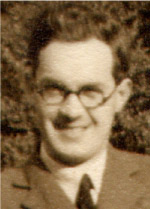
Photograph of me taken in 1944
- Contributed by
- Bogeybuilder
- People in story:
- Alexander McIntosh
- Location of story:
- Stirling
- Background to story:
- Royal Air Force
- Article ID:
- A8946660
- Contributed on:
- 29 January 2006
[as written when approaching 91 years of age]
STORY 1
BEFORE THE HOSTILITIES
My involvement in wartime work really began before 3rd September, 1939, on which
date war was officially declared by Great Britain following the invasion of Poland by
the German Army. That day saw the beginning of one of the blackest eras in the
history of the world.
I was not under the discipline of one of the Fighting Forces at that early stage
but I had become much involved because on 20th August, 1939, I had taken up my
new appointment as Depute Town Clerk of Stirling following a 5 months’ spell as
Assistant Solicitor in the Town Clerk’s Office, Kirkcaldy. In Stirling, I was suddenly
confronted with national emergency work, particularly an impending evacuation of
mothers and children from Glasgow, as well as food control functions, these and
other miscellaneous emergency items supplanting the otherwise normal routine of
Council work. When I returned from Kirkcaldy, it was to an Office beset with a new
variety of responsibilities. The customary functions which I expected to face were
suddenly being shelved in favour of a host of new-found priorities. Supplementary
to my regular appointments, I found myself appointed as the Depute Reception
Officer and Depute Food Executive Officer for the Burgh of Stirling, the first-named
post giving me a continuous heartache until the day I was able to lay down its
responsibilities on my call-up to the Royal Air Force just over a year later.
I was no sooner back in the Municipal Buildings, Stirling, in an Office which I
knew so well since I had spent all my post-schooldays there from 1930 learning how
to be an office-boy, a legal apprentice, a Solicitor and Clerk of Court, than I was to
hear the Prime Minister’s statement that war had been declared. Things were moving
at such a tremendous pace — we were notified within about a couple of days of my
return that Stirling , having been earmarked to be a Reception area for evacuees,
would receive, on Friday, 1st September, 5464 evacuees [including 2660
unaccompanied children] for billeting in local homes, and that they would be arriving
in special trains from Glasgow. Some time before that, the Burgh Assessor had been
instructed to carry out a survey of all dwelling-houses in the town to establish how
many vacant rooms there were throughout the Burgh and had established that there
was an exceedingly large number - a good deal more than the quota of evacuees
listed to arrive.
It was a blessing that fewer than the indicated numbers did arrive as we quickly
learned how difficult it was going to be to get the cooperation of the public to take
the mothers and young children into their homes, except in the poorer parts of the
town. Whether these poorer people were glad to take the evacuees out of the
goodness of their hearts, or because of a higher sense of civic responsibility, or
merely to get the Government’s billeting allowances, it is difficult to say. It is a fact,
nevertheless, that the folks in the less affluent areas came to our rescue on many
occasions. Our staff and the hard-working ladies of the Women’s Voluntary Services
were frequently left on the doorsteps with their pleas rejected by many residents in
large empty houses. Coupled with the reduction in the number of evacuees
dispatched to Stirling, many hurriedly returned to Glasgow, so that, on a survey
carried out on 28th October, i.e. after around 2 months, to ascertain the details of
those remaining, the figure was found to be 551, including 50 mothers, 27 Teachers,
and 2 Helpers. Even with that smaller number, there were many difficulties due to
host parents becoming ill or wishing to be relieved of their charges for a variety of
reasons. I recognised that it was a great burden to have strangers deposited with
you for an indefinite period, often in a house full of attractive furniture and fine
ornaments, the greatest resistance coming when we were trying to billet mothers and
young under-5 children — there was less opposition to the taking of unaccompanied
school children. Ultimately it became necessary to resort to compulsory billeting by
the service of Billeting Orders, with a small Appeals Committee in the background to
hear and decide on appeals.
The Evacuation Office had built up a large stock of bedding, including
blankets, etc. and these were generously issued to house-holders who were
prepared to take the evacuees. A check of the stock on 6th November, 1939,
revealed that there were still on hand 90 camp beds, 1120 blankets, 2850 sheets, and
1675 mattresses, most being of very good quality.
The Government had obviously decreed that the evacuation of great numbers
of the population could be achieved smoothly on the basis of pure statistics, failing
to realise that a great human problem had to be surmounted.
It was all so different in the Food Control Office, which had been set up in the
Reading Room of the Public Library. The work there was progressed without any
difficulty.
STORY 2
MOVING TOWARDS MILITARY SERVICE
Since the list of reserved occupations was published indicating those who
would not be called up, at least in the first instance, with the critical ages, I had
learned that in relation to my post the reservation age was 25. Since I was only 24, I
accordingly was aware that I was not free from call-up and that the prospect of
conscription would face me sooner or later. I had no knowledge, of course, as to
when the little brown envelope would fall through my letter-box. All I knew was that,
like flu in winter, it was bound to come.
It seemed no time at all before I received, on 14th June, 1940, the command to
report to the Medical Board Centre at the Allan’s School, Spittal Street, Stirling, on
18th June, 1940, for the preliminary medical examination. I passed my medical test all
right, except that my colour-blindness was discovered, thereby preventing me from
having any air crew involvement. As a matter of record, I was graded 2[a][v]. It was
concluded that my eyes were hazel, my hair was black, and that the examination had
taken place 24 years 358 days after I was born. In an interview, I had expressed a
preference for service in the Royal Air Force and this was granted. As the
alternative to aircraft positions, which were ruled out because of my defective
eyesight, I was told that there was a great need to fill a post called Clerk/Accounting
and that would be my destiny. The pay was to be 3s.3d. per day and I received the
number 1119565. I was originally called up for 23rd September, 1940, then that date
was postponed to 29th November, 1940, on which date I set off for Padgate.
My enlistment notice sparked a bit of a panic at Town Council level,
encouraged, naturally, by the new Town Clerk, who did not wish to see his recently
appointed lieutenant snatched from him. A special meeting of the Council was called
to try and have the call-up notice cancelled on the basis that my work was of
considerable importance to the community and that it should take priority. The
council, by a large majority, resolved to make representations accordingly, but these
were rejected. I have always been glad that it turned out the way it did and that I
could always claim that I ‘did my bit’.
© Copyright of content contributed to this Archive rests with the author. Find out how you can use this.


 Recommended story
 Story with photo